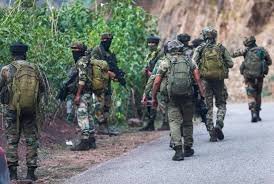


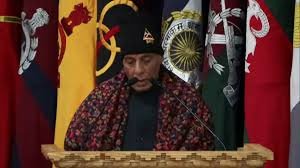
Leh, December 7, 2025 : Defence Minister Rajnath Singh on Sunday said that the Indian armed forces “could have done much more” during Operation Sindoor following the Pahalgam terror attack, but deliberately chose a restrained and calibrated response, reflecting both their strength and discipline.

Addressing a gathering after inaugurating 125 Border Roads Organisation (BRO) infrastructure projects across different parts of the nation, the defence minister said the May operation demonstrated the capability, coordination, and maturity of India’s military forces.
“During Operation Sindoor, the coordination we witnessed among our armed forces, civil administration and border-area citizens was incredible. I express my deep gratitude to every citizen of Ladakh and the border regions for extending unwavering support to our forces,” Singh said.
Operation Sindoor was launched on May 7, 2025, targeting terror infrastructure in Pakistan and Pakistan-occupied Kashmir (PoK) as retaliation for the April 22 Pahalgam terror attack, in which 26 people, mostly tourists, were killed.
“Just a few months ago, we all saw how, in response to the heinous Pahalgam attack, our armed forces executed Operation Sindoor. The world knows what they did to the terrorists,” Singh said.
“Of course, we could have done much more had we wanted, but our forces showed not only valour but also great restraint by doing only what was necessary,” he added.
Highlighting the role of border connectivity in ensuring the success of the operation, Singh said strong logistics and communication networks enabled the armed forces to act swiftly and decisively.
“Our armed forces were able to deliver logistics right on time. Connectivity with border areas gave Operation Sindoor its historic success,” he said.
Emphasising the strategic importance of infrastructure, the defence minister said that modern roads, real-time communication systems, satellite support, surveillance networks, and logistics connectivity now allow soldiers to operate efficiently even in the most difficult terrains.
“Every minute and every second of a soldier deployed on the border is extremely important. Connectivity must not be seen merely as networks, optical fibre, drones or radars, but as the very backbone of national security,” Singh said.
He added that his ability to reach armed forces in any remote part of the country is possible only because of robust communication infrastructure.
“Communication is not just physical infrastructure. It is essential for peace, harmony and understanding in society,” he said, adding that the government is continuously strengthening connectivity with all border areas, including Ladakh.
Rajnath Singh said the Central government is working with full commitment for the holistic development of border regions, ensuring security as well as economic growth.
Improved connectivity, he noted, is not only boosting national security but also driving economic momentum. Referring to the 8.2 per cent GDP growth in the second quarter of 2025–26, he said stronger communication networks and pro-growth reforms have played a key enabling role.
“Our government, armed forces and organisations like the BRO stand firmly with the people of border areas. We must continue to strengthen this bond so that no external force can weaken it,” the defence minister asserted.