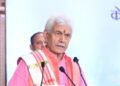


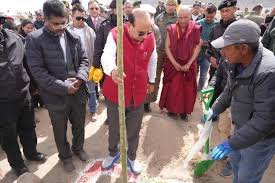
Leh, March 23, 2026 : Lieutenant Governor Vinai Kumar Saxena on the occasion of International Day of Forests launched the ambitious Indus River Green Corridor Eco-Restoration Plantation at Spituk Pharka, aimed at restoring the fragile riverbank ecosystem along the Indus River.

Described as India’s first-of-its-kind cold desert riverbank restoration project, the initiative focuses on creating green buffers and reviving ecological balance in the high-altitude desert landscape of Leh.
As part of the drive, around 1,000 saplings of indigenous species such as Oleaster, Sea buckthorn, Indian Willow, Black Poplar, and White Willow were planted along the riverbanks. Additionally, another 1,000 saplings of Cherry Blossom and Apricot were planted across the city to enhance urban greenery.
The plantation drive was carried out through a collaborative effort involving civil administration, defence forces, police, paramilitary units, and local communities, with significant support from Spituk Monastery, which contributed one hectare of land for the project. The initiative was organised by the Forest, Ecology and Environment Department in collaboration with the University of Ladakh.
Calling the project historic, LG Saxena said it would serve as a model for high-altitude ecological restoration globally. He emphasized that such initiatives are crucial for sustainable development and for addressing environmental challenges like desertification, biodiversity loss, and climate vulnerability in Ladakh.
Highlighting the vision of Prime Minister Narendra Modi, the Lieutenant Governor reiterated India’s commitment to restoring 2.6 crore hectares of degraded land by 2030. He also urged wider participation in the “Ek Ped Maa Ke Naam” campaign and called for identifying more land for large-scale plantation.
Expressing concern over Ladakh’s forest cover—currently below one per cent—he set a target to increase it to five per cent within the next two years. He noted that plantation efforts would help reduce soil erosion, improve biodiversity, stabilise micro-climates, and enhance oxygen levels.
The LG stressed the importance of adopting innovative techniques such as gravity-based solar irrigation and drip systems to ensure efficient water use in the region’s challenging terrain.
Encouraging youth participation, he called upon young people to lead sustainability initiatives and contribute to environmental conservation, while reiterating his vision of transforming Ladakh into a premier global tourism destination rooted in ecological balance.
On the occasion, a special postal cover was released and individuals and organisations contributing to environmental conservation were felicitated, marking the event as a significant step towards a greener and more sustainable Ladakh.