

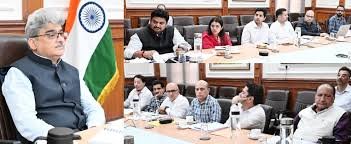
Jammu, March 29, 2026 : Chief Secretary Atal Dulloo on Sunday outlined a comprehensive vision to transform newly established medical colleges and district hospitals into fully functional tertiary care institutions, aiming to bring advanced healthcare services closer to the people across Jammu and Kashmir.

Chairing a high-level review meeting of health experts, the Chief Secretary assessed progress made by the Health & Medical Education Department in strengthening patient care infrastructure and service delivery across the Union Territory.
Emphasizing equitable access to quality healthcare, Dulloo stated that reliance on premier institutions in Jammu and Srinagar alone is insufficient to meet the growing healthcare demands. He stressed the urgent need to enhance capacities in peripheral institutions to bridge gaps in specialized treatment.
Focused Tertiary Care Roadmap
The Chief Secretary directed that, in the initial phase, each institution must prioritize the development of six core specialty areas:
- Trauma & Emergency Care
- Critical Care Units (ICUs, HDUs, CCUs)
- Cardiology
- Neurology
- Nephrology
- Oncology
He noted that strengthening these departments would enable hospitals to deliver comprehensive tertiary care within their respective regions.
Collaboration With Premier Institutions
To accelerate progress, Dulloo called for close coordination with leading healthcare institutions such as AIIMS Jammu and SKIMS, along with Government Medical Colleges in Jammu and Srinagar. He highlighted that such partnerships would facilitate knowledge sharing, faculty support, and capacity building.
Technology-Driven Healthcare Expansion
The Chief Secretary underscored the role of digital health solutions, advocating the adoption of Tele-ICU and Tele-Radiology services to strengthen diagnostics and critical care in remote areas. He urged stakeholders to develop time-bound action plans with a forward-looking approach.
Boost To Medical Education & Workforce
In addition to patient care, Dulloo emphasized expanding MBBS, postgraduate, and super-specialty seats to build a robust healthcare workforce. Strengthening medical education, he said, is key to sustaining long-term improvements in healthcare delivery.
Commissioner Secretary Health & Medical Education M. Raju presented a detailed progress report, highlighting advancements in infrastructure, specialty services, and manpower capacity across new medical colleges.
Expert Insights & Institutional Support
Former Director of AIIMS Jammu, Shakti Kumar Gupta stressed the importance of integrating teaching, research, and patient care, while advocating modern academic practices like grand rounds and collaborative learning.
Director SKIMS, Ashraf Ganai, revealed that the institute currently offers services across 52 specialties and is working towards achieving quaternary care status. He also announced the formation of a dedicated expert team to support emerging institutions.
Executive Director SMVDIME, Yashpal Sharma, highlighted key initiatives including MoUs for staff training, faculty pooling, and resource sharing. He also detailed plans for virtual medical boards, referral committees, and the J&K Research Consortium to enhance coordinated care and research.
Reiterating the government’s commitment, the Chief Secretary called for a collective effort to strengthen healthcare infrastructure and ensure accessible, affordable, and quality healthcare services for all citizens of Jammu and Kashmir.