

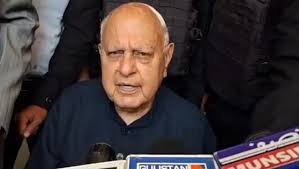
Srinagar, May 12,2026 : Farooq Abdullah on Tuesday said the Jammu and Kashmir Government could impose a ban on alcohol “within two minutes” if the Centre compensates the Union Territory for the revenue losses resulting from such a move.
Speaking amid the ongoing political controversy over liquor outlets in Jammu and Kashmir, the former Chief Minister said he personally does not consume alcohol but argued that people who drink would continue to procure liquor from outside the region even if local sales were banned.
“I do not drink alcohol. Those who drink, they will drink. If they do not get it here, they will bring it from outside,” Abdullah said while speaking to reporters in Srinagar.
Recalling an incident from 1977, Abdullah said former Prime Minister Morarji Desai had once asked his father, former Jammu and Kashmir Chief Minister Sheikh Abdullah, to stop liquor sales in the erstwhile state.
“My father told him that if the Centre compensates the revenue earned from alcohol sales, then we will stop it. Nothing happened then,” Abdullah said, adding that the same condition remains relevant today.
The National Conference president further alleged that the liquor issue was being unnecessarily politicised by opposition parties and questioned why there had been no major protests when liquor shops were opened earlier across Jammu and Kashmir.
“We did not open liquor stores. Those who opened them, why was no one raising their voice then?” he remarked.
Apparently targeting the Jammu and Kashmir Peoples Democratic Party, Abdullah accused opposition leaders of using the issue only to attack the government politically.
The controversy intensified after Jammu and Kashmir Chief Minister Omar Abdullah recently stated that no one was being forced to consume alcohol and people visit liquor shops voluntarily. The remarks triggered criticism from opposition parties, including PDP leader Iltija Mufti.
A day later, Omar Abdullah clarified that his remarks were being “twisted” by political opponents and reiterated that alcohol available in Jammu and Kashmir was intended only for communities whose religions permit its consumption.
Farooq Abdullah also expressed concern over the worsening fuel and gas crisis amid tensions between Iran and the United States, warning that the country could face serious economic consequences if the conflict escalates further.
“We are facing a fuel crisis and a gas crisis. If this conflict does not end, only God knows what will happen to us,” he warned.
Commenting on education challenges, Abdullah said online learning could not become a practical solution for economically weaker families as many students lack access to digital facilities.
“Education is necessary, but online education is not possible for everyone,” he added while urging authorities to find alternative solutions for underprivileged students.