


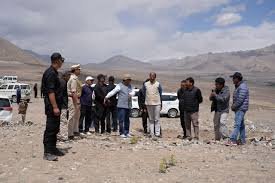
LEH, May 24, 2026 : Lieutenant Governor Vinai Kumar Saxena on Sunday launched an ambitious ecological restoration initiative aimed at reclaiming nearly 800 acres of barren land near Spituk in Ladakh through innovative freshwater recharge techniques.

The large-scale project is being seen as a major step towards reversing land degradation in the cold desert region of Ladakh.
According to officials, the pilot project was initiated on the directions of the Lieutenant Governor after authorities identified around 800 acres of land near Spituk village in Leh that has remained barren for centuries.
Officials said the initiative will utilise excess water from the recently restored Igoo-Phey irrigation canal by diverting it through temporary channels and minor earthwork interventions using tractors and machinery across the degraded landscape.
Ladakh receives less than 100 millimetres of annual rainfall and depends heavily on glacial meltwater for irrigation and water supply.
However, rapid runoff during the spring season often results in:
- Soil erosion
- Poor groundwater recharge
- Declining soil moisture
- Expansion of arid and unproductive land
Authorities said the new project aims to improve the local ecosystem by allowing freshwater to spread naturally and percolate into the soil, thereby restoring groundwater levels and replenishing depleted aquifers.
The initiative is also expected to:
- Trigger natural vegetation growth
- Improve soil health
- Support sustainable agriculture
- Encourage afforestation
- Reduce dependency on costly engineering interventions
Officials explained that the freshwater recharge process will help flush harmful salts from degraded land, rehydrate dry subsoil layers and dissolve nutrients essential for plant growth.
The project is expected to generate both immediate and long-term ecological benefits including:
- Groundwater recharge
- Soil stabilisation
- Desalinisation
- Regeneration of grasses and shrubs
- Reduction in wind and water erosion
Authorities further stated that moisture exposure may activate dormant seeds already present in the barren soil, initially resulting in the growth of grasses and hardy shrubs, followed later by larger vegetation cover.
The establishment of vegetation is expected to strengthen soil structure and reduce erosion, one of the primary causes of desertification in the region.
Officials said the project also carries significant agricultural and economic potential.
With improved soil moisture and irrigation support, the reclaimed land may eventually be used for:
- Crop cultivation
- Livestock grazing
- Sustainable farming activities
- Livelihood generation for local communities
“This initiative is expected to become a model for sustainable irrigation expansion, improved agricultural productivity and ecological restoration across Ladakh,” LG Saxena said.
He added that nearly 800 acres of barren land are being irrigated using surplus water from the Igoo-Phey Canal to increase soil moisture and trigger natural ecological rejuvenation.
The Lieutenant Governor said the initiative aligns with the vision of Prime Minister Narendra Modi to restore 26 million hectares of degraded land across India by 2030.
Officials said the project follows the successful implementation of Project Him Sarovar, an initiative aimed at improving long-term water security through the creation of small water bodies to harness snow resources.
The restoration drive also comes shortly after the operationalisation of the Igoo-Phey Canal on May 15, 2026, a major irrigation network expected to irrigate more than 4,300 hectares of agricultural land across several villages in Ladakh.