

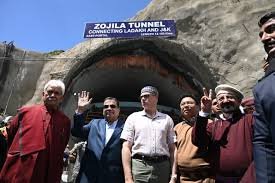
MINIMARG (Ladakh), June 09, 2026 : In a landmark achievement for India’s infrastructure sector, the much-anticipated breakthrough of the Zojila Tunnel was successfully achieved on Tuesday, marking a major step toward establishing year-round connectivity between the Kashmir Valley and Ladakh.

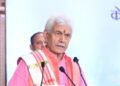
The breakthrough was accomplished through a controlled blast near the East Portal at Minimarg, bringing to fruition a decades-old dream of ensuring uninterrupted access across one of the country’s most challenging mountain corridors. The event was witnessed by Union Minister for Road Transport and Highways Nitin Gadkari, who remotely triggered the blast, alongside Jammu & Kashmir Lieutenant Governor Manoj Sinha and Chief Minister Omar Abdullah.
Officials from the National Highways & Infrastructure Development Corporation Limited (NHIDCL) described the breakthrough as a significant engineering accomplishment, achieved six months ahead of schedule. According to project authorities, approximately 85 percent of the overall work has been completed, with civil construction expected to continue for another seven to eight months before electrical and finishing works commence.
The 13.153-kilometre-long Zojila Tunnel, designed as a single-tube, bi-directional two-lane tunnel, measures 9.5 metres in width and 7.57 metres in height. Constructed at an altitude of around 11,578 feet above sea level, it is set to become the world’s longest single-tube bi-directional road tunnel at such a high elevation.
The project, executed by Megha Engineering and Infrastructure Limited (MEIL) using the advanced New Austrian Tunnelling Method (NATM), has successfully navigated the fragile Himalayan geology. The entire corridor spans 31 kilometres, including approach roads and bridges connecting Sonmarg in Kashmir to Minimarg in Ladakh.
Once operational, the tunnel will dramatically transform travel and connectivity in the region. The current journey across the snowbound Zojila Pass, which often remains closed for nearly three months during winter due to heavy snowfall, will be reduced from over an hour to just 15 minutes. The tunnel will provide reliable all-weather connectivity, boosting tourism, trade, emergency services, and strategic military movement along the vital Srinagar–Leh National Highway.
Project officials have indicated that the tunnel is likely to be opened to the public by February 2028, ushering in a new era of connectivity and development for Ladakh and Jammu & Kashmir.
The successful breakthrough represents not only an engineering triumph but also a significant stride toward integrating remote Himalayan regions with the rest of the country through modern, resilient infrastructure.