

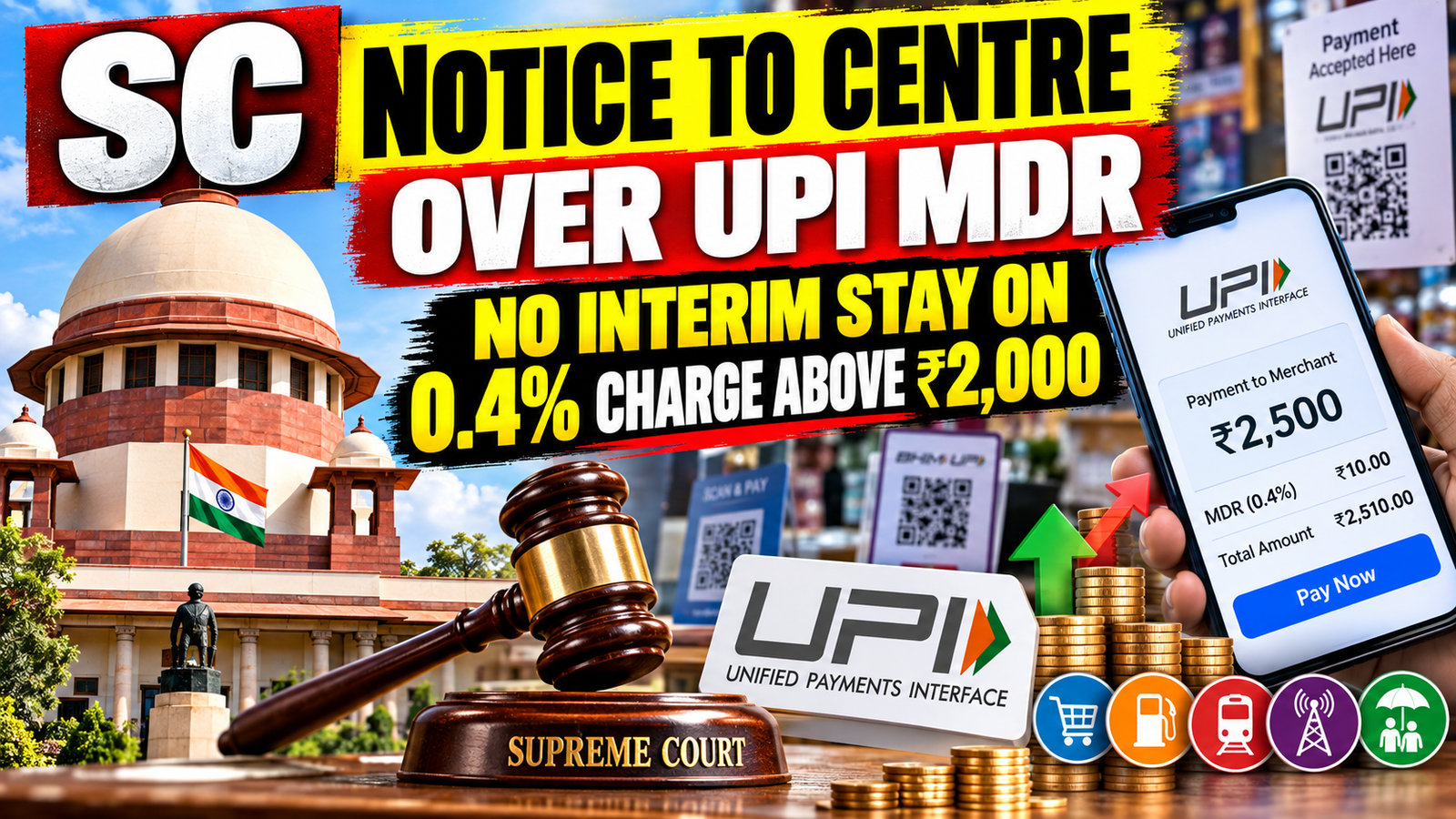
New Delhi | September 28, 2026: The Supreme Court on Monday sought responses from the Centre, the Reserve Bank of India and other respondents on a petition challenging the proposed Merchant Discount Rate (MDR) on specified UPI person-to-merchant transactions above ₹2,000. The three-judge bench, headed by Chief Justice of India Surya Kant and comprising Justices Joymalya Bagchi and V. Mohana, directed the respondents to file their counter-affidavits within four weeks.

The court, however, declined to grant an interim stay on the implementation of the MDR framework. The plea was filed by advocate Anjan Datta, challenging the legal basis of the Centre’s September 14 notification and the MDR framework announced on September 15.
During the hearing, Additional Solicitor General N. Venkataraman, appearing for the Centre, told the bench that around 96 per cent of users covered by the gateway were exempt. The bench observed that the issue appeared to be more technical than purely legal.
The petition challenges the constitutional validity of the amended Section 10A of the Payment and Settlement Systems Act, 2007, and questions the manner in which the new MDR framework has been introduced. The petitioner has also raised concerns over the distinction between UPI transactions and RuPay debit-card payments.
What Changes From October 15?
Under the new framework, specified person-to-merchant UPI transactions above ₹2,000 will attract an MDR of 0.4 per cent from October 15, 2026. The charge will be capped at ₹300 for transactions of ₹75,000 and above.
The framework keeps person-to-person UPI transfers free, irrespective of transaction value. Merchant payments up to ₹2,000 also remain outside the standard MDR, while eligible small merchants continue to receive exemptions under the applicable criteria.
For specified essential and thin-margin sectors—including railways, telecom, insurance, fuel and agricultural inputs—the MDR will be a flat ₹5 per transaction above ₹2,000. Transactions involving mutual funds, securities, stockbrokers and dealers will attract an MDR of 0.02 per cent, subject to a ₹300 cap.
The Supreme Court’s latest order means the proposed framework remains scheduled for implementation on October 15, 2026, while the legal challenge continues before the court.