

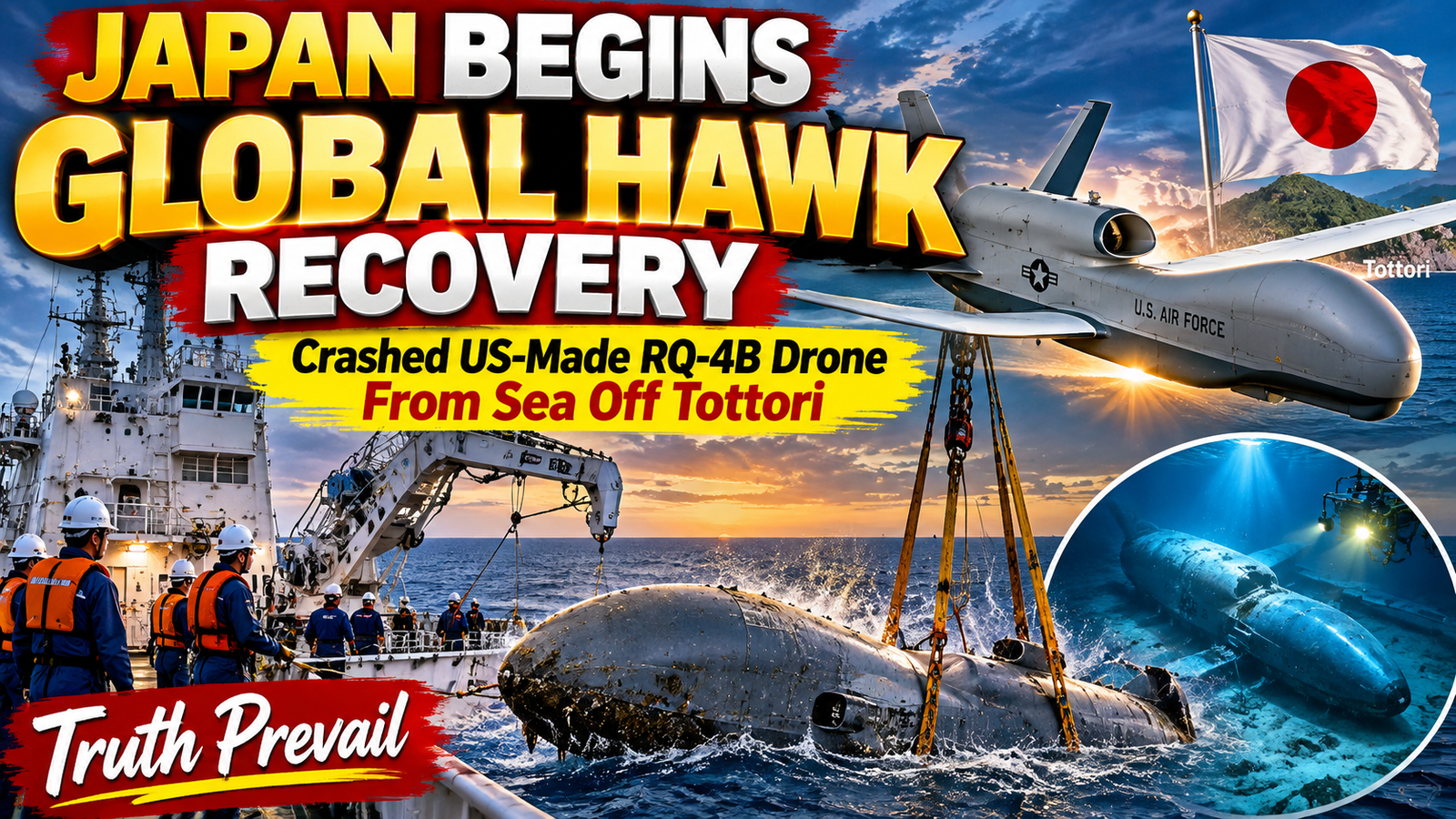
TOKYO, OCTOBER 02, 2026 : Japan’s Air Self-Defence Force (JASDF) has begun recovery operations for a US-made RQ-4B Global Hawk surveillance drone that crashed into the sea off the coast of Tottori Prefecture last month, as Tokyo continues to strengthen its focus on unmanned systems as part of its evolving defence strategy.

The long-range surveillance aircraft went missing in mid-September while operating off the northern coast of Tottori in northwestern Japan. Following search operations, the JASDF determined that the aircraft had crashed into the sea and located what appeared to be its fuselage on the seabed at a depth of approximately 200 to 300 metres (650 to 980 feet).
Recovery Operation Begins
The recovery effort formally began on Friday, October 2, 2026, with the arrival of a specialised mother ship. According to the JASDF, the vessel deployed a remotely operated underwater vehicle (ROV) to precisely identify the drone’s location, examine the wreckage and recover debris.
Japanese officials expect the operation to move toward recovering larger sections of the aircraft later in October.
The recovery is also expected to provide investigators with important information about what happened to the aircraft before it disappeared from radar.
Communication Problems Before Crash
The Global Hawk had taken off from Misawa Air Base, where the aircraft was stationed. Japanese officials have said that approximately 90 minutes after take-off, the drone experienced difficulties connecting with a communication device.
About three minutes later, the aircraft disappeared from radar. Its last known position was approximately 50 kilometres (31 miles) off the Tottori coast.
The precise cause of the accident remains under investigation.
There has so far been no indication of foul play, according to Japanese officials.
Japan, US and Northrop Grumman Investigating
JASDF Chief of Staff Takehiro Morita said Japanese defence officials are working closely with the aircraft’s manufacturer, Northrop Grumman, as well as the US military as part of the investigation.
Japanese authorities have released relatively limited information about the incident while the recovery and investigation continue.
The aircraft is one of three RQ-4B Global Hawks operated by Japan’s Air Self-Defence Force. The remaining two aircraft have reportedly been grounded, apart from missions considered necessary, following the crash.
A Major Surveillance Asset
The RQ-4B Global Hawk is designed for long-duration, high-altitude intelligence, surveillance and reconnaissance missions. It can operate at altitudes of around 60,000 feet (18 kilometres) and remain airborne for as long as 36 hours.
The aircraft provides Japan with an important capability to monitor developments across the wider region, including areas on the Asian mainland and surrounding waters.
Its long-range surveillance capabilities are particularly relevant to Japan’s monitoring of security developments involving North Korea and China.
Costly Loss for Japan
The crashed Global Hawk was valued at approximately 17 billion yen (around US$107 million), making its loss a significant financial and operational setback.
Beyond the financial cost, the incident temporarily reduces Japan’s available long-range unmanned surveillance capacity at a time when Tokyo is placing increasing emphasis on unmanned aircraft and advanced technologies.
Growing Focus on Drones and AI
Japan has been revising its defence strategies with greater emphasis on drones, artificial intelligence and emerging methods of warfare.
Unmanned systems are increasingly being viewed as important tools for surveillance, intelligence gathering and operations in contested environments. The Global Hawk fleet forms part of Japan’s broader effort to strengthen its ability to monitor developments over large distances without placing aircrews directly at risk.
The recovery operation could therefore have significance beyond the fate of a single aircraft, as investigators seek to determine whether the crash resulted from a technical problem, communication failure or another operational factor.
For now, Japanese authorities say the cause of the crash remains under investigation, while efforts continue to recover the aircraft from the seabed.
Hashtags