

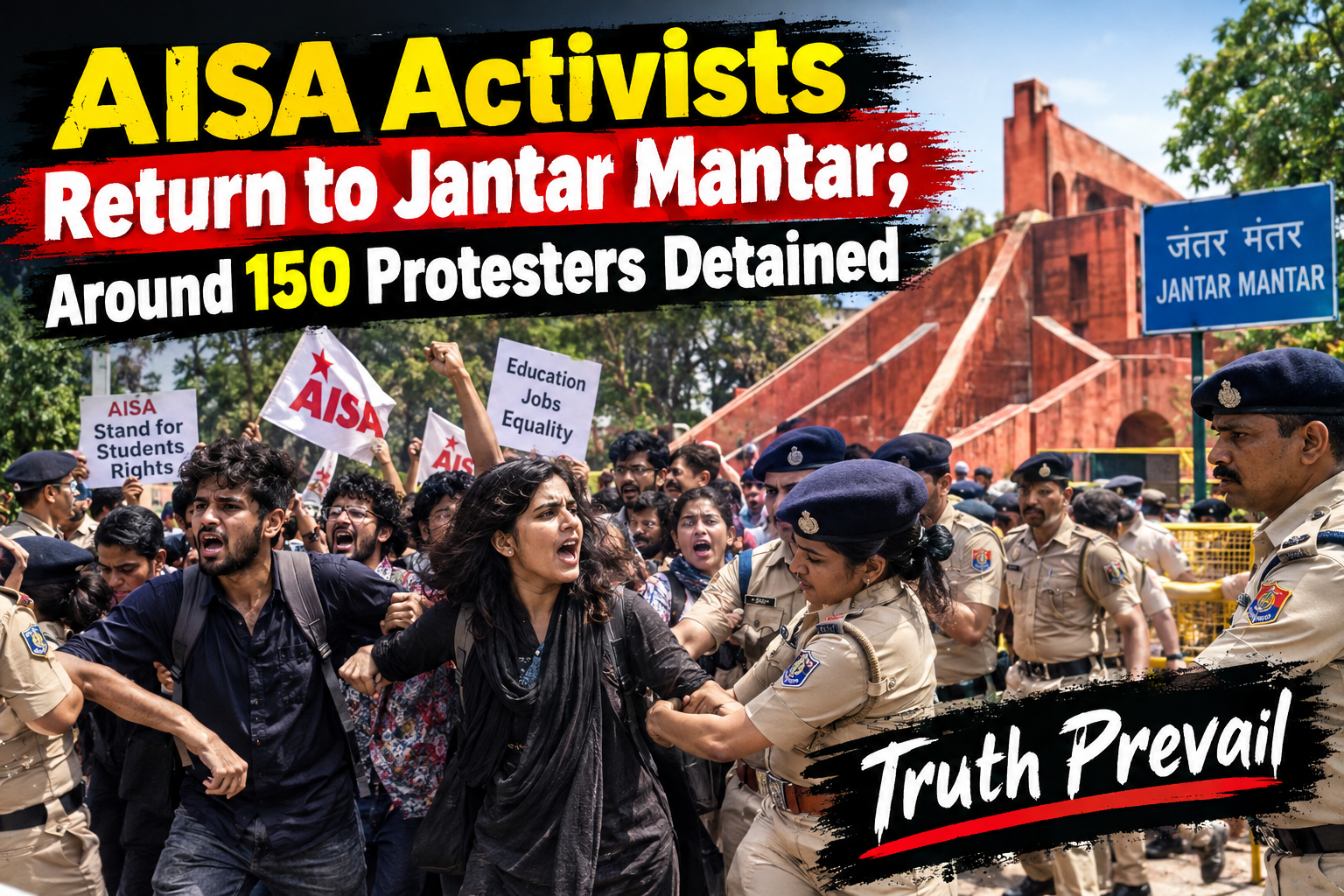
NEW DELHI, OCTOBER 03, 2026 : Around 150 protesters, including All India Students’ Association (AISA) national president Neha Bora, activist Yogendra Yadav and senior advocate Prashant Bhushan, were detained on Saturday as protesters marched from Patel Chowk towards Jantar Mantar to demonstrate against Chief Election Commissioner Gyanesh Kumar and demand his resignation.

The Saturday mobilisation came a day after a much larger demonstration in central Delhi, during which more than 1,000 protesters were detained as police prevented groups from reaching Jantar Mantar. Bora, who was detained on Friday, had called on activists to return to the protest site at 1 pm on Saturday and continue their campaign concerning the Special Intensive Revision (SIR) of electoral rolls.
Protesters Demand CEC’s Resignation
AISA and other participating groups are demanding Kumar’s resignation and alleging irregularities in the revision of electoral rolls. The demonstration has focused particularly on concerns surrounding the SIR process and the reported deletion of voters’ names.
Senior advocates Kapil Sibal, Nitya Ramakrishnan, Pallav Sisodia and Prashant Bhushan, along with Yogendra Yadav, were reported to have joined Bora and students during the march.
Police began detaining protesters as they gathered near Jantar Mantar. Security personnel were deployed at several points, while barricades were placed on roads leading to the protest site.
AISA members alleged that Bora was manhandled by a male police officer and that another officer abused her. Those allegations had not been independently verified at the time of reporting.
FIRs Registered Over Friday’s Demonstration
Delhi Police registered at least three FIRs in connection with Friday’s protests — two at Parliament Street police station and one at Connaught Place police station.
The cases were registered under Section 223 of the Bharatiya Nyaya Sanhita (BNS) concerning alleged disobedience of an order promulgated by a public servant.
Police said the FIRs did not name any individual or organisation as an accused, although the contents referred to organisers and organisations involved in the proposed or actual demonstrations.
The cases relate to alleged violations of prohibitory orders imposed across New Delhi under Section 163 of the Bharatiya Nagarik Suraksha Sanhita (BNSS). The orders restricted gatherings of five or more people, processions, demonstrations, picketing, dharnas and slogan shouting without prior written permission.
Police Had Denied Permission
Delhi Police had denied permission for Friday’s gathering and imposed heightened security measures across central Delhi. Roads were barricaded and access to several Metro stations near Jantar Mantar was temporarily restricted during the previous day’s protest.
The second day’s mobilisation therefore took place under a substantial police presence, with protesters continuing to assemble near the designated demonstration area.
SIR Controversy and Election Commission Response
The protests come amid continuing debate over the Election Commission’s Special Intensive Revision (SIR) of electoral rolls.
An investigation published by The Indian Express reported that Election Commissioners Sukhbir Singh Sandhu and Vivek Joshi had formally recorded objections at least 14 times over 10 months concerning decisions and orders related to the SIR process.
The Election Commission, however, has rejected the characterization of these objections as evidence that its final decisions lacked collective approval. EC officials said that SIR-related decisions were unanimous and that differing views and observations are part of institutional deliberations.
The controversy has also reached the courts. The Supreme Court has agreed to hear a petition challenging aspects of the Election Commission’s functioning under CEC Gyanesh Kumar and the SIR process.
The Situation
As of October 03, 2026, AISA and other participating groups continue to press their demands at Jantar Mantar, while police maintain heightened security and continue detentions around the protest area.
The competing positions remain clear: protesters are raising concerns about the conduct and consequences of the SIR exercise, while the Election Commission maintains that its decisions have followed statutory procedures and received the required approval.