

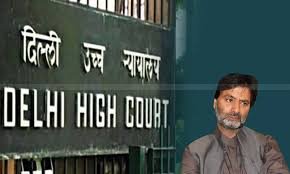
NEW DELHI, OCTOBER 14, 2026 : The Delhi High Court on Wednesday sought a report from the concerned jail superintendent after separatist leader and Jammu and Kashmir Liberation Front (JKLF) chief Yasin Malik failed to appear virtually during proceedings in a terror funding case.

A bench comprising Justices Navin Chawla and Arun Bhardwaj noted that Malik was scheduled to join the proceedings through video conferencing but was not produced before the court as directed.
“Respondent (Malik) had to be produced virtually before us. However, it is not done. Let a report in this regard be called from the jail superintendent concerned,” the bench observed.
The court listed the matter for further hearing on December 9, 2026, directing that Malik be made to participate in the proceedings virtually on that date.
NIA Seeks Enhancement of Life Sentence to Death Penalty
The High Court was hearing an appeal filed by the National Investigation Agency (NIA), which has sought enhancement of Malik’s life imprisonment sentence to the death penalty in the terror funding case.
Malik is currently lodged in Tihar Jail, where he is serving a life sentence imposed by a trial court in May 2022.
He had previously expressed his desire to argue in person against the NIA’s plea seeking an enhancement of his punishment.
On May 29, 2023, the High Court issued notice to Malik on the agency’s appeal and directed that he be produced before it on the next date of hearing.
Subsequently, jail authorities sought permission for his virtual appearance, describing him as a “very high-risk prisoner” and citing public order and security concerns associated with his physical production in court. The High Court allowed the request.
Background of the Terror Funding Case
On May 24, 2022, a trial court in Delhi convicted Malik under provisions of the Unlawful Activities (Prevention) Act (UAPA) and the Indian Penal Code and sentenced him to life imprisonment.
Malik had pleaded guilty to the charges, including those under the UAPA.
Challenging the sentence, the NIA argued that pleading guilty should not automatically shield a convicted terrorist from capital punishment. The agency contended that refusing to impose the death penalty in such circumstances could undermine the sentencing framework for serious terrorist offences.
The trial court had rejected the NIA’s request for the death penalty, observing that although Malik’s offences struck at the “heart of the idea of India” and were aimed at forcibly separating Jammu and Kashmir from the Union of India, the case did not meet the legal threshold of the “rarest of rare” category required for capital punishment.
NIA Challenges Malik’s Claims About Back-Channel Peace Efforts
In his response to the NIA’s appeal, Malik claimed that he had spent nearly three decades participating in a state-sanctioned back-channel mechanism involving successive prime ministers, intelligence chiefs and other influential figures to pursue peace in Jammu and Kashmir.
In an 85-page affidavit, he reportedly detailed his journey, including his early life, associations with militants and meetings with political leaders.
The NIA rejected his arguments in its rejoinder, maintaining that references to senior politicians, bureaucrats and other prominent individuals did not absolve him of responsibility for the offences for which he had been convicted.
The agency also alleged that Malik had links with multiple terrorist organisations and supporters of Lashkar-e-Taiba (LeT), arguing that his claims were irrelevant to the determination of the appropriate sentence.
Next Hearing Scheduled for December 9
The High Court’s latest direction seeks an explanation from the jail authorities for Malik’s failure to join the scheduled virtual proceedings.
The court has directed that he participate in the next hearing on December 9, 2026, when the matter concerning the NIA’s plea for enhancement of his sentence is expected to proceed.
The question of whether his life sentence should be enhanced to the death penalty remains before the High Court.