

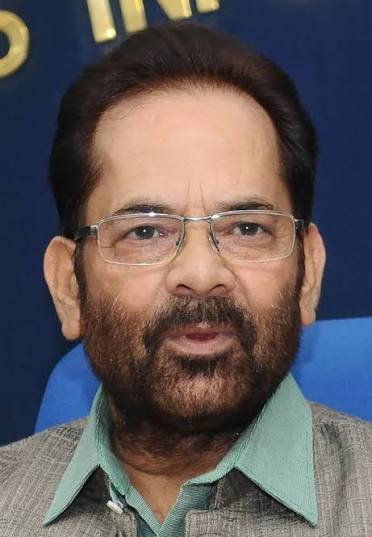
New Delhi, October 18, 2026 : Senior BJP leader and former Union Minister Mukhtar Abbas Naqvi on Sunday launched a sharp attack on the Opposition, accusing certain political parties of pursuing what he described as a “regime change craze.” He asserted that in India’s vibrant democracy, governments are formed and changed through the power of the ballot, not through the threat of bullets.

Speaking to reporters in New Delhi, Naqvi emphasised that the people’s mandate, expressed through free and fair elections, remains the foundation of India’s democratic system. He said political parties must respect the electoral verdict rather than attempt to destabilise elected governments through disorder or unconstitutional means.
Referring to India’s electoral history, Naqvi said that, apart from the period of Emergency from 1975 to 1977, voters had consistently exercised their democratic rights through elections. He pointed to 18 general elections and hundreds of Assembly, Panchayat and local body elections, asserting that people had used the ballot as their instrument of political choice rather than resorting to violence.
“Governments are chosen and changed by the power of the ballot, not by the threat of bullets,” Naqvi said, underlining what he described as the enduring strength of India’s democratic traditions.
Naqvi Warns Against Attempts to Destabilise Democracy
The BJP leader alleged that certain forces, including what he described as national and international sponsors, were backing activities intended to create “anarchy, arrogance and chaos” in the name of regime change. He expressed confidence that such efforts would ultimately fail before the strength of the people’s democratic mandate.
Naqvi also criticised what he described as attempts to undermine public confidence in democratic institutions through protests and political activities at Jantar Mantar. He alleged that these efforts were aimed at weakening the authority of the people’s electoral verdict.
He further warned those whom he accused of attempting to intimidate democracy that the Indian electorate would continue to defend its constitutional rights and democratic choices.
Rajnath Singh Had Earlier Targeted Congress and Its Allies
Naqvi’s remarks came after Union Defence Minister Rajnath Singh recently criticised the Congress and its allies over protests in the national capital. Singh had accused the Opposition of pursuing a regime-change agenda similar to developments in Bangladesh and alleged that the energy of young people was being used to spread “anarchy.”
Addressing a press conference in Lucknow, Singh maintained that democracy does not grant anyone the licence to create disorder or undermine the credibility of constitutional institutions. His comments added to the ongoing political confrontation between the BJP and Opposition parties over the nature and objectives of the protests.
Congress Rejects BJP’s Allegations
The Congress, in response to the BJP’s regime-change allegations, defended the Opposition’s democratic role. The party referred to former President Pranab Mukherjee’s statement that the responsibility of the Opposition in a democracy is to “oppose, expose and depose.”
The Congress also categorically rejected any unconstitutional seizure of power, stating that it believes in peaceful democratic mobilisation, constitutional institutions, free and fair elections, and the sovereign will of the Indian people.
Political Debate Over Protests and Democratic Accountability
The exchange highlights the growing political disagreement between the ruling BJP and the Congress over protests, democratic dissent and the legitimacy of political mobilisation.
While BJP leaders have accused the Opposition of attempting to destabilise the government and undermine constitutional institutions, the Congress has maintained that peaceful protest and holding the government accountable are legitimate functions of a democratic Opposition.
At the centre of the debate is the distinction between peaceful political dissent and actions alleged to threaten constitutional order. Naqvi reiterated that electoral mandates must remain paramount, arguing that political power in India can only be legitimately acquired or changed through the democratic process.