

By M S Nazki

On Adapting for Tomorrow: The difference between today and tomorrow is something called change… If we do not become future-focused, we are doomed to obsolescence when tomorrow arrives
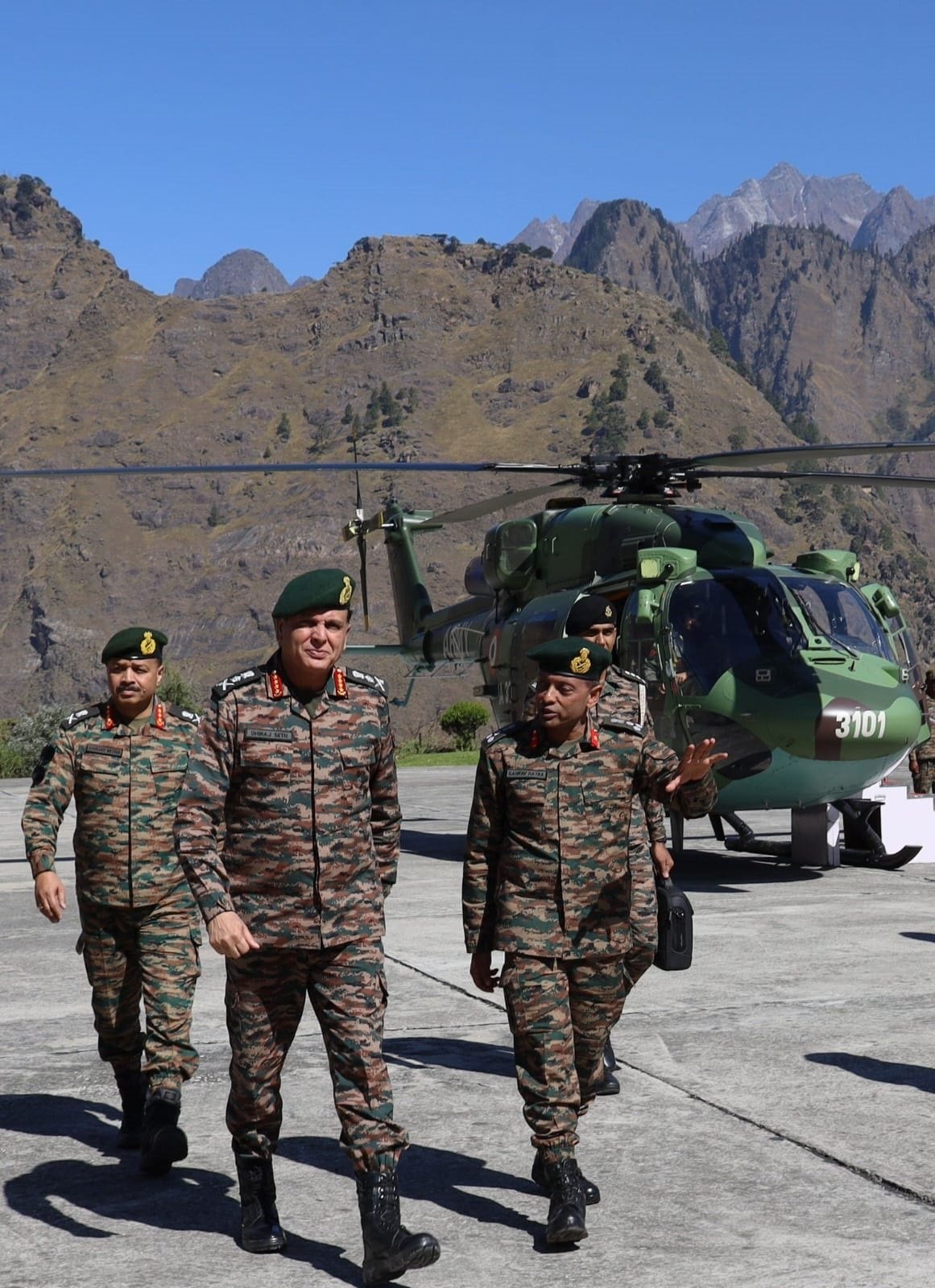
-Mission Ready. Future Focused. General Dhiraj Seth, COAS, visited Ibex Brigade at Joshimath and forward areas in the strategically significant Middle Sector of the Northern Borders, in the Garhwal region, reviewing operational preparedness, technology integration and inter-agency synergy.
– He also visited Mana, India’s First Village in the region and interacted with the local community. During the visit, COAS was briefed on all aspects of capability development and initiatives taken to further strengthen combat capability.
-The COAS commended all ranks for their professionalism and dedication while serving in the Sector’s inhospitable, high-altitude terrain. He exhorted all ranks to embrace ‘VIJAY’, the five-point framework for building an agile, future-ready force, capable of responding at short notice across the full spectrum of operations. The COAS also emphasised the importance of proactive HADR planning, through joint exercises and close coordination with civil
While there is no single quote combining the exact phrase “Mission Ready. Future Focused” on Goodreads, the platform features highly impactful quotes from renowned authors that perfectly capture these dual concepts of tactical readiness and long-term vision.
-The VIJAY roadmap
-The VIJAY roadmap is a strategic blueprint introduced by the 31st Chief of the Army Staff, General Dhiraj Seth, designed to modernize the Indian Army into a digitized, technology-enabled, and multi-domain capable combat force.
-Grounded in the philosophy of “JAI leads to VIJAY”, the framework outlines a structured path aligned with the Ministry of Defence’s Decade of Transformation (2023–2032) and the broader national vision of Viksit Bharat 2047.
-The framework uses the acronym VIJAY to represent five core priority pillars:
* V – Vigilance and Readiness: Maintaining persistent, high-tech border surveillance and constant operational alertness. The objective is to swiftly respond to traditional and emerging hybrid threats across all terrains at short notice.
* I – Innovation and Transformation: Overhauling legacy systems by adopting advanced military doctrines and integrating cutting-edge technologies like artificial intelligence (AI), unmanned systems (drones), cyber defense mechanisms, and electronic warfare assets.
* J – Jointness and Integration: Enhancing tri-services synergy across the Army, Navy, and Air Force. This pillar focuses on structural coordination through integrated theatre commands and military-civil fusion via a whole-of-nation approach.
* A – Atmanirbharta (Self-Reliance): Committing completely to domestic defense manufacturing and localized supply chains. The target is centered on the principle of “Winning Our Wars with Indigenous Solutions” to insulate the force from foreign supply disruptions.
* Y – Yodha First (Soldier First): Prioritizing human capital by enforcing demanding training standards, advancing technological skilling, and enhancing welfare ecosystems for all ranks. This covers personnel across the entire lifecycle, from the youngest Agniveers to veterans and Veer Naris.
-Proactive Humanitarian Assistance and Disaster Relief:
-Proactive Humanitarian Assistance and Disaster Relief (HADR) planning is the cornerstone of minimizing loss of life, reducing economic damage, and ensuring rapid recovery during natural or man-made crises. When military forces, civil authorities, and international bodies plan ahead, they transform chaos into an organized, efficient response.
-The Value of Joint Exercises
Joint military-civilian exercises (like Pacific Angel, Cobra Gold, or domestic mock drills) serve as the ultimate rehearsal for real-world crises.
* Builds Interoperability: Different organizations use different communication systems, terminology, and hierarchies. Joint exercises harmonize these systems before a crisis hits.
* Tests Logistics & Equipment: Standardizes the use of assets (like heavy-lift aircraft, field hospitals, and water purification units) so they can be deployed instantly.
* Identifies Bottlenecks: Simulating a disaster reveals gaps in supply chains, legal permissions, and command structures that would otherwise cause deadly delays.
-The Power of Close Civil-Military Coordination
While the military possesses the heavy logistics, airlift capabilities, and manpower needed for immediate response, civil authorities hold local knowledge, legal jurisdiction, and long-term recovery mandates.
-Primary Strength, Rapid deployment, heavy logistics, structural engineering. Local trust, cultural nuances, long-term rehabilitation.
-Role in HADR Search and rescue, clearing debris, establishing supply lines. Distributing aid, managing shelters, restoring local governance.
-Coordination Focus Subordinating to civil authority to respect local sovereignty. Directing military assets to the areas of greatest human need.
– Key Benefits of Proactive Planning
* Faster Response Times: The “Golden Hour” of disaster relief—the critical period immediately following an event—is optimized when protocols for deployment, border clearances, and airspace management are pre-arranged.
* Resource Optimization: Pre-mapping available assets prevents duplication of effort, ensuring that three agencies don’t send blankets to the same village while another village starves.
* Enhanced Local Resilience: Working closely with civil authorities empowers local communities, teaching them how to manage early warnings and initial first response before external aid arrives.
* Political and Diplomatic Trust: In international HADR, proactive joint planning creates “disaster diplomacy,” fostering trust and open communication lines between nations that might otherwise have strained political relationships.
On Breaking from the Past: You can’t reach your potential by remaining in a past due season. Your breakthrough is coming. Strongholds are breaking. Get Ready
-About Joshimath:
-Joshimath, also known as Jyotirmath, is a town and a municipal board in Chamoli District in the state of Uttarakhand. Located at a height of 6,150 feet (1,875 m), it is a gateway to several Himalayan mountain climbing expeditions, trekking trails and pilgrim centres like Badrinath. It is home to one of the four cardinal pīthas believed by tradition to be established by Adi Shankara.
-Since 7 February 2021, the area was severely affected by the 2021 Uttarakhand flood and its aftermath. The town is confirmed to be sinking due to its geographic location being along a running ridge.
-Between the 7th and 11th centuries C.E., Katyuri kings ruled the area to varying extent from their capital at “Katyur” (modern day Baijnath) valley in Kumaon.
-The Katyuri dynasty was founded by Vashudev Katyuri. The ancient Basdeo temple at Joshimath is attributed to Vasu Dev.
– Vasu Dev was of Buddhist origin, but later followed Brahminical practices and the brahminical practices of Katyuri kings in general is sometimes attributed to a vigorous campaign of Adi Shankara (788-820 CE).
-According to Badri Datt Pandey in his book Kumaon Ka Itihas, Joshimath was the original capital of the Katyur dynasty before it moved to Kartikeya Pur (modern day Baijnath). According to the story, king Vasudev was a devotee of Narsingh (avatar of lord Vishnu). One day he went hunting and lord Narsingh came to his home disguised.
-His wife offered food to the god. After eating the food the god went in the king’s room for some rest. When the king returned from hunting he got angry after seeing a man sleeping in his bed. He took his sword and cut the left hand of god. Instead of blood, milk started flowing from the wound. After seeing this, the king realised the disguised person was not a common man. He asked for forgiveness from the god. The god said he came because he was happy with his kingdom but after this incident he cursed the king to move to a new location (Baijnath). Because of this wound, the statue in the temple will also have a weak left hand. When the statue’s hand will fall off, this will be the end of his dynasty.
-Katyuri kings were displaced by the Panwar dynasty in the 11th century AD.
-A part of the Nanda Devi glacier broke off in Nanda Devi National Park in Uttarakhand’s Chamoli district on 7 February 2021, causing flash flood in Rishiganga and Dhauliganga River, devastating among others the village Rini, the Dhauliganga Dam, the Rishi Ganga dam, Tapovan Vishnugad Hydropower Plant, killing and endangering people. According to media, at least 31 people were confirmed to have been killed and around 165 were reported missing after the flash flood.
-In the aftermath of the floods, residents began noticing cracks in homes; eventually over 600 houses were evacuated after a local temple collapsed. Eventually over 700 of approximately 4,400-4,600 structures would show cracking and the streets and paved areas in the affected area also showed cracking. Hundreds of residents were able to evacuate and authorities classified zones within the town as “danger”, “buffer” and “completely safe” areas; demolition work began on 9 January 2023.
A two year study released in 2023 by the Indian Institute of Remote Sensing used satellite sensing to determine the area was sinking 6.5 cm (2.6 in) each year.
-Mana: Village in Uttarakhand
-Mana is the first Indian village, located in the Chamoli district of Uttarakhand, India, sitting at an elevation of 3,200 meters (10,500 feet).
-Location: Just 3 to 4 km north of the Badrinath Temple along National Highway 7, and about 26 km from the Indo-Tibetan border.
-Inhabitants: Home to the Bhotia (Marchha) community, who live here for about 5 to 6 months a year (May to October) before moving lower down due to harsh winters.
Language: Hindi and the native Rangpo (Marchha) language.
-Major Attractions & Mythology
-Vyas Gufa & Ganesh Gufa: Ancient caves where Sage Vyasa is believed to have composed the Mahabharata with Lord Ganesha acting as his scribe.
-Bhim Pul: A massive rock bridge over the roaring Saraswati River, believed to have been placed by Bhima.
-Saraswati River: One of the rare spots where the Saraswati River flows visibly before disappearing into the earth (Gupt Gamini).
-Vasudhara Falls: A scenic high-altitude waterfall located about 5 km ahead of the village.
-The phrase “the story of a soldier from Mana Village” encompasses several powerful, overlapping realities of the Indian Army. Nestled at 10,500 feet in the Chamoli district of Uttarakhand, Mana is officially designated as “India’s First Village”. Because of its hyper-strategic positioning right on the Indo-China border, the entire identity of the village is deeply intertwined with the soldiers who guard it and the local Bhutia community that acts as the nation’s frontline eyes and ears.
The story manifests in three distinct, profound ways:
1. The Living Frontlines: The Indigenous Soldiers of the Soil
-For the young men born in Mana Village, the Indian Army isn’t just a career choice; it is a cultural inheritance. Growing up in the shadow of the Mana Pass, the local youths—primarily from the indigenous Bhutia community—are uniquely adapted to the brutal high-altitude terrain.
* Many enlist directly into the Garhwal Rifles or the Garhwal Scouts (specialized “Scout” battalions trained specifically for high-altitude mountain warfare).
* Their story is one of ultimate resilience: patrolling treacherous ridges, enduring sub-zero temperatures, and navigating unpredictable avalanches to secure the nation’s perimeter.
* Senior military leaders frequently visit Mana to reinforce this unique civil-military bond, recognizing that the local population stands shoulder-to-shoulder with the uniformed forces.
2. The Guardians of the Border: Sacrifices at Mana Pass”
-Mana Village serves as the staging ground for soldiers deployed to the perilous Mana Pass. The narrative of the soldiers stationed here is defined by quiet heroism against both geopolitical threats and extreme nature.
* The area stands as a solemn reminder of ultimate sacrifice, such as the tragic 2004 reconnaissance mission where Major General DP Singh, Lt Col PK Pande, and Capt Arjun Sardana lost their lives when their Cheetah helicopter crashed in the unforgiving terrain near Mana Pass.
* Furthermore, the Indian Army and the Border Roads Organisation (BRO) routinely risk their lives in the region to battle devastating seasonal avalanches, demonstrating unparalleled bravery just to keep the vital border links open.
3. The Pilgrimage of Valor: The Kargil Connection
Mana Village holds a symbolic place in modern Indian military lore. To honor the legendary heroes of the 1999 Kargil War—specifically the 13 JAK RIF unit of Captain Vikram Batra (Param Vir Chakra)—the Indian Army famously launched a massive commemorative Motorcycle Expedition.
* The expedition was intentionally flagged off from Mana Village.
From the “First Village,” these modern soldiers tracked a grueling, epic route across the Himalayas all the way to the Drass War Memorial in Kargil, symbolically linking the frontline defense of Uttarakhand to the battlements of Jammu & Kashmir.
On the Power of Collective Vision: Teams and organizations with a strong sense of mission significantly outperform those without the strength of vision… a primary factor influencing the success of civilizations is the ‘collective vision’ people have of their future
-The Ibex Brigade (officially designated as the 9th Independent Mountain Brigade Group) is an elite high-altitude formation of the Indian Army.
-Key Details & Role:
* Location & Sector: Headquartered in Joshimath, Uttarakhand, the brigade is stationed in the strategically vital Middle Sector of the Northern Borders along the India–China frontier in the Garhwal region.
* Core Units: It works closely with specialized high-altitude and reconnaissance units such as the Garhwal Scouts.
* Operational Readiness: The brigade specializes in extreme high-altitude warfare, mountain combat, and rapid response across rugged terrain.
* Recent Leadership Visit: Chief of the Army Staff (COAS) General Dhiraj Seth visited the Ibex Brigade at Joshimath and forward areas like Mana in October 2026 to review operational preparedness, tech integration, and inter-agency coordination.
* Disaster Response & Humanitarian Work: The brigade frequently acts as a first responder during natural calamities in Uttarakhand, such as leading rescue and relief operations during flash floods (e.g., in Dharali/Harsil) and high-altitude medical evacuations (e.g., on Mt. Trishul).
* Modernization & Innovation: The unit actively incorporates future-ready tech, including drone design, modification, and tactical field operation training (such as the “Ibex Dronathon”).
Would you like to know more about the Garhwal Scouts, the Middle Sector border dynamics, or recent disaster relief operations by the brigade?
-The Middle Sector of the Northern Borders in the Garhwal region of Uttarakhand”
-The Middle Sector of the Northern Borders in the Garhwal region of Uttarakhand is a highly strategic zone along the Line of Actual Control (LAC) separating India and China. Spanning critical areas like Joshimath, Mana Valley, Harshil, Niti, and Barahoti, this sector has seen significantly elevated military focus, infrastructure scaling, and operational modernization.
-Strategic Significance & Geography:
* Critical Valleys: The Middle Sector includes four crucial high-altitude valleys in Uttarakhand—Harshil, Mana, Niti, and Barahoti—which together contain 22 vital mountain passes that control cross-border access.
* Barahoti Plains: The Barahoti Valley represents one of the historically recognized disputed zones along the LAC with frequent overlapping patrol claims.
* Water & Topography: The region serves as the birthplace of major Indian river systems, including the Alaknanda and Bhagirathi. While the Indian side features rugged, inhospitable mountain terrain, the Chinese side opens into the flatter Tibetan plateau.
-Military Command & Modernization:
* Ibex Brigade & 18 Corps: The Indian Army operates its Ibex Brigade out of Joshimath, providing front-line defense and reconnaissance for the Garhwal sector. To counter military posturing, India structurally raised the 18 Corps (Central Command), heavily backing it with strike reserves stationed in Dehradun to seamlessly cover both the Garhwal and Kumaon frontiers.
* Operational Readiness: Under the Indian Army’s modernized ‘VIJAY’ framework, forces deployed here focus on short-notice agility, next-generation technology integration, advanced surveillance networks, and joint civil-military coordination.
* Defensive Fortification: In response to high-tech missile threats and drone proliferation, comprehensive theater-wide projects have commenced to construct underground protective fortresses to shelter personnel, ammunition, and command hardware.
-Infrastructure & Civil Integration:
* Border Connectivity: Under the multi-phased India–China Border Roads (ICBR) initiative, the Border Roads Organisation (BRO) continues to pave all-weather dual-use access networks, heavy equipment corridors, and forward staging helipads.
* The Vibrant Village Programme: Security architecture has transitioned to treating border populations as active national security assets. Tourism-led livelihood initiatives, infrastructure upgrades, and medical support grids are heavily pushed in places like Mana (India’s First Village) to stem outward migration and build local resilience.
-Modern defense and security architecture increasingly relies on three core pillars: operational preparedness, technology integration, and inter-agency synergy:
1. Operational Preparedness & Force Restructuring
* Integrated Theatre Commands (ITCs): India is actively restructuring its military by establishing geographic and functional ITCs to unify the capabilities of the Army, Navy, and Air Force under a single commander.
* Separation of Roles: Reforms led by the Chief of Defence Staff (CDS) separate active operational roles from administrative Raise-Train-Sustain (RTS) functions, allowing commanders to focus strictly on security and readiness.
* Joint Exercises: Large-scale drills—such as Tri-Service exercises (e.g., Exercise Trishul)—bring together tens of thousands of personnel across the Army, Navy, Air Force, Indian Coast Guard, BSF, and central agencies to validate joint Standard Operating Procedures (SOPs).
2. Technology Integration & Multi-Domain Warfare
* Real-Time Data Fusion: Modern combat efficiency depends on the real-time fusion of intelligence from Army units, IAF surveillance platforms, and Navy maritime reconnaissance assets to build a shared battlespace picture.
* Indigenous Hardware & Robotics: The armed forces are rapidly inducting indigenous loitering munitions (such as Nagastra-1R), upgrading artillery like the Pinaka rocket system, and deploying robotic mules and autonomous support platforms for field logistics.
* AI & Cyber Incubation: Partnerships with academic institutions (such as IITs and DTU) train personnel in artificial intelligence, robotics, and cyber-defense, shifting security frameworks from reactive responses to anticipatory, technology-driven architectures.
3. Inter-Agency Synergy & A Whole-of-Nation Approach
* Unified Command and Frameworks: Effective crisis and disaster response utilizes shared communication models and common operational picture frameworks (such as the CSCATTT model: Command and Control, Safety, Communication, Assessment, Triage, Treatment, and Transport) to harmonize multi-agency efforts.
•Civic-Military Coordination: A true “Whole-of-Nation” approach bridges military branches with paramilitary forces (like the BSF), coast guards, intelligence bodies, and civilian authorities to handle complex land, maritime, cyber, and counter-terrorism challenges.
Joshimath in Uttarakhand’s Chamoli district is a historic high-altitude region known for tales of military valor, disaster response, and frontline sacrifice.
-Key Stories and Remembrances of Bravery:
* ITBP & Armed Forces in the 2021 Tapovan-Joshimath Disaster: When a massive glacial burst triggered flash floods in the Dhauli Ganga river near Joshimath, Indo-Tibetan Border Police (ITBP) and Army bravehearts worked through extreme terrain and tunnels at Tapovan to rescue trapped workers.
* The Ibex Brigade & Garhwal Frontline Units: Stationed in Joshimath as part of the pivotal Middle Sector of the Northern Borders, Indian Army brigades regularly honour troops (such as recent visits by senior leadership recognizing frontline readiness and the service of personnel like Lance Naik Pritpal Singh and Sepoy units).
* Commemorating Fallen Heroes: The region frequently holds homage and memorial events—such as ITBP ceremonies in Ravigram, Joshimath—to honor long-standing martyrs like Lance Naik Prakash Chander Dimri and Head Constable Badri Ram who laid down their lives in the line of duty.
* Rescues in Difficult Himalayan Terrain: Local police, SDRF units, Army troops, and fire/rescue personnel stationed out of Joshimath routinely risk their lives in sheer ravines, high-altitude blizzards, and emergency aircraft incidents across the Badrinath-Joshimath axis.
Finally the last few lines:
The stories of bravery emerging from Joshimath span across centuries, from the legendary lore of ancient dynasties to the military valor of the Indian Army and the quiet, agonizing resilience of local residents fighting to protect their families during the recent land subsidence crisis.
-The Modern Resilience: Surviving the Sinking Town
When catastrophic land subsidence struck the heart of Joshimath, the definition of bravery shifted from battlefield heroism to everyday survival and community defense.
* The Vigilant Families: Residents like the Bhotiyal family found themselves facing a slow-moving, invisible enemy as gaping cracks tore through the walls of their newly built homes. Bravery here became the agonizing discipline of staying awake late into the night, packed and ready to rush out at the slightest sound of crumbling concrete to save their 11-member extended family.
* The Joshimath Bachao Sangharsh Samiti: Led by local activists like Atul Sati, ordinary citizens stood up against powerful state and corporate entities. Despite the imminent threat of structural collapse, they stayed behind to organize protests, demand accountability for flawed infrastructure projects, and guide vulnerable, document-less families through the rehabilitation process.
-Military and Rescue Valor: The Guardians of the Sector:
-As a critical strategic outpost near the Indo-Tibetan border, Joshimath’s military presence has given rise to legendary acts of physical bravery.
* The Historic Defense of 1962: In October 1962, leaders like Major Sardul Singh Randhawa, 2nd Lieutenant G.V. Prasanna Rao, and Subedar Sonam Stopdhan displayed indomitable courage and exemplary leadership in the face of enemy forces in the high-altitude terrain surrounding Joshimath, earning the prestigious Maha Vir Chakra.
* Commando Surjan Singh: Stationed in the region, Rifleman/Commando Surjan Singh’s final act remains a pinnacle of selflessness. During an intense engagement, he crawled through a hail of bullets despite sustaining severe splinter injuries to his face, ultimately diving to shield his commander with his own body. He continued to engage the enemy until he succumbed to his wounds.
* The First Responders: During the Chamoli avalanches and the devastating 2013 Kedarnath floods, the Garhwal Scouts and the Indo-Tibetan Border Police (ITBP) stationed at the Joshimath Cantonment risked their lives in inhospitable terrains to rescue thousands of trapped pilgrims.
-The Mythological Lore: King Vasudev’s Confrontation
-In the foundational folklore of the region, bravery takes on a spiritual dimension. According to historical texts like Kumaon Ka Itihas, the ancient Katyuri king, Vasudev, was a fierce warrior and an ardent devotee of Lord Narsingh (the half-man, half-lion avatar of Vishnu). The legend goes that when a disguised visitor occupied his chambers, the king fiercely defended his home with his sword, only to realize he had struck his own deity. His willingness to face divine judgment led to the establishment of the famous Narsingh Temple in Joshimath.
On Imagination vs. Memory: “When you live out of your memory, you focus on the past. When you live out of your imagination, you focus on the future.” — Stephen R. Covey, How to Develop Your Personal Mission Statement! On Silencing the Noise to Deliver: “Set your mission and be like a candle, do your job, quietly, calmly… by stepping into our God-ordained responsibility…