


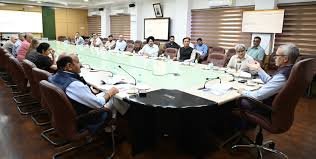
Jammu, March 6, 2026 : Chief Minister Omar Abdullah on Friday chaired a high-level meeting to review the progress of Compliance Reduction and Deregulation 2.0, a nationwide initiative aimed at reducing regulatory burdens and creating a more business-friendly and citizen-centric governance framework in Jammu and Kashmir.
Emphasising the government’s governance philosophy, the Chief Minister said the reforms should benefit not only industries but also the general public. “We should endeavour to make life easy not just for industry, but for the common population as well,” he said during the meeting.
Officials informed the meeting that under Phase 1 of the programme, the J&K Government had identified 23 priority reform areas and successfully achieved all the targets set under the initiative. Phase 2 aims to expand the reform agenda to 23 additional critical sectors, including healthcare, education, tourism, industry, and other service sectors.
The meeting was attended by Deputy Chief Minister Surinder Kumar Choudhary and ministers Sakeena Itoo, Javed Ahmed Rana, Javid Ahmad Dar, and Satish Sharma. Advisor to the Chief Minister Nasir Aslam Wani also participated in the deliberations.
Senior bureaucrats present included Chief Secretary Atal Dulloo, Additional Chief Secretary to the Chief Minister Dheeraj Gupta, Financial Commissioner and Additional Chief Secretary of the Power Development Department Ashwani Kumar, and Financial Commissioner and Additional Chief Secretary of the Tourism Department Ashish Chandra Verma, among other officials.
During the meeting, the Chief Secretary presented the current status of ongoing reforms and highlighted efforts to reduce the number of approvals and permissions required to start and run businesses in the Union Territory.
The Chief Minister conducted a detailed review of each reform intervention and asked departments to provide clear timelines for implementation. He stressed that regulations should help organise systems efficiently rather than create unnecessary bureaucratic hurdles for citizens and businesses.
A range of key reform areas were discussed during the meeting, including simplifying land-use frameworks, easing building permissions, improving industrial land utilisation in both rural and urban areas, and removing dual licensing requirements for businesses. The role of a nodal agency for industrial development to streamline approvals was also deliberated upon.
The meeting further explored reforms in the education and healthcare sectors, including simplifying minimum norms for private educational institutions and introducing a unified licensing mechanism for medical practitioners.
At the governance level, discussions also focused on strengthening digital infrastructure. Proposed measures include introducing an auto-appeal mechanism under the Public Services Guarantee Act (PSGA) to ensure time-bound delivery of services and creating a centralised digital repository of all state laws, rules, regulations and government orders.
Officials also highlighted the need to reduce end-to-end processing time in the Single Window System to facilitate quicker approvals for investors and businesses.
Concluding the meeting, the Chief Minister directed all departments to submit measurable timelines for each reform initiative and reiterated that simplifying regulations is key to attracting investment and ensuring tangible benefits for citizens, entrepreneurs and investors in Jammu and Kashmir.