

Srinagar, February 26, 2026 : Jammu and Kashmir Chief Minister Omar Abdullah on Thursday underscored that sustainable development is impossible without peace, asserting that areas once identified with conflict are today emerging as symbols of harmony and opportunity.

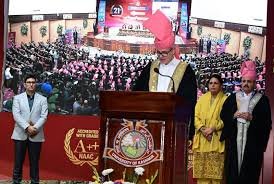
Addressing the 21st convocation ceremony of University of Kashmir, the Chief Minister said, “Development requires the oxygen of peace. My government’s primary objective is to provide a transparent, democratic and stable environment where growth can truly flourish.”
Referring to the challenges faced by the Union Territory in recent years, Abdullah said Jammu and Kashmir has demonstrated remarkable resilience, transforming adversity into opportunity. He noted that while tourism is beginning to realise its true potential, it cannot depend only on iconic destinations such as Gulmarg and Pahalgam.
“We are pioneering border tourism. Villages like Keran, Gurez and Teetwal, once synonymous with conflict, are now symbols of connection. In collaboration with the Union government, we are developing nine new destinations so that tourism benefits reach the last mile,” he said.
Emphasising environmental responsibility, Abdullah cautioned that climate change was already impacting the region. “Our glaciers are receding and our winters are changing. That is why we are investing in sustainable infrastructure — from artificial snow technology to safeguard skiing in Gulmarg, to promoting eco-tents instead of concrete hotels,” he said, adding that tourism of the future must not destroy the ecology of today.
Calling upon environmental science graduates, the Chief Minister urged them to help frame green standards for Kashmiri hospitality. He also outlined the government’s three core commitments — meritocracy, sustainability and digital sovereignty.
“Through recruitment reforms, we want qualification to replace recommendation. Whether one is the son of a shikarawala or the daughter of a minister, merit must be the only currency,” Abdullah said.
Highlighting women’s achievements, he described women as Jammu and Kashmir’s strongest asset against poverty and instability. “Over 60 per cent of degrees awarded today have gone to our daughters. We have moved from women’s welfare to women-led development,” he said, encouraging women graduates to aspire for leadership roles in civil services, science, technology and global platforms.
The Chief Minister also presented his vision of a diversified economy driven by innovation and technology. He urged science and IT graduates to bridge the gap between laboratories and the land by developing solutions such as real-time pest detection for orchards and blockchain-based traceability so that global buyers can verify that saffron truly originates from Pampore.
Describing this approach as the “saffron and silicon vision,” Abdullah said Jammu and Kashmir’s naturally cool climate positions it as an ideal destination for green data centres. He added that the government is restructuring industrial policy to promote knowledge-based industries and ensure that local graduates find opportunities within the region, including research labs near the Zabarwan Range.
Addressing mental health concerns, Abdullah stressed that years of conflict have taken a psychological toll on the youth. He said the government is expanding district-level counselling through Mission Youth and called upon psychology and social work graduates to help destigmatise mental health conversations.
Concluding his address, the Chief Minister said Jammu and Kashmir is no longer defined by a single narrative. “In 2026, we are becoming a hub of innovation, resilience and participatory governance. Peace is our foundation, and empowered youth are our future,” he said.