

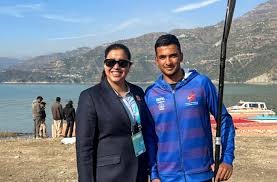
New Delhi, January 22, 2026 : From the serene waters of Dal Lake to the grandeur of Kartavya Path, the journey of young kayaker Mohsin Ali and his mentor Bilquis Mir is a powerful tale of perseverance, sacrifice and unwavering belief in dreams.

Mohsin was barely seven years old when he decided that a kayak paddle, not a shikara oar, would define his future. Growing up in Kand Mohalla, a small hamlet within Dal Lake known as the home of “people of water,” the now 18-year-old has emerged as one of Jammu and Kashmir’s brightest sporting talents.
This Republic Day, Mohsin will be part of Jammu and Kashmir’s tableau at the January 26 parade, bringing a strong sporting identity to the Union Territory, which is often recognised primarily for tourism.
Although Mohsin has been competing since 2018, his defining breakthrough came last year when he won gold in the men’s 1000m kayaking event at the Khelo India Water Games. The achievement caught the attention of Prime Minister Narendra Modi, who later interacted with Mohsin on Mann Ki Baat.
“I am the first sportsperson in my family. My dream is to win an Olympic medal for India someday. I have won 17 medals so far,” Mohsin said, recalling his brief but memorable interaction with the Prime Minister, which made him a local icon back home in Srinagar.
Having completed his schooling, Mohsin is now training at an academy in Koteshwar, Uttarakhand, preparing for upcoming World Championship trials scheduled in April.
The Bilquis Mir Effect
Behind Mohsin’s rise stands Bilquis Mir, a former kayaker who has been instrumental in shaping not just his career, but the future of water sports in Kashmir. Mir has trained Mohsin since he was six or seven years old, guiding him through injuries, lack of infrastructure, outdated equipment and harsh weather conditions.
“She has been there from the very beginning. I wouldn’t have made it this far without her,” Mohsin said, acknowledging his coach’s role.
Bilquis Mir herself is a trailblazer. She was the national coach of the Indian women’s team at the 2012 London Olympics and went on to become the first Indian canoeing/kayaking judge at the Paris Olympics in 2024. Through Mohsin, she hopes to live the Olympic dream that eluded her as an athlete.
“What people see is the medal, not the struggle behind it,” Mir said, highlighting challenges ranging from nutrition—moving away from traditional Kandru Roti and Nun Chai—to training amid Kashmir’s extreme weather.
Mir’s own journey has been equally tough. She recalls beginning her career in 1998 at the peak of militancy, facing social resistance and later fighting a prolonged legal battle over her appointment as a physical education teacher, which the High Court termed a “witch hunt.”
“In a male-dominated society, when Mohsin proudly says I am his coach, that itself is one of my biggest victories,” she said.
After the Prime Minister’s interaction with Mohsin, Mir’s small academy in Srinagar saw over 100 admission enquiries, a testament to the inspiration their journey has sparked among Kashmiri youth.
With more than 15 Olympic medals available in canoeing and kayaking, Mir believes India has vast untapped potential in the sport—and Mohsin Ali could be among those leading the charge.
From Dal Lake’s quiet waters to the nation’s ceremonial boulevard, their story is one of resilience, courage and belief.