

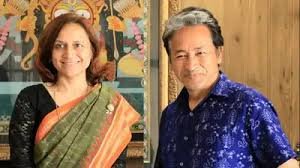
New Delhi, January 27, 2026 : As the nation marked the 77th Republic Day with grand parades and cultural displays, Gitanjali J Angmo, co-founder of the Himalayan Institute of Alternatives Ladakh (HIAL) and wife of noted climate activist Sonam Wangchuk, expressed deep anguish and disillusionment, questioning the very spirit of the celebration when constitutional rights remain unfulfilled.
Angmo said this was the first time she did not feel inspired to watch the Republic Day parade, an event she had followed unfailingly for years. Her remarks come amid the continued detention of Sonam Wangchuk, who has been lodged in jail for the past four months under the stringent National Security Act (NSA).
“It has been 120 days of Sonam Wangchuk’s unlawful and illegal detention. For the first time ever, I did not feel motivated to watch the Republic Day parade on television,” Angmo said, adding that it was painful to feel disconnected from an occasion meant to instil national pride.
Questioning the essence of Republic Day, she asked how the celebration holds meaning when constitutionally guaranteed safeguards are denied to regions that legitimately deserve them. Referring to Ladakh’s long-standing demand for statehood and Sixth Schedule protection, Angmo said that expressing democratic dissent has instead led to incarceration.
“When constitutional safeguards are not granted, when people are jailed for raising their voices, where is the respect for the Constitution we claim to celebrate?” she asked.
Wangchuk, a Ramon Magsaysay Award-winning educator and environmentalist, was detained on September 26, 2025, two days after protests in Ladakh demanding statehood and Sixth Schedule status turned violent, leaving four people dead and nearly 90 injured. He was later shifted to a jail in Jodhpur after ending a 15-day hunger strike.
Angmo also questioned the emphasis on pageantry, saying national pride must be rooted in justice, transparency and accountability. “A lot of taxpayers’ money is spent on showcasing achievements, but inspiration cannot be built on shaky foundations,” she said.
She spoke of a growing sense of disillusionment, not just personally but among many citizens, as pressing issues like pollution, unemployment and the weakening education system remain unaddressed. Citing Ladakh as an example, she pointed out the contradiction between official claims of making the region carbon-neutral and the continued construction of conventional cement-mortar government buildings instead of proven passive solar designs.
“There is pride in our armed forces and capabilities, but we must also ask how much is reality and how much is façade, when real issues on the ground are ignored,” Angmo said.
Her remarks have added a strong moral and constitutional dimension to the ongoing debate around Ladakh’s political future, civil liberties and the true meaning of democracy in contemporary India.