


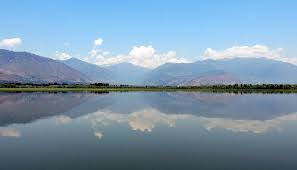
JAMMU, April 11, 2026 : In a major ecological restoration effort, authorities have successfully revived nearly five square kilometres of degraded area at Wular Lake—one of Asia’s largest freshwater lakes and a designated Ramsar site—through large-scale conservation and scientific intervention.

Officials said the restoration drive involved dredging approximately 78.43 lakh cubic metres of silt, significantly enhancing the lake’s water-holding capacity and helping reclaim critically silted zones.
A key component of the initiative has been the phased removal of around 1.31 lakh willow trees, carried out under a scientifically approved plan to restore the wetland’s natural ecosystem. Authorities clarified that this step is part of habitat management and not deforestation, as it targets invasive or ecologically adverse vegetation.
To safeguard the lake from encroachments and flooding, protection bunds have been strengthened across nearly 15 kilometres of vulnerable stretches, providing both environmental and community-level benefits.
In addition, the boundary of the lake has been clearly demarcated with 1,159 geo-referenced RCC pillars using advanced GPS and remote sensing technologies, ensuring better monitoring and protection of the lake’s 130 sq km revenue area.
The eco-restoration project also integrates eco-tourism and public engagement. A 2.5-km non-motorable walkway at Banyari–SK Payeen, featuring cycling tracks and scenic viewpoints, has been developed, while projects like Delta Park (Banyari), Gurura Park, and an Eco-Park at Ningli, Sopore are underway to boost sustainable tourism.
Further strengthening surveillance, two CCTV-equipped watch towers have been installed, with additional cameras planned to enhance monitoring.
Officials noted that while the lake region has an estimated 19–21 lakh willow trees, only selective, phased removal is being carried out under the Comprehensive Management Action Plan (CMAP). Out of 1.91 lakh identified trees in the first phase, around 1.35 lakh have already been cleared, generating approximately ₹31.95 crore in revenue.
Simultaneously, extensive afforestation efforts are being undertaken in the catchment areas. Over 19 lakh plants have been planted since 2012 under schemes like CAPEX and CAMPA, with more than 2,900 hectares treated in the Bandipora region to control soil erosion and reduce sediment inflow into the lake.
The integrated approach—combining restoration, conservation, infrastructure development, and afforestation—is expected to significantly revive the ecological health of Wular Lake while supporting local livelihoods and promoting sustainable tourism.