

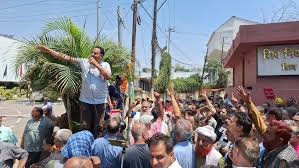
Jammu, May 6, 2026 : Tensions flared in Jammu on Wednesday as members of the displaced Kashmiri Pandit community staged a strong protest against the administration’s move to integrate their relief ration system into the National Food Security Act (NFSA). The demonstration briefly turned chaotic when protesters attempting to march towards the Relief Commissioner’s office were stopped by police, leading to minor scuffles.

Hundreds of protesters, including residents from migrant camps in Jagti, Purkhoo, Nagrota, and Muthi, gathered near the office premises, raising slogans against the implementation of NFSA. The protest saw participation from various groups such as the Panun Kashmir, United Alliance of Kashmiri Displaced Community, and was supported by Shiv Sena.
Officials said a heavy police deployment was made to prevent escalation. As demonstrators attempted to move forward, they were was stoped, resulting in brief pushing and clashes before the crowd was dispersed. Protesters later staged a sit-in, continuing their protest with anti-government slogans.
At the heart of the agitation is the administration’s decision to merge migrant ration cards into the NFSA database. The process, initiated earlier this year, has already covered over 17,500 cards, with plans to include more than 50,000 families to expand access to welfare schemes.
However, community leaders strongly opposed the move, terming it a “conspiracy” to dilute their identity as displaced persons and genocide survivors. Dr Agnishaker described NFSA as a “black law” and warned that its implementation could undermine the unique status and long-standing struggle of Kashmiri Pandits.
“For 36 years, the community has suffered displacement. Now, under NFSA, our identity is being diluted. This is not just a policy change—it is an injustice,” he stated, also raising concerns about the upcoming census and demanding formal recognition of their identity as internally displaced persons.
Another community leader, Arvind Kaul, accused authorities of restricting their fundamental right to peaceful protest. He demanded restoration of existing relief mechanisms and called for a comprehensive rehabilitation policy, highlighting that many displaced families still lack permanent homes.
Echoing similar concerns, leader Sunil Kumar asserted that the agitation would continue until a “dignified and permanent solution” is achieved. Protesters emphasized that instead of altering relief distribution systems, the government should prioritize their safe and sustainable rehabilitation in Kashmir.
The protestors warned of intensifying agitation in the coming days if their demands are not addressed, signaling a growing discontent within the displaced community over policy changes impacting their status and future.