

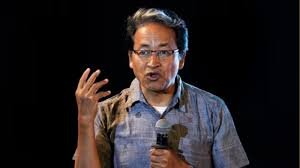

NEW DELHI, May 23, 2026 : The Centre has proposed constitutional safeguards for Ladakh under Article 371 instead of inclusion under the Sixth Schedule and has also agreed in principle to a legislative governance structure for the Union Territory, activists from the region said on Saturday after fresh talks with the Union Ministry of Home Affairs (MHA).
Representatives of the Leh Apex Body (LAB) and Kargil Democratic Alliance (KDA) met a sub-committee of the MHA on Friday to discuss constitutional safeguards, democratic representation and the long-pending demand for statehood for Ladakh.
Activist Sonam Wangchuk said the government proposed safeguards on the lines of Articles 371A and 371G, similar to protections granted to Nagaland and Mizoram, while also agreeing that any future governance structure should apply to the whole of Ladakh rather than being confined to district councils.
“The government said it has some issues with the Sixth Schedule but is willing to consider protections under Article 371,” Wangchuk said after the meeting.
Article 371A & Article 371GArticle\ 371A \; \& \; Article\ 371G
Article 371 provides special constitutional provisions to certain states to safeguard their unique socio-cultural identities, customary laws, land rights and regional interests. Under Article 371A, Parliament cannot legislate on matters relating to Naga customary practices, religion and land rights without the consent of the state assembly. Similar protections exist for Mizoram under Article 371G.
The Sixth Schedule of the Constitution, meanwhile, grants special administrative and legislative protections to tribal areas in select northeastern states through Autonomous District Councils empowered over land, forests, customs and local governance matters.
Wangchuk said the latest discussions reflected a “major shift” from earlier proposals where powers were largely limited to district councils in Leh and Kargil while key authority remained with the Lieutenant Governor and bureaucracy.
“Yesterday, they agreed that whatever constitutional arrangement is created will be at the level of the whole of Ladakh and not at the district level,” he said.
He explained that the proposed framework revolves around three broad categories of powers — legislative, executive and financial — under an elected institution representing the entire Union Territory.
“This is a very big change,” Wangchuk remarked, noting that elected representatives currently have limited authority over Ladakh’s annual budget and administrative decision-making.
“The best arrangement in India is a state. We are moving in the direction of a UT with legislature or statehood,” he added.
Wangchuk also indicated that the Centre’s primary concern regarding full statehood relates to Ladakh’s financial sustainability and revenue-generation capacity.
“Their objection was mainly about income and resources,” he said, adding that studies were underway to assess the Union Territory’s long-term economic viability.
At the same time, he cautioned against interpreting the latest round of talks as a final breakthrough.
“There is no reason either for disappointment or excitement. This is a work in progress. There is an in-principle understanding, not an agreement,” Wangchuk clarified.
KDA member Sajjad Kargili said the Centre had proposed legislative, executive, administrative and financial powers for Ladakh and had been asked to share a formal draft for consultation with legal and constitutional experts.
“A proposal has been submitted by the government. It says safeguards will be given to Ladakh under Articles 371A and 371G, and legislative, executive, administrative and financial powers will also be given,” Kargili said.
He added that the LAB and KDA had requested a written draft similar to the memorandum already submitted by Ladakh representatives.
“We asked the government to give us a draft so that we can discuss it with our legal and constitutional experts and then give our response,” he said.
Kargili stressed that discussions were still at a preliminary stage and no final agreement had been reached.
“There is neither disappointment nor excitement. This is only a dialogue, and we can speak further once we receive the draft,” he said.
Calling continued engagement a positive sign, Kargili said both sides appeared committed to finding a mutually acceptable solution.
“Dialogue is also positivity. It is not positive to stop talking,” he observed.
He further said the MHA emphasized during the meeting that discussions were taking place not “as two opposing sides but as one,” with the common objective of addressing the aspirations and concerns of Ladakh’s people.
“The people of Ladakh should maintain regional sensitivity, diversity and balance. People should get representation and respect,” Kargili said.
No date has been announced yet for the next round of talks, though the Ladakh delegation has requested the Centre to first share the proposed draft framework.
The LAB and KDA have jointly been demanding statehood for Ladakh, constitutional safeguards for land and jobs, and greater democratic powers ever since Ladakh was made a Union Territory without a legislature in 2019.
In a joint statement issued after the meeting, both groups said they had reached an “in-principle understanding” with the Government of India on restoring democracy in Ladakh and extending constitutional safeguards similar to those available to Nagaland, Sikkim and Mizoram under Article 371.