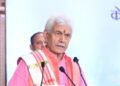


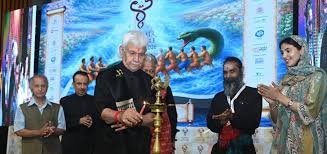
Srinagar, May 30, 2026 : Lieutenant Governor Manoj Sinha on Saturday inaugurated the third edition of the Kashmir Literature Festival in Srinagar and called upon writers, intellectuals and creative thinkers to play a transformative role in shaping positive discourse and presenting India’s true historical and cultural narrative to the world.

Addressing a gathering of writers, scholars, artists and literature enthusiasts, the Lieutenant Governor said that authors have a unique responsibility to inspire society through fiction, non-fiction and other creative forms, emphasizing that a writer’s influence extends beyond words and resonates in the lives of people.
“Writer’s craft lives not only in words, but in the pulse of people,” he said.
The Lieutenant Governor stressed the need to erase every trace of the colonial mindset and prevent distortions of India’s history by external narratives.
“We must ensure that people abroad do not distort our history and present to serve their own narratives. It is the responsibility of writers to correct such errors and take the truth to global readers,” he said.
Highlighting India’s ancient civilizational achievements, Sinha said that the country had been a global centre of economy, education, culture and philosophy since ancient times.
“We must repeatedly remind the world that when the Vedas were composed some 6,000 years ago, India was the centre of the world’s economy, education, culture and philosophy. For centuries, India was the engine of global civilization and culture,” he said.
The Lieutenant Governor noted that India’s contributions in science, mathematics, astronomy and medicine laid the foundation for socio-economic advancement across large parts of the world.
He observed that there is an urgent need to restore historical narratives and communicate them accurately to every section of society so that India’s story is presented in its true form.
According to Sinha, India’s ancestors carefully documented knowledge and facts from the Vedic age, but over time the nation lost the habit of writing and preserving its own history.
“We failed to communicate our priceless traditions, culture, knowledge and sciences, which allowed misconceptions to grow and led some people to wrongly claim that many achievements originated elsewhere or were introduced by invaders,” he said.
The Lieutenant Governor described such assertions as baseless and argued that foreign historians had, at times, overlooked or omitted India’s ancient contributions in fields such as science, literature, art and architecture.
“When India stood at the peak of scientific achievement, many countries showed almost no mention of science. Centuries before many nations discovered innovations, India had already established itself as a scientific civilization,” he remarked.
Sinha further stated that Europe’s early renaissance movements and scientific developments drew inspiration from India’s vast reservoir of knowledge, culture and intellectual traditions.
Calling upon contemporary writers to make India’s rich legacy accessible to wider audiences, he urged them to present the achievements of the nation’s great thinkers, scientists and innovators in simple and engaging language.
The Lieutenant Governor also underlined that India’s story is not confined to its past achievements but is equally reflected in its present-day progress.
“Despite centuries of subjugation and plunder, India has emerged as the world’s fourth-largest economy and one of the fastest-growing major economies. By 2047, we aspire to become a fully developed nation,” he said.
He observed that a renewed sense of pride and ownership in India’s civilizational heritage is emerging across society and called upon writers and thinkers to help build a new national narrative rooted in historical truth, cultural confidence and intellectual strength.
“The task is not self-praise, but for respected writers and thinkers to build India’s new narrative on this strong foundation. Writers have the power to change civilizations,” the Lieutenant Governor said.
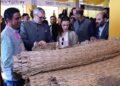
The Kashmir Literature Festival brings together authors, scholars, academics and cultural figures from different parts of the country, providing a platform for discussions on literature, history, culture, society and contemporary issues.