


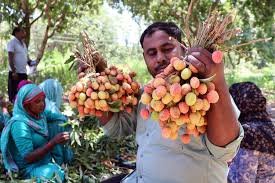
Jammu, June 2, 2026 : Litchi cultivation is rapidly emerging as a profitable horticulture venture in the Jammu region, with an increasing number of farmers adopting High-Density Plantation (HDP) techniques to improve productivity and earnings. Encouraged by government support and attractive returns, growers are earning between ₹24,000 and ₹30,000 annually from a single kanal of land, officials said on Tuesday.
The Jammu and Kashmir administration has set an ambitious target of converting more than 3,200 kanals of conventional litchi orchards into high-density plantations over the coming years, aiming to enhance fruit production, improve land-use efficiency, and strengthen farmers’ livelihoods.
Director Horticulture Jammu Gul Syed said the HDP programme has generated considerable interest among farmers due to its economic benefits and the increasing market demand for litchi.
“Farmers in the region are increasingly turning to litchi cultivation under the HDP programme. A farmer can earn around ₹24,000 to ₹30,000 annually from a kanal of land. Besides profitability, litchi also offers significant nutritional value,” he said.
Officials noted that several farmers have already established extensive litchi orchards in areas surrounding Jammu city, contributing to the expansion of the horticulture sector in the region.
To encourage greater adoption, the Horticulture Department is extending financial assistance and technical support under various government schemes. Farmers opting for high-density plantation methods are eligible for subsidies of up to 50 percent, making the transition more affordable and attractive.
Syed said the administration remains committed to supporting growers not only in cultivation but also in the marketing of litchi and other horticultural produce. He added that Lieutenant Governor Manoj Sinha has appreciated the efforts of progressive farmers who are motivating small and marginal cultivators to diversify into high-value horticulture crops.
The Director emphasized that successful litchi cultivation requires reliable irrigation facilities and adequate water availability. Areas such as Marh and RS Pura, where irrigation infrastructure is well established, are witnessing substantial growth in litchi plantations.
Apart from its commercial value, litchi is gaining popularity due to its nutritional benefits. The fruit is rich in vitamin C, carbohydrates, natural sugars, potassium, antioxidants, and essential micronutrients, making it a healthy addition to consumers’ diets.
“A single litchi fruit can provide nearly nine percent of the recommended daily allowance of vitamin C,” Syed noted.
To further improve production and orchard management, the department is providing quality planting material, technical guidance, and promoting modern cultivation practices such as micro-irrigation systems and scientific orchard management techniques.
Regular training programmes are also being organized to educate farmers on high-density plantation methods, pruning, canopy management, and scientific cultivation practices aimed at maximizing productivity and profitability.
According to officials, the growing adoption of litchi cultivation reflects a broader shift towards diversified and high-value agriculture in Jammu and Kashmir. The initiative is expected to strengthen the horticulture sector, create sustainable income opportunities for farmers, and contribute significantly to rural economic development.
The department has encouraged more growers to take advantage of available schemes and embrace modern horticultural practices to increase productivity and secure better returns from their land.