


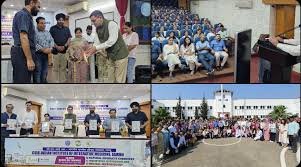
Jammu, June 18, 2026 : In a significant initiative aimed at bridging the gap between academic learning and real-world scientific research, the CSIR–Indian Institute of Integrative Medicine (IIIM), Jammu, through its Technology Business Incubator (IIIM-TBI) and BioNEST Bioincubation Centre, on Thursday launched the 10-day hands-on training programme “Yuva Kaushal Karyashala 5.0” in Chemical Sciences.

The workshop has brought together 42 students from Government College for Women (GCW), Gandhi Nagar, Jammu, along with participants from other educational institutions, providing them direct exposure to advanced laboratory techniques, scientific research methodologies and innovation-driven ecosystems.
A specially prepared training manual for the programme was also formally released during the inaugural session.
Building Scientific Temperament Among Youth
Addressing the participants, Director, CSIR-IIIM Jammu, Dr. Zabeer Ahmed, underscored the importance of scientific thinking and practical exposure in shaping future professionals.
He said science today extends far beyond textbooks and classrooms, influencing every aspect of modern life and development.
“Science is no longer confined to academic classifications. It has become a way of life that impacts every sector. Students must develop a scientific temperament and research-oriented mindset irrespective of the career path they choose,” he said.
Dr. Ahmed highlighted the immense scientific and intellectual potential of Jammu and Kashmir, pointing to the presence of premier institutions such as IITs, IIMs, Central Universities and national research laboratories that offer vast opportunities to aspiring researchers.
He noted that programmes like Yuva Kaushal Karyashala are designed to connect young minds with scientific innovation and research at an early stage.
Showcasing Indigenous Drug Discovery Success
Sharing an example of research excellence at CSIR-IIIM, Dr. Ahmed spoke about the institute’s ongoing work in medicinal chemistry and drug discovery.
He revealed that scientists at the institute successfully modified a naturally derived molecule that initially exhibited strong anti-cancer properties but had toxicity-related challenges. Through extensive chemical research and structural modification, researchers enhanced the molecule’s safety profile while preserving its therapeutic effectiveness.
According to him, the candidate molecule has successfully progressed through pre-clinical evaluation and has received regulatory approval to advance into clinical stages, marking a major achievement in indigenous drug development.
Beyond Classroom Education
Welcoming the participants, Senior Principal Scientist and Principal Investigator, IIIM-TBI, Dr. Saurabh Saran, said the workshop has been carefully designed to provide exposure beyond conventional theoretical education.
He explained that the programme integrates laboratory training with sessions on entrepreneurship, innovation and startup development, enabling students to understand both scientific processes and pathways for converting innovative ideas into successful ventures.
Dr. Saran also informed participants that promising ideas emerging during the workshop could receive incubation support through IIIM-TBI and BioNEST facilities.
Extensive Hands-On Laboratory Training
Providing an overview of the technical sessions, Senior Principal Scientist, NPMC Division, Dr. Showkat Rashid, described the workshop as a unique platform that combines expert lectures with practical laboratory-based learning.
Participants will receive hands-on training in:
- Natural Products Chemistry
- Synthetic Organic Chemistry
- Analytical Sciences
- Laboratory Safety Protocols
- Drug Discovery Techniques
- Isolation and Characterisation Methods
- Medicinal Chemistry
- Computer-Aided Drug Design
Students will also gain practical experience in conducting chemical reactions, chromatography, purification methods, sample preparation and operating advanced analytical instruments available at the institute.
Encouraging Careers in Research
Speaking on the broader significance of chemistry education, Senior Principal Scientist, NPMC Division, Dr. Qazi Naveed Ahmed, stressed the need to create greater awareness among students about career opportunities in scientific research.
He observed that many students pursue science degrees without fully understanding the scope and impact of research careers.
“The objective of programmes like Yuva Kaushal Karyashala is to encourage students to view scientific research as an aspirational and meaningful profession that contributes directly to society and national development,” he said.
Dr. Qazi also highlighted CSIR-IIIM’s contributions to chemical and pharmaceutical sciences and its continued efforts to create opportunities for young researchers.
Collaborative Learning Environment
The inaugural session witnessed participation from faculty members, scientists, research scholars and officials of CSIR-IIIM, reflecting the institute’s commitment to fostering a collaborative scientific environment.
The programme concluded with a formal vote of thanks by Dr. Vidushi Abrol, Business Manager, IIIM-TBI, who appreciated the support of the institute leadership, organising team and participating students. She expressed confidence that the workshop would serve as a transformative learning experience for the young participants.