

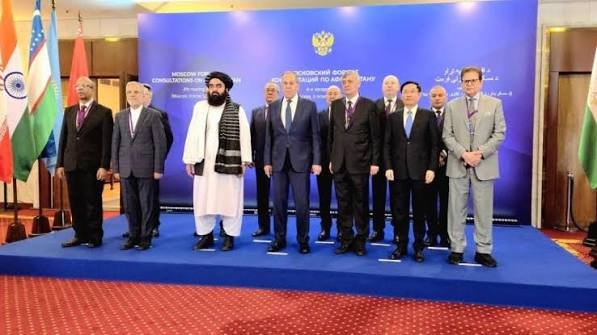
MOSCOW , OCTOBER 06, 2026 : The eighth Moscow Format regional consultations on Afghanistan ended without a joint statement, with disagreements between the Pakistani and Afghan delegations reportedly preventing consensus on the final document.

Russian presidential envoy for Afghanistan Zamir Kabulov said Moscow regretted that participants were unable to agree on the statement, according to a media report.
Dispute Over Terrorism Language
Kabulov said the main difficulty emerged during negotiations over the wording of the final document, with the Pakistani and Afghan sides unable to reach agreement.
The disagreement centred particularly on references to terrorism and counterterrorism, with Kabul reportedly objecting to language that placed Afghanistan in a terrorist context.
The failure to produce a joint statement highlighted the continuing tensions between Islamabad and Kabul and their impact on broader regional diplomatic efforts concerning Afghanistan.
Major Regional Powers Take Part
The Moscow Format meeting brought together special envoys and senior officials from Afghanistan, China, India, Iran, Kazakhstan, Kyrgyzstan, Pakistan, Russia, Tajikistan and Uzbekistan.
Belarus and Egypt participated as guest countries.
Established in 2017, the Moscow Format has become one of the principal regional diplomatic mechanisms focused on Afghanistan, with discussions generally centred on security, political stability, counterterrorism and regional cooperation.
Pakistan Raises Terrorism Concerns
Pakistan’s special envoy for Afghanistan, Mohammad Sadiq, told the meeting that Islamabad remained committed to regional peace and stability and had pursued political and diplomatic engagement with the Taliban leadership.
He also accused the Taliban authorities of allowing terrorism emanating from Afghan territory to increase, alleging that Pakistan’s diplomatic efforts and goodwill gestures had been met with increased militant attacks.
Pakistan has repeatedly made security concerns and cross-border militancy a major issue in its relations with Kabul.
Afghan Taliban Rejects Pakistan’s Position
Afghan Taliban Foreign Minister Amir Khan Muttaqi criticised Pakistan’s statements and actions towards Afghanistan.
Muttaqi accused Islamabad of using military pressure, refugees, students and transit routes as instruments of leverage.
At the same time, he said the problems between the neighbouring countries could be resolved through dialogue and diplomacy.
Russia Offers to Help De-escalate
Russia offered to assist Pakistan and Afghanistan in reducing tensions, although Kabulov stressed that resolving bilateral disputes was not itself the primary purpose of the Moscow Format.
He said Russia was prepared to help if both sides requested such assistance, either independently or together with other regional partners.
Lavrov Backs Taliban Authorities
Russian Foreign Minister Sergey Lavrov, who opened the meeting, expressed support for assistance to Kabul and praised the performance of the Taliban authorities.
Lavrov also warned against attempts by NATO to establish military infrastructure in Afghanistan or neighbouring countries.
He argued that strengthening Afghanistan’s counterterrorism capabilities would serve the interests of the wider region.
Regional Diplomatic Challenge
The absence of a joint statement represents a setback for consensus-building within the Moscow Format, particularly as relations between Pakistan and Afghanistan remain strained.
The forum’s stated objective remains to promote national reconciliation in Afghanistan and support the establishment of peace and stability, while encouraging regional engagement on the country’s political and security challenges.