

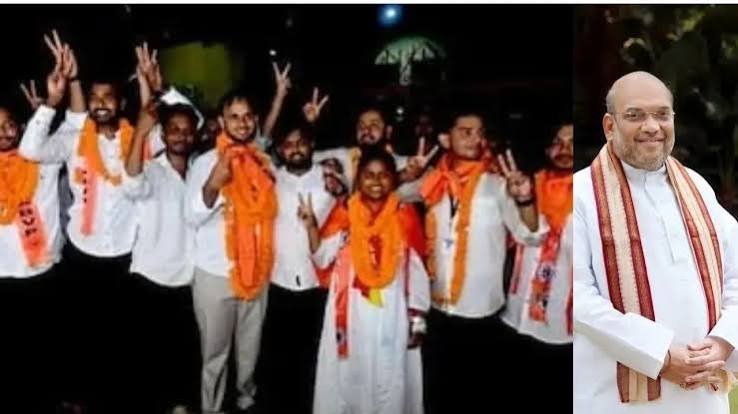
BHUBANESWAR, OCTOBER 17, 2026 : Union Home Minister and senior BJP leader Amit Shah on Saturday congratulated the Akhil Bharatiya Vidyarthi Parishad (ABVP) on its performance in Odisha’s student union elections, describing the results as a “stern response to anti-national forces” and saying they reflected young voters’ support for the “Nation First” ideology.

The elections were held on October 15, with the RSS-affiliated student organisation securing victories in eight of Odisha’s 13 state universities, according to the report. ABVP also claimed wins across several colleges in the state.
Amit Shah Says Results Reflect ‘Nation First’ Ideology
In a post on X, Shah congratulated ABVP office-bearers on what he described as a resounding victory.
He referred to the organisation’s reported successes at Panjab University, Delhi University and in Odisha, arguing that the results demonstrated support among young people for the “Nation First” approach.
Shah said the outcome was a stern response to forces that, in his view, spread falsehoods, confusion and chaos. His remarks appeared to refer to the ongoing agitation against the Special Intensive Revision (SIR) of electoral rolls.
ABVP Reports Strong Performance Across Universities
According to figures cited by the Odisha ABVP unit, the organisation won in eight of the state’s 13 universities.
ABVP claimed victories in the following university-level posts:
- Eight president positions.
- Eight vice-president positions.
- Ten secretary positions.
- Eleven assistant general secretary positions.
ABVP state secretary Diptimayee Pratihari said the organisation won the entire panel at Utkal University. She also claimed that ABVP won all positions except the president’s post at Ravenshaw University.
These figures reflect ABVP’s own account of its performance.
BJD and Congress-Backed Candidates Also Win Posts
Although student union elections in Odisha are not formally conducted along party lines, political parties support candidates through their student organisations.
The ruling BJP backed ABVP candidates, while the opposition Biju Janata Dal (BJD) supported candidates from the Biju Chhatra Janata Dal (BCJD). Congress-backed candidates contested under the National Students’ Union of India (NSUI).
According to the report, BCJD candidates won the presidents’ posts in five universities and the general secretary’s position in one university. NSUI secured one university-level general secretary position.
BCJD president Ipsita Sahoo, meanwhile, claimed that BJD-backed candidates had won approximately 55 to 60 per cent of college union elections across Odisha, including at prominent institutions such as Rama Devi Women’s University and Ravenshaw University.
She also said BJD-supported candidates performed strongly in women’s colleges across the state.
Competing Claims Highlight a Closely Contested Student Election
The statements from ABVP and BCJD present differing assessments of the overall outcome, particularly regarding college-level contests.
ABVP highlighted its university-level victories and the number of office-bearer positions it secured. BCJD, on the other hand, emphasised its claimed performance across college unions and women’s institutions.
The results underline the continuing role of student organisations associated with major political parties in campus politics, even though the elections are not formally conducted as party elections.
Political Significance Beyond Campus
Shah’s remarks give the ABVP results a broader political interpretation, presenting them as evidence of youth support for the BJP-aligned “Nation First” message.
However, the election figures alone do not establish the political preferences of all young voters in Odisha. The competing claims by ABVP and BCJD also indicate that the overall outcome depends on whether university-level positions or college-level results are considered.