

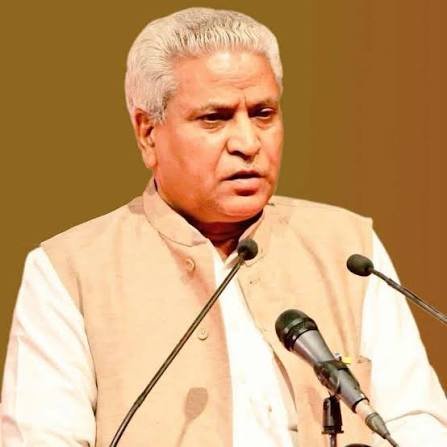
SRINAGAR, October 21, 2026 : Senior Rashtriya Swayamsevak Sangh (RSS) functionary Ramlal on Wednesday strongly criticised Congress leader and Lok Sabha Leader of Opposition Rahul Gandhi over his recent remarks describing the Sangh as an “all-male anti-constitutional cult,” calling the allegation a manufactured falsehood and asserting that the organisation commands growing public trust.

Speaking to reporters in Srinagar, Ramlal defended the RSS’s approach towards women and challenged political leaders who, he said, make claims about the organisation without understanding its activities firsthand.
His comments came a day after Gandhi made the remarks in a post on X on the occasion of the RSS’s foundation day, triggering a fresh political exchange between the Congress and the organisation.
RAMLAL ACCUSES OPPOSITION OF SPREADING FALSE NARRATIVES
Ramlal said the RSS generally refrains from commenting on political matters or individual political leaders but felt compelled to respond because, in his view, misleading claims about the organisation had continued for years.
He alleged that when previous accusations lose credibility, new allegations emerge.
The RSS functionary argued that political leaders who rely on such narratives risk losing public confidence rather than expanding their support.
“Public support does not grow on falsehoods; public support grows on truth,” Ramlal said, emphasising that people should examine the organisation directly before forming an opinion about it.
He also referred to RSS chief Mohan Bhagwat’s position that people should visit and understand the Sangh before making judgements about its functioning.
WOMEN’S ROLE IN RSS AT CENTRE OF POLITICAL DEBATE
Responding to Gandhi’s criticism, Ramlal asserted that the RSS treats women with respect and said women participate in various programmes associated with the organisation.
He pointed to women attending events as speakers and presiding over programmes as chief guests, arguing that such participation contradicted the characterisation made by the Congress leader.
Gandhi, in his October 20 post on X, had described the RSS as an organisation that believes women are the property of men. He also said that many women associated with the Sangh were on his side.
Ramlal rejected Gandhi’s assessment and broadened his response by asserting that respect for women was deeply rooted in Indian society and culture.
The exchange has brought questions about gender, organisational participation and competing political narratives into focus, with both sides presenting sharply contrasting views.
RSS LEADER POINTS TO RECEPTION DURING KASHMIR VISIT
Ramlal, who was visiting Kashmir as the chief guest at a function organised by the Jammu and Kashmir Democratic Foundation, cited the atmosphere at his public engagement as an example of how direct interaction can challenge perceptions formed from a distance.
He said the event proceeded smoothly, with people listening to speeches and engaging with one another despite differences in political or ideological outlook.
Drawing a parallel between perceptions of the RSS and those of Jammu and Kashmir, Ramlal argued that outsiders sometimes develop conclusions without adequately understanding ground realities.
He maintained that people should engage directly with communities and organisations before reaching firm judgements.
WARNS AGAINST DIVISIVE POLITICS AND SOCIAL CONFLICT
Commenting on RSS chief Mohan Bhagwat’s warning that protests could be used to advance political interests and deepen social divisions, Ramlal said peace was essential for India’s continued development.
He alleged that certain forces benefited from ongoing conflict and sought to destabilise a country making economic and social progress. He did not identify any specific group in his remarks.
The RSS functionary urged citizens to remain vigilant against attempts to create instability and called for greater unity across social and regional differences.
He stressed that India’s diversity of caste, class, language and region should be viewed as a source of strength rather than a reason for division.
“Accepting everyone, respecting everyone, tolerating everyone—this is what India stands for,” he said.
JAMMU AND KASHMIR CAN SEND A MESSAGE OF PEACE
Ramlal said Jammu and Kashmir could play an important role in promoting a positive message of coexistence and national unity.
He argued that development must extend to every region and expressed the view that the Union Territory could demonstrate how communities with different traditions and backgrounds can live together peacefully.
Referring to Kashmir’s cultural history, he described the region as having a rich heritage shaped by both Sanatani and Sufi traditions.
He said communities had historically lived and worked together in harmony, while acknowledging that a period of terrorism and violence had disrupted that coexistence.
Ramlal expressed hope that people in the Valley would continue to choose peace, arguing that violence and terrorism could not deliver lasting tranquillity, development or security.
He also urged residents not to be influenced by outside forces that could undermine peace and stability.
CALL FOR CAUTION OVER MOSQUE EVICTION NOTICE
Asked about an eviction notice involving a historic mosque in Delhi, Ramlal said development and infrastructure projects should not be viewed exclusively through a religious lens.
He observed that infrastructure work can sometimes affect religious structures belonging to different communities, including temples, gurdwaras and mosques.
However, he emphasised that authorities should handle such situations with utmost caution and through mutual dialogue.
His remarks highlighted the need to balance infrastructure development with sensitivity towards religious institutions and the concerns of affected communities.
A WIDER DEBATE OVER POLITICS, IDENTITY AND NATIONAL UNITY
Ramlal’s comments have added another dimension to the political exchange following Rahul Gandhi’s criticism of the RSS. The dispute centres on sharply differing assessments of the organisation’s ideology, its approach towards women and its place in India’s political and social landscape.
While Gandhi’s remarks challenged the RSS’s organisational character, Ramlal defended the Sangh and urged critics to examine its work firsthand.
Beyond the political confrontation, the RSS leader also used his Kashmir visit to emphasise peace, cultural coexistence, mutual respect and inclusive development.
The exchange underscores continuing political disagreements over ideology and social values, while Ramlal’s broader message calls for national unity, peaceful coexistence and greater understanding across India’s diverse communities.