

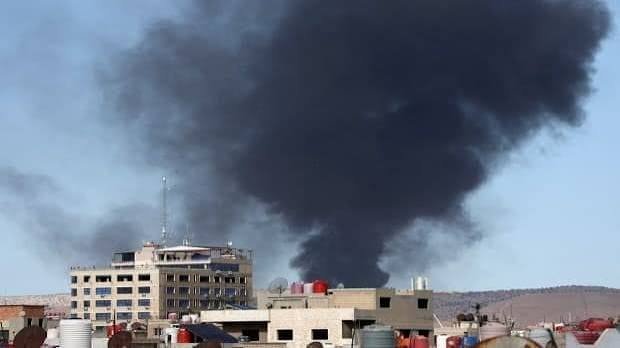
AL-TUFF, SYRIA | October 27, 2026 : A devastating cross-border military operation has left families grieving in southern Syria after Jordan acknowledged that civilians were killed in airstrikes intended to target Islamic State (IS) extremists.

Jordan says its air force killed approximately 20 militants in the strikes conducted on Monday evening. However, the admission of civilian casualties has intensified concerns over the human cost of military retaliation, the protection of innocent lives and the fragile security situation along the Jordanian-Syrian border.
Behind the competing accounts and official statements lies a heartbreaking reality: ordinary families have been caught in the violence.
💔 A Family Lost Beneath the Rubble
Among the most distressing accounts is that of Masoud al-Salim, a resident of the Syrian border village of Al-Tuff in Daraa province.
According to the report, he lost his wife, son and three grandchildren in one of the airstrikes that hit his home.
Describing the scene he encountered, al-Salim recalled rushing back to find his home destroyed.
“I came running and found there was no house anymore, no tent, nothing. I couldn’t find anyone,” he said.
He searched through the debris, looking for his loved ones and hoping they might have survived beneath the rubble.
The children’s schoolbooks and toys scattered among the wreckage offered a painful reminder of the lives and futures lost.
His account illustrates the devastating consequences that military operations can have for families living in areas where security threats and civilian life overlap.
⚠️ Jordan Says Strikes Targeted Islamic State Militants
Jordanian government spokesperson Mohammad al-Momani said the airstrikes were based on intelligence indicating confirmed threats and planned terrorist attacks against Jordan.
The operation followed a deadly attack the previous week at a funeral held at a Greek Orthodox church in Karak, a city in southern Jordan. Nine people were killed in that attack.
Jordanian authorities announced earlier on Monday that three suspected gunmen had been arrested, although their affiliation was not disclosed in the announcement described in the report.
Jordan subsequently launched the strikes inside Syrian territory, saying the operation targeted Islamic State militants responsible for security threats.
Al-Momani expressed regret over the civilian deaths, acknowledging the tragic consequences of the attacks even as Jordan defended the operation on security grounds.
🕯️ Syrian Authorities Report Civilian Casualties
The figures released by Jordan differ from those provided by Syrian emergency responders.
According to Syria’s Civil Defence, responders recovered the bodies of seven civilians killed in the strikes in the southern provinces of Daraa and Sweida.
The reported victims included five members of one family, among them three children and a woman. Two other victims were elderly men.
Jordan’s estimate of approximately 20 militants killed and Syria’s account of seven civilian deaths describe different categories of casualties. The full circumstances, total toll and details of the affected locations were not independently established in the supplied report.
The discrepancy underscores the importance of transparent investigations and reliable casualty assessments following military operations.
🇸🇾 Syria Condemns Violation of Its Airspace
Syria’s government said the strikes were conducted without prior coordination or notification.
In a statement, the Syrian Foreign Ministry condemned the operation as an “unacceptable violation and encroachment” of Syrian airspace.
At the same time, Damascus indicated that both governments would continue security coordination to prevent attempts to destabilise the two countries and endanger their populations.
Both Jordan and Syria said they were communicating and following up on the incident.
The episode presents a difficult challenge for two neighbours that have maintained strong bilateral relations since the fall of the Assad dynasty in December 2024 and the emergence of interim President Ahmad al-Sharaa’s Islamist-led government.
🌐 The Difficult Balance Between Counterterrorism and Civilian Protection
The airstrikes raise several important questions:
- Civilian protection: What measures were taken to minimise the risk to families living in the targeted areas?
- Accountability: Will the deaths and damage be investigated transparently?
- Regional coordination: Could closer communication between Amman and Damascus help prevent further civilian harm?
- Security and stability: How can governments confront extremist threats without exposing innocent people to disproportionate danger?
States have legitimate security concerns when facing terrorist threats. But protecting civilians remains a fundamental obligation, and military operations must comply with applicable international humanitarian law.
Acknowledging civilian deaths is an important step. Establishing what happened, assessing responsibility and providing appropriate remedies where warranted are also essential.
🕊️ Innocent Lives Must Never Become Footnotes
For governments, the language of military operations often revolves around targets, intelligence and strategic objectives.
For grieving families, the reality is far more personal: a missing child, a destroyed home, a family photograph buried in rubble or a toy that no one will ever pick up again.
The suffering of Syrian civilians must not be overlooked amid competing security claims. Nor should the grief of Jordanian families affected by the earlier deadly attack be forgotten.
Condemning terrorism and demanding accountability for civilian harm are not contradictory positions. Both reflect the same fundamental principle: human life has value, regardless of nationality, religion or political circumstance.
The path forward must combine credible security measures, transparent investigations, stronger regional coordination and meaningful protection for civilians.
🕯️ May the victims rest in peace, may grieving families receive support, and may diplomacy prevent further bloodshed.