

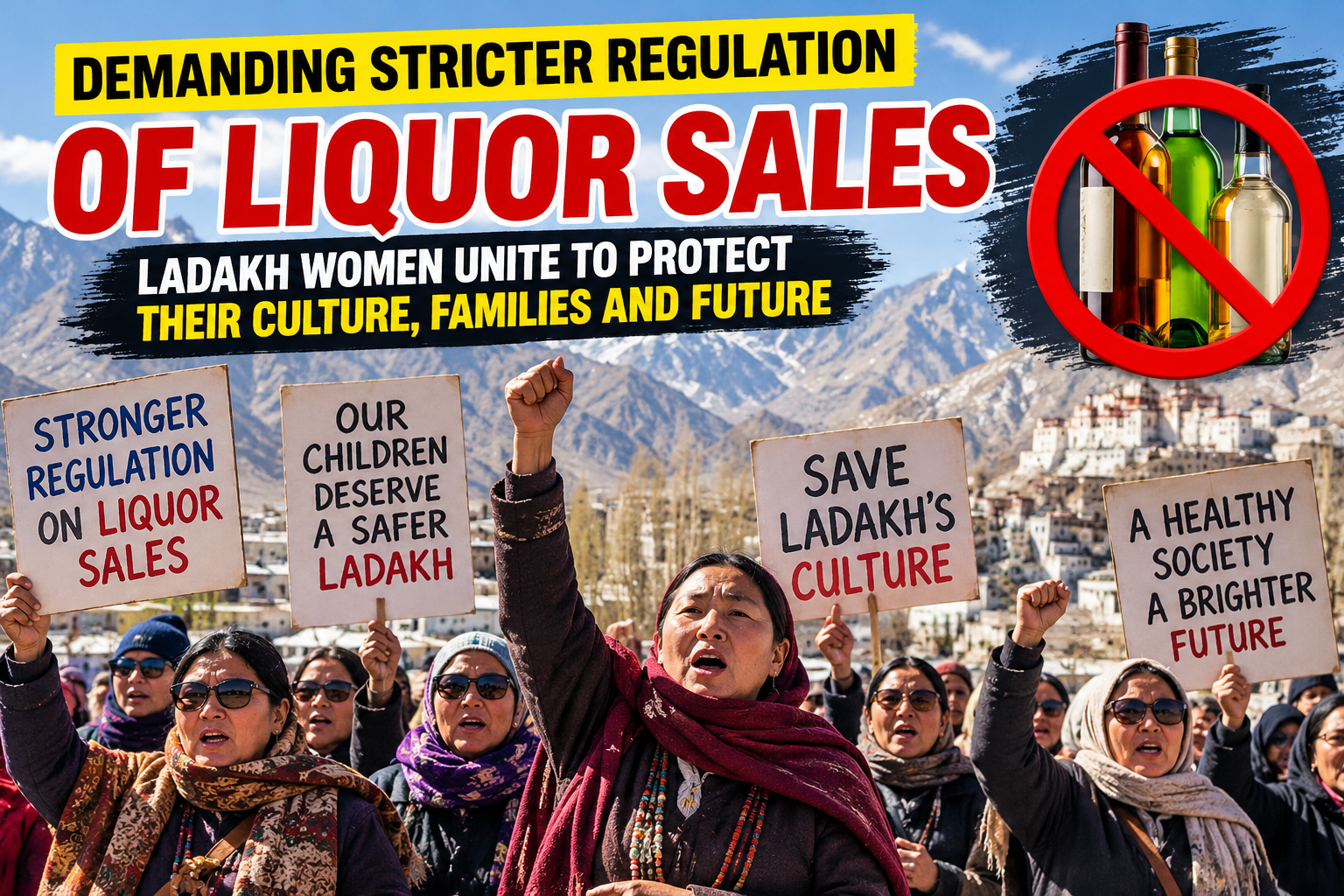
Leh, Ladakh | October 30, 2026 : In a significant development in Ladakh’s ongoing debate over liquor sales and the region’s social and cultural values, religious women’s organisations in Leh have agreed to temporarily suspend their protest for one week after the Union Territory Administration gave an assurance that it had, in principle, accepted their recommendations on the liquor policy.

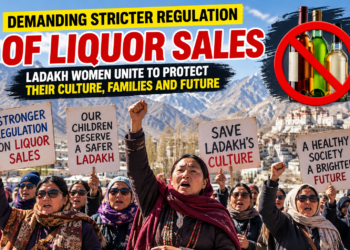
The decision follows days of demonstrations by women from different religious communities, who have demanded stricter regulation of liquor sales and greater consideration of Ladakh’s cultural sensitivities in the formulation and implementation of excise policy.
According to a statement issued by the protesters, the administration has sought one week to finalise the agreement, complete the necessary formalities and issue a comprehensive written document.
✊ ONE-WEEK PAUSE, NOT AN END TO THE MOVEMENT
The women’s organisations have agreed to suspend their dharna from October 29 to November 5, 2026, following assurances conveyed by the Home Department.
The protesters said the administration had agreed, in principle, to the recommendations contained in the “proposed interim consensus” submitted by the religious women’s organisations.
Their statement declared:
“The Administration of the Union Territory of Ladakh has agreed, in principle, to all the points and recommendations put forward by the Religious Women’s Organisations of Ladakh on the UT’s liquor policy.”
The one-week period is intended to allow the administration to formalise the understanding and document the agreed points.
However, the women have made it clear that the temporary suspension should not be interpreted as the conclusion of their campaign. They expect the administration to fulfil its commitments and provide the promised written agreement.
👩👩👧 WOMEN FROM DIFFERENT RELIGIOUS COMMUNITIES UNITED IN PROTEST
The agitation has brought together women from different religious communities in Leh, making it a prominent public campaign concerning liquor sales and social policy in the Union Territory.
The protesters have called for stricter regulation of liquor outlets and a policy that takes account of Ladakh’s social environment, religious values and cultural traditions.
Their demonstrations have drawn attention to the role of women’s organisations and civil society in raising concerns about policies they believe could affect families and communities.
The reported assurance from the administration represents an important step in the ongoing discussions, although the final written agreement remains pending.
🏛️ ADMINISTRATION SEEKS TIME TO FORMALISE THE AGREEMENT
According to the protesters’ statement, the Home Department conveyed the administration’s in-principle acceptance of their recommendations.
The administration has requested one week to complete the formalities and prepare a comprehensive written document.
The next stage will therefore be crucial: the assurances communicated during the negotiations will need to be reflected in a formal document that clearly records the agreed measures.
For the protesting organisations, written confirmation is central to ensuring that the understanding reached with the administration translates into concrete policy action.
⚖️ LIQUOR POLICY ROW: ADMINISTRATION AND SONAM WANGCHUK AT ODDS
The latest development comes amid a wider dispute between the Ladakh Administration and activist Sonam Wangchuk over the region’s liquor policy.
On Wednesday, the administration rejected Wangchuk’s allegation that it was “pushing alcohol in Ladakh.” It maintained that only one liquor shop was operational in the Union Territory and described his claims as “false” and “baseless.”
Wangchuk, in response, argued that sustained opposition from civil society and the women’s week-long protest had forced the administration to roll back what he described as its “infamous liquor policy.”
He questioned why hundreds of mothers would have spent six nights protesting in sub-zero temperatures if there had been no genuine public concern.
Wangchuk also alleged that although liquor shops had been withdrawn, several alcohol bars had been introduced in the region.
These assertions remain part of the public dispute, with the administration maintaining its own position on the policy and the extent of its rollback.
📅 ADMINISTRATION SAYS POLICY WAS ROLLED BACK ON AUGUST 26
The administration has maintained that the excise policy was already rolled back on August 26, 2026, in deference to public sentiment.
This position differs from Wangchuk’s criticism and the concerns raised by the protesting women’s organisations.
The current negotiations have therefore brought renewed focus to the exact scope of the policy changes, the regulation of liquor outlets and bars, and the need for clarity about the administration’s commitments.
The promised written document may prove important in clarifying the agreed recommendations and the steps expected from the administration.
🔎 WHAT HAPPENS NEXT?
The coming week will be important for both sides.
🔹 Formal documentation: The administration has sought time to issue a comprehensive written agreement.
🔹 Implementation of recommendations: The women’s organisations expect the administration to honour its in-principle acceptance.
🔹 Monitoring commitments: The temporary suspension of the protest does not mean the movement has ended.
🔹 Clarity on liquor policy: The dispute over liquor shops, bars and the claimed rollback remains a central issue.
The outcome will depend on whether the administration’s assurances are translated into a formal and satisfactory agreement.
🕊️ A SIGNIFICANT MOMENT FOR CIVIL SOCIETY IN LADAKH
The temporary suspension of the protest marks a potentially important moment in the engagement between Ladakh’s religious women’s organisations and the Union Territory Administration.
The women have agreed to give the authorities additional time, but their statement makes clear that their campaign remains contingent on the fulfilment of commitments.
The episode also highlights the importance of transparent communication, public consultation and written assurances when governments address sensitive social and cultural issues.
For the protesting women, the next milestone is not simply the end of a dharna — it is the delivery of a clear, formal agreement that reflects the recommendations they have placed before the administration.