

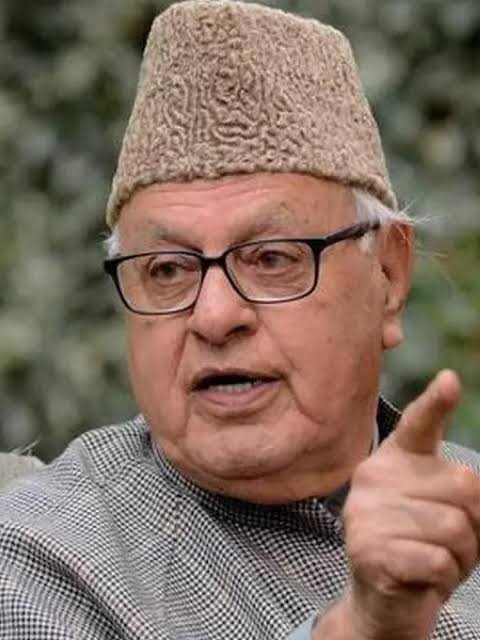
SRINAGAR, NOVEMBER 20, 2026 : Jammu and Kashmir National Conference (NC) President Dr Farooq Abdullah has said that the government led by Chief Minister Omar Abdullah is implementing a planned five-year roadmap aimed at promoting development, prosperity and regional harmony across Jammu and Kashmir.

Addressing party leaders and office-bearers at his residence in Jammu, Farooq Abdullah said the National Conference government had formulated a development strategy after assuming office in October 2024. He maintained that development activities were being undertaken across the Union Territory, although several key issues, including rationalisation of reservations and regularisation of daily wagers, remained unresolved.
According to the NC president, the existing Union Territory administrative arrangement had constrained progress on certain matters, while the government continued to pursue its broader development agenda.
Farooq Abdullah Accuses BJP of Neglecting Jammu
Launching a sharp attack on the Bharatiya Janata Party (BJP), Farooq Abdullah alleged that the party had exploited the people of Jammu by seeking votes in the name of religion while failing to deliver substantial development.
He accused the BJP of pursuing divisive political strategies and urged people to assess its record in the region. Referring to the period from 2014 to 2024, he cited concerns over road infrastructure, electricity and water supply, unemployment, toll plazas, outsourcing of jobs and mining activities as examples of what he described as the BJP’s neglect of local interests.
He further alleged that the Pir Panjal and Chenab Valley regions had faced discriminatory treatment.
These remarks reflect the National Conference’s political criticism of the BJP and its assessment of development in Jammu and Kashmir during the period under discussion.
Darbar Move Restoration Highlighted as a Major Step
Farooq Abdullah also highlighted the restoration of the Darbar Move, saying the Omar Abdullah government had revived the traditional practice soon after taking office.
The Darbar Move involves the seasonal shifting of the civil secretariat and other government offices between Srinagar and Jammu. The tradition has long been associated with administrative links between the two regions and economic activity in Jammu during the winter months.
Describing it as an important symbol of Jammu and Kashmir’s shared cultural identity, Farooq Abdullah said the practice helped strengthen trade, community relations and understanding between the regions.
He maintained that the tradition was intended to promote unity in diversity and bring the people of Jammu and Kashmir closer together.
Focus on Regional Balance and Social Harmony
The NC president said his party’s government would continue working to reduce regional and communal divisions while promoting equitable development.
He emphasised that the government’s priorities extended beyond infrastructure and economic growth to include stronger social bonds and greater cooperation among communities.
Farooq Abdullah said that, under Chief Minister Omar Abdullah’s leadership, comprehensive development was being pursued across Jammu, including the Pir Panjal and Chenab Valley areas.
Unresolved Issues Remain a Challenge
While highlighting the government’s development agenda, Farooq Abdullah acknowledged that important public concerns remained unresolved. These include the rationalisation of reservation policies and the regularisation of daily-wage workers.
Both issues have significant implications for employment opportunities, public-sector workers and social equity in Jammu and Kashmir. Their resolution remains an important concern for affected communities.
Political Debate Over J&K’s Development Continues
Farooq Abdullah’s remarks underscore the continuing political contest between the National Conference and the BJP over development, governance and regional representation in Jammu and Kashmir.
While the NC leadership has presented its five-year roadmap as a path towards balanced growth and unity, its allegations against the BJP remain political claims that must be assessed alongside verifiable development data and the record of successive governments.
The debate is likely to remain central to the region’s political discourse as the Omar Abdullah government works to address infrastructure needs, employment concerns and longstanding demands for equitable development.