

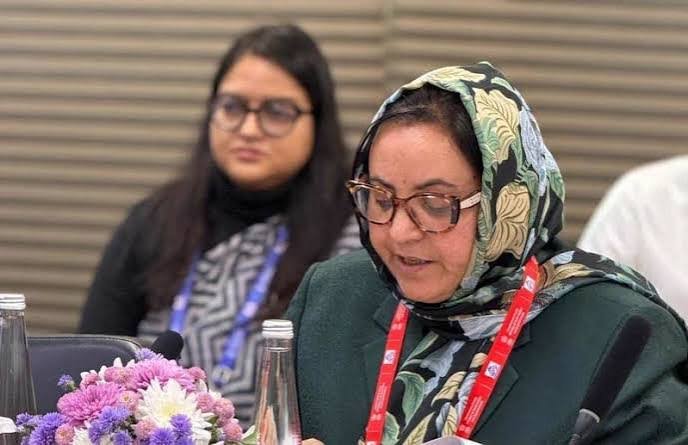
JAMMU, NOVEMBER 20, 2026 : Jammu and Kashmir Minister for Health and Medical Education and Social Welfare, Sakeena Itoo, has called for a comprehensive, measurable and results-oriented strategy to combat drug abuse, stressing that the fight against substance addiction must move beyond awareness campaigns towards coordinated prevention, treatment, rehabilitation and sustained recovery.

Addressing the second day of the National Social Justice Summit, Samaveshi Niti Sankalp, at Sushma Swaraj Bhawan, the minister advocated an integrated framework involving district administrations, educational institutions, healthcare professionals, law enforcement agencies and communities.
She emphasised that tackling substance abuse requires clearly defined responsibilities, measurable outcomes and long-term support for individuals recovering from addiction.
Four-Pillar Framework Proposed to Combat Drug Abuse
Presenting a practical approach to strengthen the national anti-drug campaign, Sakeena Itoo outlined four key principles:
- One District, One Action Plan: Every district should prepare a dedicated strategy based on local drug-use patterns, vulnerable areas and high-risk groups.
- One School, One Prevention Programme: Every school and college should implement structured prevention and awareness initiatives.
- One Patient, One Recovery Plan: Each person struggling with addiction should receive an individualised treatment and rehabilitation plan.
- One Year of Follow-up: Recovered individuals should receive regular post-treatment support to reduce the risk of relapse.
The minister said the framework could be adopted across districts nationwide to improve early identification, timely medical intervention, rehabilitation and long-term recovery.
District-Level Coordination and Accountability
Sakeena Itoo stressed that district administrations must take the lead in implementing targeted action plans in coordination with the Health, Education and Police Departments.
She called for identifying vulnerable communities and high-risk groups, strengthening local preventive measures and ensuring that people affected by substance abuse can access appropriate medical and counselling services.
Under the proposed approach, districts would be expected to take responsibility for implementation and assess progress against clearly defined objectives.
Schools and Colleges to Become Prevention Centres
Highlighting the importance of early intervention, the minister said educational institutions should play a central role in preventing drug abuse among young people.
She advocated appointing trained nodal teachers to educate students about the harmful consequences of substance use, recognise early warning signs and facilitate confidential counselling and professional assistance when necessary.
The approach aims to strengthen awareness while ensuring that students experiencing difficulties can seek help without fear of stigma or discrimination.
Individualised Treatment and Long-Term Rehabilitation
Emphasising a people-centred approach, Sakeena Itoo said that rehabilitation should not end with admission to a de-addiction facility.
She called for a personalised recovery plan for every patient, taking into account individual needs, medical conditions, psychological support requirements and rehabilitation goals.
The minister also proposed a structured one-year follow-up mechanism after treatment. Under this system, a designated counsellor or healthcare worker would maintain regular contact with the individual, monitor recovery, provide emotional support and help prevent relapse.
The proposed measures underline the importance of continuity of care in supporting individuals as they return to their families, education, employment and community life.
Zero Tolerance for Drug Trafficking
Calling for stronger enforcement alongside prevention and rehabilitation, Sakeena Itoo urged law enforcement agencies to dismantle drug trafficking networks through coordinated, intelligence-led operations.
She advocated strict action against those involved in drug peddling and distribution, while emphasising that individuals suffering from addiction and their families must be treated with compassion and sensitivity.
The minister stressed that an effective anti-drug strategy must combine compassion for victims with zero tolerance towards drug traffickers and peddlers.
J&K Reaffirms Commitment to the National Campaign
Reaffirming Jammu and Kashmir’s commitment to tackling substance abuse, Sakeena Itoo called for making every district accountable for its action plan, every educational institution a centre of prevention and every recovered individual a symbol of hope.
The minister also addressed disability-related issues and scholarship-related themes during the summit, highlighting broader social welfare concerns.
Her proposed framework places emphasis on measurable action, institutional coordination and sustained rehabilitation. Its effectiveness would ultimately depend on implementation, adequate resources, trained personnel, access to treatment and regular assessment of outcomes at the district level.