

By M S Nazki

-The flowers are like gold on the fields!
-The rich history of Kashmiri saffron—known locally as kong—is woven together by ancient texts, royal records, and enduring regional folklore.
-The Sufi Saints and the Crocus Bulb:
-The most popular local legend traces saffron’s arrival to the 11th or 12th century CE. Two wandering Sufi ascetics, Khwaja Masood Wali and Hazrat Sheikh Sharif-u-Din Wali, traveled through the Valley of Kashmir and fell gravely ill. A local tribal chieftain or resident took them in and nursed them back to health. In deep gratitude, the saints gifted their host a single saffron crocus bulb. Planted on the high, well-drained plateau of Pampore, that single bulb is said to have multiplied into the sprawling saffron fields that define the region today. Grateful prayers are still offered to the saints during the autumn harvest.
-The Sacred Spring of Takshaka Naga:
Another foundational narrative appears in the 12th-century Sanskrit text Vikramankadeva Charitam by the poet Bilhana and later echoed in Abul Fazl’s Mughal chronicle Ain-i-Akbari. This tradition links the birth of saffron cultivation to Takshaka Naga, a sacred spring near Zewan. According to a popular myth recounted by British historian Walter Lawrence in The Valley of Kashmir, a Naga chieftain (or serpent deity) was cured of an eye ailment by a local vaidya (physician) from Padmapur—modern-day Pampore—and gifted him a saffron bulb in return.
-Historical & Royal Roots
While folklore points to Sufi saints and serpent deities, historical and archaeological records place the spice in Kashmir even earlier:
* Persian Influence: Many historians and ancient accounts suggest saffron was introduced to Kashmir much earlier—around 500 BCE—brought by Persian/Iranian settlers or trade campaigns.
* Ancient Mentions: The Chinese medical expert Wan Zhen (reporting during the Eastern Wu period) and the 7th-century Sanskrit drama Ratnavali by King Harshavardhana both praise the superior color and scent of Kashmira saffron.
* The Rajatarangini: Kalhana’s historic chronicle of Kashmir notes that saffron was actively cultivated in the region by 725 CE, and later immortalized as a treasure “not available even in paradise”.
Today, the golden-domed shrine of the Sufi saints stands in Pampore—the recognized saffron capital of India—where hand-harvesting the delicate crimson stigmas remains a treasured cultural tradition.
-People wonder why so many writers come to live in Paris. Ten years in Paris and the answer seems simple to me: because it’s the best place to pick ideas. Just like Italy, Spain.. or Iran are the best places to pick saffron. If you want to pick opium poppies you go to Burma or South-East Asia. And if you want to pick novel ideas, you go to Paris. My words were traded in marketplaces like pieces of gold. Merchants bought my verses for as much as they paid for saffron and Indian jade ..Unknown!
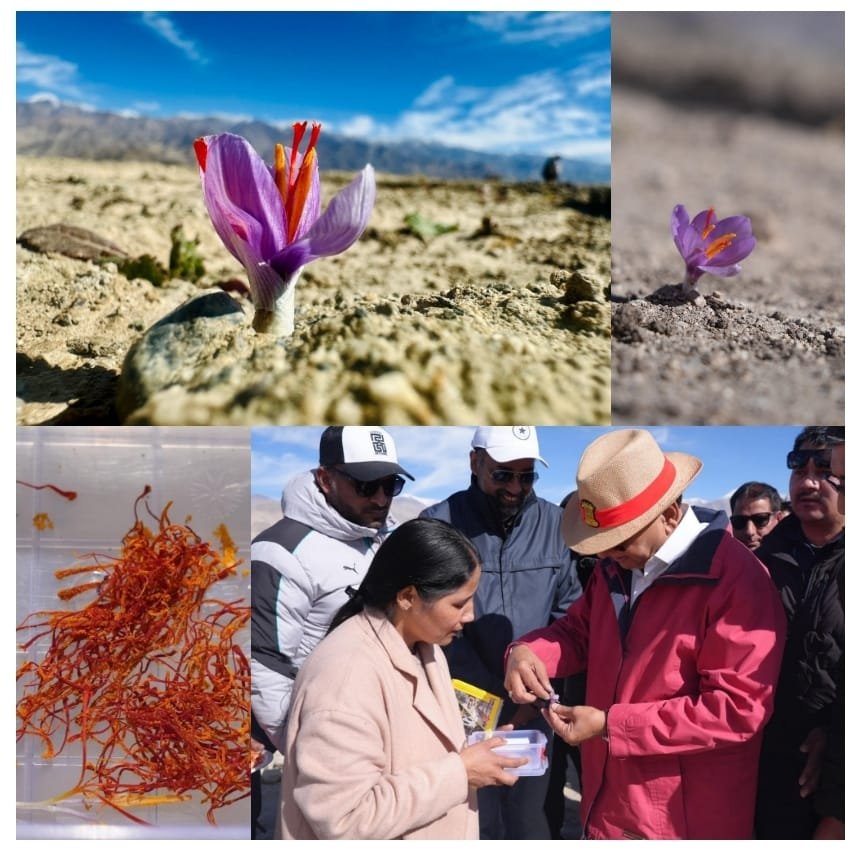
-Lieutenant Governor of Ladakh breaks new grounds in Ladakh’s high-altitude agricultural landscape! Proud to announce that the experimental saffron cultivation, over recently restored degraded land in Leh, has begun to blossom, in a record-breaking 30 days, against the usual two-month timeline for the first bloom. I
– He inspected the saffron field today to witness the first saffron bloom. On an average, 20 to 25 flowers are blooming daily with 72 flowers blooming this morning. In just 04 days, nearly 22 grams of pure saffron has been collected.
-This remarkable achievement is a powerful testament to the resilience of our environment and the immense, untapped potential of high-altitude farming in our region.
-This breakthrough lays a promising foundation for commercial-scale production, thereby, opening up new avenues for cultivation, agro-based entrepreneurship in Ladakh and paving the way for a stronger, thriving, self-reliant local economy.
-High-altitude farming involves growing crops and raising livestock in mountainous or elevated regions (such as the Himalayas, the Andes, or the Alps) where cool temperatures, short growing seasons, thin air, and steep slopes create unique environmental conditions.
-Key Characteristics & Challenges
* Climate & Temperature: Thin air and lower air pressure reduce ambient warmth, leading to cold nights, high radiation/sunlight intensity during the day, and a compressed, short growing season.
* Water & Drainage: Steep slopes promote rapid runoff, which can lead to summer dryness or soil erosion, though localized snowmelt, mountain springs, and heavy dews provide vital moisture.
* Soil & Terrain: Sloped lands require terracing to prevent soil loss and create flat, workable surfaces.
Common Practices & Innovations
* Terrace Farming: Cutting steps into mountain slopes helps control water flow and prevent erosion for crops like barley, wheat, rice, potatoes, and maize.
* Cold-Hardy & Short-Season Crops: Farmers rely on resilient staple crops (such as hardy barley varieties, buckwheat, potatoes) and high-value niche options. For instance, experimental saffron cultivation in cold, high-altitude terrain like Leh (Ladakh) has recently shown rapid flowering cycles in restored land.
* Value Chain & Livelihood Initiatives: Programs like the Tata Trusts Maximising Himalayan Agriculture Initiative focus on building local Producer Groups and expanding seed production, orchards, and agri-allied products.
* Specialized Livestock Care: High-altitude dairy farming (such as in parts of Himachal Pradesh) requires customized feeding and metabolic strategies to help cattle cope with elevated oxygen and temperature stresses.
-Ladakh has a short 4- to 5-month summer growing season (typically April/May to September) and relies heavily on glacier-meltwater channelled through traditional khuls (irrigation channels).
-Staple and Field Crops
* Barley (Naktey/Nas): The primary, cold-adapted staple crop of Ladakh.
* Wheat: Cold-tolerant varieties grown widely across lower and mid-altitude valleys.
* Buckwheat (Bragoo/Chapa): A traditional high-altitude cold-region grain.
* Pulses & Millets: Green peas (grown extensively for commercial demand), lentils, and traditional millets like foxtail millet (Tse Tse) and quinoa.
* Oilseeds: Mustard.
* Fodder Crops: Alfalfa and oats.
-Vegetables
* Root Vegetables: Potatoes (accounting for a large share of local production), turnips, radishes, carrots, and beetroot.
* Brassicas & Greens: Cabbage, cauliflower, spinach, and various kale/cabbage varieties.
* Alliums & Others: Onions, garlic, tomatoes, and green chillies (increasingly cultivated using protected greenhouse structures to beat sub-zero temperatures).
* Note: Research lists up to 28 to 36 traditional and newly introduced vegetable species across Leh and Kargil, including beans, squashes, cucumbers, and coriander.
-Fruits and Orchards
* Apricots: A major cash crop, particularly famous in Kargil (including the GI-tagged Raktsey Karpo variety).
* Apples: Cold-adapted orchard varieties grown in lower valley areas.
* Sea Buckthorn: Widely harvested across wild and pure production clusters in Leh district.
-High-altitude farming in Ladakh takes place in a cold, arid desert environment at elevations around 3,500 meters or higher, characterized by intense sunlight, scarce rainfall (under 100 mm annually), and very short growing seasons.
-Key Aspects of High-Altitude Farming in Ladakh
* Traditional Crops & Organic Practices: Farmers traditionally grow subsistence crops and organic produce like barley, buckwheat, potatoes, green peas, apricots, apples, and leafy greens.
* Water Management: Irrigation relies heavily on glacial meltwater channeled through traditional networks of gravity-fed streams called Khuls. Initiatives like Project Him Sarovar also focus on restoring barren and degraded land by harvesting snowmelt and improving soil moisture.
* Passive Solar Greenhouses: Developed largely with the help of the Defence Institute of High-Altitude Research (DIHAR), the Ladakh Greenhouse uses passive solar heating to let farmers cultivate fresh vegetables during freezing, harsh winters.
* Crop Diversification & High-Value Trials:
* Floriculture: Ladakh has expanded into high-value flower cultivation, including large-scale production of Lilium and Gladiolus in areas like Choglamsar and Stakna.
* Saffron Cultivation: A pilot saffron project at Spituk Pharka (Leh) planted 90,000 Iranian saffron corms on restored degraded land, producing its first blooms in a record-breaking 30 days.
0Pilot saffron cultivation in Ladakh receives first bloom in just 30 days.
-Pilot saffron cultivation in Ladakh receives first bloom in just 30 days Leh, November 1: Breaking new ground in Ladakh’s high-altitude agricultural landscape, the experimental saffron cultivation project initiated by Lt. Governor Shri VK Saxena, on recently restored degraded land in Leh, has begun to blossom.
-The first bloom at the Saffron field came in a record-breaking 30 days, as against the two-month timeline typically required for the first bloom.
-The LG inspected the saffron field to witness the first bloom, where he was informed that the cultivation site is currently averaging 20 to 25 blooming flowers daily, with a peak of 72 flowers blooming this morning alone.
-This rapid, robust growth has led to the successful collection of nearly 22 grams of pure saffron in just four days. As an ambitious experiment, nearly 800 kg corms (90,000 nos.) of premium Iranian saffron were planted over nearly 4000 square meters of land, which was earlier barren and has been recently restored and rejuvenated, as part of Project Him Sarovar, under the guidance of LG, Shri Saxena.
-The plantation was done on October 1, and the first bloom has been reported in less than 30 days. The initiative is guided by Hon’ble Prime Minister Shri Narendra Modi’s vision of diversifying traditional agricultural practices for financial sustainability and economic empowerment of the farmers and the youth. Saffron plantation in Ladakh builds on the Administration’s successful experiment with high-value floriculture, particularly the massive cultivation of Lilium and Gladiolus in Leh, that has opened new employment and livelihood opportunities for farmers, Self-Help Groups and other local entrepreneurs.
-“This remarkable achievement is a powerful testament to the resilience of the local environment and highlights the immense, untapped potential of high-altitude farming in the Ladakh region. The breakthrough of this pilot project also lays a promising foundation for future commercial-scale saffron production. It will open highly lucrative new avenues for crop cultivation and agro-based entrepreneurship in Ladakh, actively paving the way for a stronger, thriving, and self-reliant local economy,” LG Shri Saxena said. Notably, saffron is a high-value crop with strong market demand and commands a premium price, offering the potential to provide farmers with an additional and remunerative source of income. Jammu and Kashmir is the primary region for saffron cultivation in India, accounting for approximately 90 per cent of the country’s total production.
-Its introduction in Ladakh is, therefore, being undertaken as a pilot to assess its suitability to the region’s climatic conditions and explore its economic potential. The LG also appreciated the officials of the Agriculture Department of UT Ladakh and the dedicated field staff for their significant contributions, expertise, and commitment in ensuring the overwhelming success of this pioneering pilot project.
-Saffron cultivation spans over 4,000 years of human history, traditionally thriving in semi-arid, high-altitude plateaus and elevated tablelands that provide the ideal balance of intense solar radiation, cold dormancy periods, and well-drained soils.
-Historical Timeline & Geographic Spread
* Ancient Origins (2300–1600 BCE): The earliest written records trace saffron (Crocus sativus) to the Akkadian Empire in Mesopotamia (modern-day Iraq) and the Euphrates region. By the Bronze Age, Minoan civilizations in Crete depicted saffron harvesting in frescoes at the Palace of Minos.
* Spread Across Asia & Persia (708 BCE onward): Saffron cultivation took root in ancient Persia during the Kingdom of Media. From there, Central Asian immigrants and trade routes introduced the corms into South Asia, including the Kashmir Valley around the 1st century BCE. It was widely documented in historical texts like Kalhana’s Rajtarangini.
* Medieval European Revival: Cultivation in Europe plummeted after the fall of the Roman Empire, only to be revived during the Moorish expansion into Spain, parts of France, and southern Italy around the 8th to 13th centuries. Spain and Greece eventually developed specialized high-yield!
-Mediterranean farming models.
* High-Altitude Science & Modern Frontiers: Saffron typically grows best at elevations of 1,500 to 2,000 meters above sea level. High-altitude ultraviolet (UV) light forces the plant to trigger metabolic defenses, increasing the production of crocin—the compound responsible for its deep color and potency.
* Recent Breakthroughs (2026): Pushing historical and geographical boundaries further, experimental high-altitude farming projects in cold desert regions like Leh, Ladakh, have successfully bloomed and harvested pure saffron in record-breaking windows of under 30 days.
-Saffron cultivation spans over 3,500 years, originating from the wild Mediterranean species Crocus cartwrightianus in Late Bronze Age Greece and Minoan Crete.
-Origins and Early Antiquity (c. 1700 BCE – 500 BCE)
* Minoan Crete & Greece: Depictions of saffron gathering appear in frescoes (such as those at Akrotiri on Santorini, dating to around 1700 BCE), showing humans and even monkeys harvesting the stigmas.
* Ancient Persia: Saffron cultivation took deep root on the Persian Plateau by the 10th century BCE, where it was used in royal weaving dyes, perfumes, and offerings to the gods.
* Middle East & Asia: The spice is referenced in the Hebrew Bible (Song of Solomon) and early Mesopotamian texts.
-Classical Era and Trade (500 BCE – 500 CE)
* Greece and Rome: Saffron was prized as a luxury perfume, tossed in theater aisles, and infused into royal baths by figures like Cleopatra and Nero.
* Spread to Asia: Alexander the Great’s campaigns helped carry saffron traditions further into parts of Asia, including India and China.
-Middle Ages and European Revival (500 CE – 1500 CE)
* Islamic Expansion: Moorish traders and rulers reintroduced and expanded saffron cultivation across North Africa and into Spain around the 10th century.
* Medieval Europe: The Crusaders helped revive European interest by bringing corms back from the Near East. By the 14th century, it became a major agricultural and economic driver in regions like England (e.g., Saffron Walden), France, Italy, and the Swiss town of Basel.
* Asia: Cultivation flourished in Kashmir and China (noted in the Ming-era Bencao gangmu materia medica).
-Colonial Expansion and Modern Production (1500 CE – Present)
* The Americas: Spanish colonizers introduced saffron to Central and South America during the 16th century.
* Modern Global Market: Because the sterile Crocus sativus plant cannot reproduce on its own and requires hand-picking roughly 150,000 to 200,000 flowers per kilogram of dried spice, it remains the world’s most expensive spice. Today, Iran dominates global production (accounting for over 80–90% of the world’s supply), alongside traditional and emerging growers in India (Kashmir), Spain (La Mancha), Greece, Italy, and Afghanistan.
-The title of “best saffron in the world” is typically contested among three premier global regions, each celebrated for its unique biochemical potency, rich color, and aroma:
-1. Afghan Saffron (Herat)
* Accolades: Ranked number one internationally by the International Taste Institute for multiple consecutive years.
* Characteristics: Sourced heavily from Herat, Afghan saffron is famous for its deep red threads, high purity, and vibrant flavor yield that requires only a tiny pinch for cooking.
* Producer Status: Afghanistan is a major global producer, with cultivation spreading across dozens of provinces.
-2. Iranian / Persian Saffron (Khorasan & Mashhad)
* Accolades: Iran is the world’s largest producer and exporter, widely regarded by global chefs and a consensus on platforms like Quora as top-tier.
* Characteristics: Known as Persian saffron, especially the Super Negin grade from Mashhad. It features long, unbroken, deep-red stigmas with zero yellow or white styles, offering high levels of crocin (color), picrocrocin (flavor), and safranal (aroma).
3. Kashmiri Saffron (Pampore)
* Accolades: Renowned as one of the rarest and most expensive varieties globally, with grades like Mongra or Lacha prized for exceptional quality.
* Characteristics: Grown in Pampore, Kashmir, it has a distinct dark maroon-purple hue and high crocin content (around 8.72% to 17% depending on testing metrics), giving it deep coloring and medicinal value. You can explore regional options through local selections like Rasayanam Kashmiri Mongra Saffron.
-How to Evaluate Quality
According to rankings on TasteAtlas, top saffrons are judged by ISO 3632 standards measuring three key compounds:
* Crocin: Responsible for the deep golden-red color.
* Safranal: Responsible for the distinct, pungent aroma.
* Picrocrocin: Responsible for the signature bitter-honey taste.
-We have been careless with our pie repertoire. The demise of apple-pear pie with figs and saffron and orengeado pies are tragic losses!.
-In India, where there are no passports or identity discs, and where religions counts for so much- except among those few who have crossed the ‘black water’ – I believe that a man wearing a saffron robe, or carrying a beggar’s bowl , or with silver crosses on his headgear and chest, could walk from Khyber Pass to Cape Comorin without once being questioned about his destination, or the object of his journey,
-I notice you all have written about cooking mutton a few times, but you only ever mention cooking chicken I recently learned a creative recipe from a woman I met on a journey to Srinagar. I am enclosing a packet of saffron from that Journey. It is my small way of thanking you for your recipes! For steamed chicken, in a pot add a generous pinch of saffron, coarsely chopped garlic, and parsley to a half cup of melted butter.! Aff a bit of water, Kashmiri spices and curd and enjoy the delicacy!.
-Kashmiri saffron—known locally as kesar, zafran, or kong posh—has a recorded history spanning over 1,200 years, with historical texts documenting its cultivation in the Valley as early as 725 CE in Kalhana’s Rajatarangini.
-Origins and Arrival Legends
-Because the Crocus sativus flower cannot self-reproduce, its arrival in Kashmir required intentional human transplantation:
* Historical & Literary Accounts: Early trade routes brought Persian and Central Asian influences to the region, with many historians noting that Persian settlers introduced the corms around 500 BCE or later during classical trade eras.
* The Sufi Legend: Traditional Kashmiri folklore credits two 12th-century Sufi ascetics, Khwaja Masood Wali and Hazrat Sheikh Shariffudin, who wandered into Pampore and were given a saffron crocus bulb by a local tribal chieftain in gratitude for curing an illness. To this day, a golden-domed shrine in Pampore honors them.
* Other Traditions: Alternative regional legends attribute the flower’s introduction to Buddhist monks during the reign of Ashoka,or to ancient Greek and Bactrian trade links.
-The Heart of Kashmiri Saffron: Pampore
* The Saffron Capital: The town of Pampore, located near Srinagar on the elevated plateaus of Kashmir, is world-famous as the Saffron Capital of India.
* Terroir (Karewa Soil): The crop thrives in Pampore’s unique, mineral-rich, well-drained limestone and lacustrine Karewa soil at high altitudes (1,600 to 1,800 meters) combined with a cool climate.
* Quality & Grades: Kashmiri saffron—particularly the top-grade Mongra (consisting of the pure deep-red stigmas with tails removed)—is celebrated for having some of the highest concentrations of crocin (color), picrocrocin (flavor), and safranal (aroma) in the world.
-Modern Status
* GI Tag: In 2020, Kashmiri saffron was granted a Geographical Indication (GI) tag to protect its authenticity and safeguard buyers from widespread market adulteration.
* Harvesting: Every autumn (typically in October and November), thousands of purple flowers are manually hand-picked at dawn, and the delicate crimson threads are separated and dried by hand or over gentle traditional fires.
You can explore more about authentic sourcing and regional heritage through the Kashmiril Journal on Saffron History or read supplier insights via The Better India Guide to Pampore Saffron.
Would you like to know more about how to identify 100% pure Kashmiri Mongra saffron from fake or adulterated versions, or are you interested in its traditional culinary and Ayurvedic uses?
-So we come to the final lines:
-The most famous love story from the saffron fields of Kashmir is the 16th-century romance between Kashmiri King Yusuf Shah Chak and a peasant girl named Zoon, who later became the iconic poet-queen Habba Khatoon.
-How They Met
* The Fateful Night: In the autumn of the 16th century, Yusuf Shah—then a prince or king—strayed into the blooming purple saffron fields of Pampore on a moonlit night.
* The Voice: He heard a mesmerizing, melancholic voice floating through the breeze. Drawn by the song, he found Zoon—a local woman trapped in an unhappy marriage—singing amidst the delicate purple flowers.
* Love at First Sight: Captivated by both her beauty and her poetic soul, Yusuf Shah listened to her verse and soon summoned her husband to the royal court to obtain a divorce.
-Life and Royalty
* Habba Khatoon: After marrying the king, Zoon was given the name Habba Khatoon.
* A Shared Throne: For a brief, golden period, Kashmir was shaped not just by a king, but by a powerful creative voice; Habba Khatoon’s folk songs and poetry became deeply woven into the cultural fabric and language of the Valley.
-A Tragic End
* Invasion and Exile: Their romance was cut short when the Mughal Emperor Akbar invaded Kashmir. Yusuf Shah Chak was defeated and exiled to Patna (where he eventually died), separating the couple forever.
* The Legacy: Habba Khatoon spent the rest of her days wandering the villages and the saffron highlands of Pampore, wailing and singing sorrowful verses for her lost love.
To this day, locals in Pampore say that every autumn when the purple saffron flowers bloom anew, the sound of Yusuf’s horse and Habba Khatoon’s haunting melodies echo through the fields.