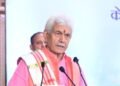



SRINAGAR | OCTOBER 26, 2026 : On the occasion of Accession Day, Peoples Democratic Party (PDP) president Mehbooba Mufti called upon people across India to reflect on the historical commitments and constitutional assurances associated with Jammu and Kashmir’s accession to India, alleging that the region’s rights and political aspirations have been undermined over the years.

Addressing a party gathering at the PDP headquarters in Srinagar on Monday, the former Jammu and Kashmir chief minister said the relationship between the region and India had been founded on trust, secularism and assurances that, in her view, must be respected.
Her remarks have brought renewed attention to the competing political interpretations of Jammu and Kashmir’s accession, its constitutional history and the continuing debate over democratic rights and the region’s future.
🔹 MEHBOOBA’S APPEAL TO THE PEOPLE OF INDIA
Mehbooba urged Indians to remember the vision of a secular and democratic country associated with Mahatma Gandhi, Jawaharlal Nehru and B. R. Ambedkar.
She argued that Jammu and Kashmir had placed its faith in an India where people of different religions could coexist and where the region’s distinct identity and rights would receive protection.
“This is not a piece of paper,” she said, referring to the commitments she believes underpin Jammu and Kashmir’s relationship with India.
She also invoked Maulana Abul Kalam Azad and Sardar Vallabhbhai Patel while describing the principles of secularism and national unity that, according to her, shaped the expectations surrounding accession.
🔹 OCTOBER 26, 1947: THE HISTORICAL BACKGROUND
Accession Day commemorates the signing of the Instrument of Accession by Maharaja Hari Singh on October 26, 1947.
The instrument was accepted by the then Governor-General of India, Lord Mountbatten, on October 27, 1947, formalising the princely state’s accession to India.
The events unfolded amid the upheaval of Partition and an armed tribal invasion from Pakistan, as the princely state faced a rapidly deteriorating security situation.
Mehbooba said the people of Jammu and Kashmir had expected their political aspirations and concerns to be respected as part of the relationship established at that time.
The historical and constitutional implications of accession remain central to political discussions about Jammu and Kashmir.
🔹 ARTICLE 370 AND THE 2019 REORGANISATION
A major focus of Mehbooba’s criticism was the constitutional change of August 5, 2019, when the Union government took steps to effectively abrogate Article 370 and reorganise the former state.
The Jammu and Kashmir Reorganisation Act, 2019, provided for the division of the former state into two Union Territories: Jammu and Kashmir, and Ladakh.
Mehbooba argued that these changes weakened the relationship of trust she believes had underpinned Jammu and Kashmir’s accession.
She alleged that the region’s residents continued to face restrictions, extensive security deployment and obstacles affecting everyday life.
These are political allegations made by the PDP president and reflect her assessment of the region’s circumstances.
🔹 YOUTH, PASSPORTS AND CIVIL LIBERTIES
Mehbooba also raised concerns about the treatment of young people, claiming that some faced police scrutiny and difficulties when seeking passports for education, employment and other opportunities.
She questioned the continued use of detention measures and investigative agencies in the region.
Her remarks placed civil liberties, freedom of movement and access to opportunities at the centre of her appeal for renewed public attention.
🔹 “DIALOGUE, NOT FORCE”: CALL FOR DEMOCRATIC ENGAGEMENT
The PDP chief called for dialogue and democratic engagement, arguing that lasting political stability could not be achieved through force alone.
Invoking former Prime Minister Atal Bihari Vajpayee’s approach to Kashmir, she referred to the principles of Insaniyat (humanity), Jamhooriyat (democracy) and Kashmiriyat (Kashmiri identity and cultural heritage).
She urged the government to pursue a more inclusive approach that recognises the concerns and dignity of the region’s residents.
In a pointed message, she said:
“If you want to keep Jammu and Kashmir together, don’t drag it. Don’t drag it with your arms. Instead, hold its hand and teach it to walk with you.”
The statement encapsulated her argument that political reconciliation and public confidence require engagement rather than coercion.
🔹 WHY HER REMARKS MATTER
Accession Day carries different political meanings for different groups in Jammu and Kashmir.
For the BJP and other supporters of accession, the anniversary highlights the region’s formal accession to India and its place within the Union.
For Mehbooba Mufti and the PDP, the occasion is also an opportunity to revisit the assurances, constitutional arrangements and political expectations they believe should guide the relationship.
Her comments underscore the continuing debate over the legacy of 1947, the consequences of the 2019 constitutional changes, the protection of civil liberties and the role of democratic dialogue in Jammu and Kashmir.
🇮🇳 THE BIGGER PICTURE
Mehbooba Mufti’s Accession Day address was a call for Indians to reconsider the historical commitments associated with Jammu and Kashmir’s relationship with the country.
Whether one agrees with her political assessment or not, the questions she raised touch on important issues of constitutional history, democratic representation, public trust and national integration.
KEY TAKEAWAY: On Accession Day, Mehbooba Mufti urged people across India to remember the historical and constitutional assurances she believes shaped Jammu and Kashmir’s accession, calling for dialogue, democratic engagement and the protection of residents’ rights and dignity.