

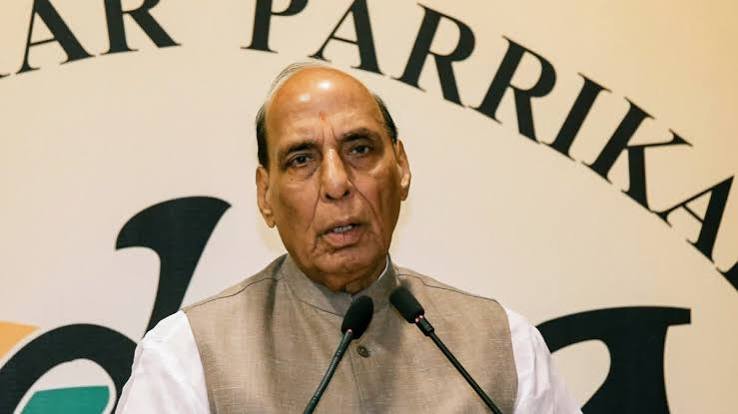
NEW DELHI | OCTOBER 14, 2026 : Defence Minister Rajnath Singh has called for an open, stable and inclusive Indo-Pacific region where all countries, irrespective of their size or influence, can make independent decisions, safeguard their national interests and pursue peaceful development.

Addressing the first ASEAN-India Defence Think Tank Forum in New Delhi on Wednesday, Singh emphasised that India and the Association of Southeast Asian Nations (ASEAN) share a common interest in maintaining regional stability, respecting national sovereignty and upholding international law.
He stressed the importance of keeping communication channels open and addressing conventional and emerging transnational challenges through collective efforts.
India Calls for Peaceful Dialogue and Regional Cooperation
Highlighting the growing strategic competition and pressure across the Indo-Pacific, Singh said no country could tackle the region’s complex security challenges alone.
He advocated resolving differences through early and peaceful dialogue before they escalate into disputes. He also called for a regional order in which countries could cooperate without being compelled to choose sides.
His remarks come amid growing international concerns over China’s expanding military assertiveness in the Indo-Pacific.
“India believes that security is strengthened when countries build capacity together, respect international law and maintain trust through dialogue,” Singh said.
The Defence Minister reiterated that India’s approach seeks to strengthen cooperation, mutual trust and respect for the sovereignty of every nation.
Act East Policy Reinforces India-ASEAN Partnership
Singh highlighted the centuries-old historical and cultural connections between India and Southeast Asia, describing New Delhi’s Act East policy as a long-term commitment to working with regional partners on an equal footing.
He noted that India’s Indo-Pacific vision and ASEAN’s regional outlook could complement each other, stressing that cooperation between regional forums should be strengthened rather than turned into competition.
The Minister underlined the importance of maintaining peace and security across the Indian Ocean and Southeast Asian waters, describing maritime security as a shared responsibility in an interconnected region essential for international trade, energy supplies and the movement of people and goods.
2026 Declared ASEAN-India Year of Maritime Cooperation
Singh pointed to the designation of 2026 as the ASEAN-India Year of Maritime Cooperation, calling it an opportunity to translate shared priorities into concrete action.
He identified maritime domain awareness, interoperability between forces and underwater awareness as important areas for strengthening a stable, rules-based maritime order.
He called for enhanced information-sharing, closer coordination between navies and coast guards, and joint capabilities to respond to emergencies.
Singh also stressed the need to tackle piracy, human and goods trafficking, illegal fishing and other maritime threats in accordance with international law.
Defence Technology and Innovation Take Centre Stage
The Defence Minister identified emerging technologies as another major area for India-ASEAN collaboration, highlighting the growing significance of artificial intelligence, drones, cyber capabilities and space-based systems.
Referring to lessons from recent conflicts, he noted that relatively inexpensive drones could pose significant challenges to sophisticated and costly defence systems.
He called for practical, affordable and adaptable technological solutions, emphasising that defence innovation should not remain confined to large organisations.
Start-ups, universities, research institutions and smaller companies, he said, all have an important role in developing technologies to meet modern security requirements.
Singh highlighted India’s Innovations for Defence Excellence (iDEX) initiative and Technology Development Fund (TDF) as mechanisms supporting collaboration with innovators to address defence needs.
He also proposed exploring collaborative innovation around clearly defined challenges, including counter-drone technology, cyber defence, maritime surveillance and disaster response.
A Shared Vision for a Stable Indo-Pacific
Singh’s address underscored India’s commitment to a regional framework built on sovereignty, peaceful dialogue, maritime security, technological collaboration and freedom of national decision-making.
As strategic competition intensifies, India is seeking deeper engagement with ASEAN partners to strengthen regional capabilities and promote a peaceful, inclusive and rules-based Indo-Pacific.