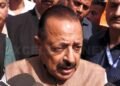


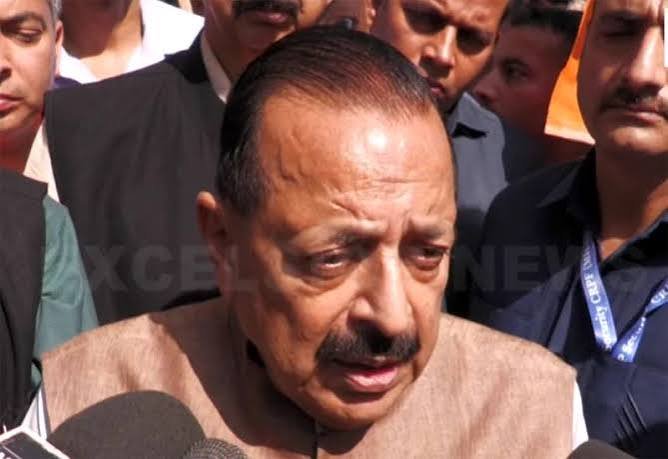
UDHAMPUR, October 8, 2026 : Union Minister Dr Jitendra Singh on Wednesday described the 2019 changes relating to Article 370 and Article 35A as among the major reforms of India’s post-Independence period, saying history would record the move as a significant development during the Narendra Modi government’s tenure.

Singh made the remarks while speaking to reporters on the sidelines of a Seva Jyoti Yatra organised in Udhampur as part of the Viksit Bharat Sankalp Abhiyan, marking Prime Minister Narendra Modi’s 25 years in public life.
His comments reflect the government’s political assessment of the 2019 constitutional and administrative changes in Jammu and Kashmir. The Union government has described the removal of Article 370 and 35A as a historic step, while the political significance and consequences of the move remain subjects of debate.
Article 370 and 35A
Singh said the Modi government’s 12 years at the national level had been marked by what he described as major reforms, specifically mentioning the changes relating to Article 370 and 35A and the implementation of the Goods and Services Tax (GST).
In August 2019, Parliament approved a resolution concerning Article 370 along with legislation reorganising the former state of Jammu and Kashmir. The Jammu and Kashmir Reorganisation Act subsequently came into force on October 31, 2019, creating the Union Territories of Jammu and Kashmir and Ladakh.
The Union government has said that the 2019 changes resulted in the wider application of the Constitution and central laws to Jammu and Kashmir and Ladakh.
Reference to Syama Prasad Mookerjee
Singh linked the 2019 changes to the political legacy of Dr Syama Prasad Mookerjee, founder of the Bharatiya Jana Sangh.
He said the move fulfilled Mookerjee’s longstanding vision of the full integration of Jammu and Kashmir with India.
This interpretation is part of the BJP’s longstanding political narrative surrounding Article 370 and the constitutional changes made in 2019.
Security and Counter-Terrorism
Singh also highlighted the Modi government’s security policies, saying it had taken measures aimed at countering terrorism and Left-wing extremism.
He referred to surgical strikes and Operation Sindoor while discussing the government’s approach to national security.
Singh also said the government had taken steps intended to improve the security situation in Jammu and Kashmir and other regions affected by violence.
Development in Jammu and Kashmir
The Union minister also focused on infrastructure and development projects in Jammu and Kashmir.
Among the initiatives he highlighted were the establishment of two AIIMS facilities in the Union Territory, describing this as a significant expansion of healthcare infrastructure.
He also referred to the Shahpur Kandi Project, saying it had remained stalled for decades before being revived.
Other projects cited by Singh included the six-laning of the Delhi-Amritsar-Katra corridor and the introduction of Vande Bharat train services to Kashmir.
Singh presented these projects as examples of the government’s efforts to improve connectivity and infrastructure in the region.
Modi’s 25 Years in Public Life
Singh also highlighted Prime Minister Modi’s 25 years in public office, describing the uninterrupted political tenure as unusual in a democratic system.
He said Modi had spent approximately 12 years as Gujarat’s chief minister and another 12 years as prime minister.
Singh argued that repeated electoral victories over such an extended period reflected sustained public confidence in Modi’s leadership.
The remarks were made as BJP workers and supporters participated in the Seva Jyoti Yatra in Udhampur.
Welfare Schemes
The Union minister also cited several welfare programmes associated with the Modi government.
These included Ayushman Bharat, free food-grain support for eligible beneficiaries and the PM-KISAN Samman Nidhi.
Singh described these as examples of policies aimed at providing direct benefits to citizens.
He also referred to Modi’s self-description as “Pradhan Sevak”, saying that the Prime Minister’s emphasis on public service had contributed to a relationship of trust with citizens.
Seva Jyoti Yatra in Udhampur
Earlier, a Seva Jyoti Yatra was taken through Udhampur town under Singh’s leadership.
A large number of BJP workers and leaders participated in the event.
Those present included Udhampur West MLA Pawan Gupta, Udhampur East MLA R S Pathania and Ramnagar MLA Dr Sunil Bhardwaj.
The event formed part of activities marking Modi’s 25 years in public life and was linked to the Viksit Bharat Sankalp Abhiyan.
A Political Assessment of the Modi Era
Singh’s remarks offered a political assessment of the Modi government’s record, with particular emphasis on Jammu and Kashmir, national security, infrastructure, welfare schemes and constitutional changes.
The 2019 Article 370 measures are an established historical event, while characterisations such as “revolutionary” or “among the most significant reforms” are political assessments expressed by Singh and the Union government rather than neutral historical classifications.
The government’s stated view is that the changes have strengthened integration and development in Jammu and Kashmir. The broader political and social impact of the 2019 changes continues to be debated across political parties and among different sections of society.