

By M Nazki

Courage in every step, fortitude in every heart : leadership stands with its troops! Being deeply loved by someone gives you strength, while loving someone deeply gives you courage
-It takes a great deal of bravery to stand up to our enemies, but just as much to stand up to our friends
-Success is not final, failure is not fatal: it is the courage to continue that counts..
-It takes courage to grow up and become who you really are.
-I wanted you to see what real courage is, instead of getting the idea that courage is a man with a gun in his hand. It’s when you know you’re licked before you begin, but you begin anyway and see it through no matter what
-Courage is the most important of all the virtues because without courage, you can’t practice any other virtue consistently…
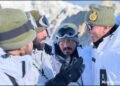
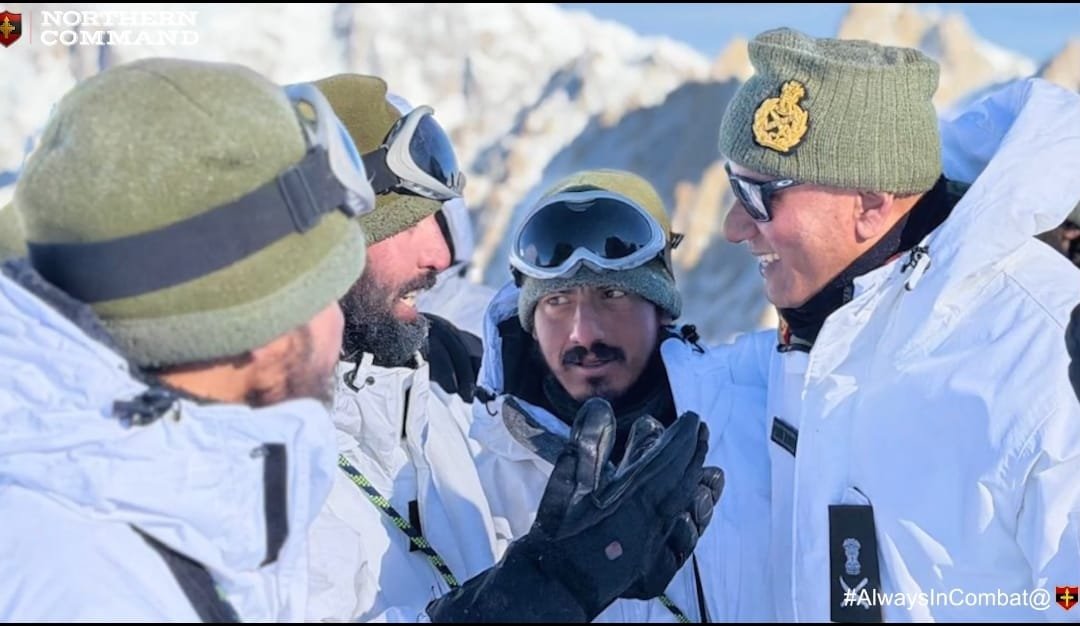
-Lt Gen Pratik Sharma Army Cdr NC visited troops deployed at the icy heights of the Siachen Glacier on the eve of Diwali.
-Interacting with the brave hearts in the world’s highest battlefield, he conveyed warm festive greetings and lauded their indomitable spirit.
-Amidst unforgiving terrain, the resolve of the IndianArmy shines brighter than a thousand lights.
-This was the story which we had and now the elaboration!
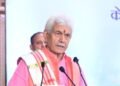
-General Officer Commanding-in-Chief (GOC-in-C) of the Army’s Northern Command, Lieutenant -General Pratik Sharma, visited troops deployed at the icy heights of the Siachen Glacier on the eve of Diwali and extended festive greetings to them.
-During his visit to the world’s highest battlefield, the Army Commander interacted with soldiers deployed in the challenging terrain and commended their courage, resilience and unwavering commitment to duty.
The Army’s Northern Command shared details of the visit in a post on X, stating that Lt Gen Sharma
-Two battles come to mind:
-The Battle of Stalingrad was fought from July 17, 1942, to February 2, 1943, and stands as the bloodiest and largest urban battle in World War II. It resulted in a decisive Soviet victory over Nazi Germany and its Axis allies, marking the major turning point of the war on the Eastern Front.
-Background and Strategy
* Axis Objectives: In the summer of 1942, Adolf Hitler launched Operation Case Blue to seize the oil fields of the Caucasus and capture Stalingrad (now Volgograd), a vital industrial and transport hub on the Volga River.
* Forces Involved: The assault was spearheaded by the German Sixth Army and Fourth Panzer Army, supported by Italian, Hungarian, Romanian, and Croatian forces.
* Soviet Defense: General Vasily Chuikov commanded the 62nd Army tasked with defending the city street by street. Joseph Stalin issued orders forbidding retreat, turning the city into an armed fortress.
-The Urban Combat
* Close Quarters: German air raids by the Luftwaffe flattened over 90% of the city’s housing, creating a maze of ruins that negated German mobile and artillery advantages.
* Attrition: Fighting raged inside factories, sewers, and burnt-out buildings with severe hand-to-hand combat. Average life expectancy for a newly arrived Soviet soldier dropped to mere hours.
-Soviet Counteroffensive and Surrender
* Operation Uranus: On November 19, 1942, the Red Army launched a massive winter counteroffensive under General Georgy Zhukov, bypassing the city and encircling the German Sixth Army under General Friedrich Paulus.
* Collapse: Despite pleas to retreat, Hitler ordered the trapped 300,000 Axis troops to hold fast. Cut off from supplies and freezing in harsh winter conditions, General Paulus surrendered on February 2, 1943.
-Casualties and Impact
* Human Toll: The battle caused an estimated 1.1 million to 1.5 million Soviet casualties (including military and about 40,000 civilians) and roughly 800,000 Axis casualties.
* Prisoners: Around 91,000 German and Axis soldiers were taken captive, of whom only a few thousand ever returned home after the war.
* Turning Point: The destruction of the German Sixth Army permanently broke the strategic initiative of the Wehrmacht on the Eastern Front.
-The Battle of Leningrad (commonly known as the Siege of Leningrad) was a prolonged military blockade and battle on the Eastern Front of World War II.
* Dates: September 8, 1941 – January 27, 1944 (lasting 872 days).
* Combatants: Nazi Germany, Finland, and Spain (Axis powers) against the Soviet Red Army and the civilian population of Leningrad (now St. Petersburg).
* Axis Objective: Hitler sought to completely obliterate the politically and industrially vital city of Leningrad and starve out its entire population rather than accept a surrender.
-Key Events and Conditions
* The Encirclement: German forces cut off all land routes into the city by September 8, 1941, while Finnish forces engaged from the north.
* The “Road of Life”: With all rail and roads severed, the Soviets relied on a dangerous ice road and transport network across the frozen Lake Ladoga—known as the Road of Life—to bring in minimal food and ammunition while evacuating hundreds of thousands of children, the sick, and the elderly.
* Breakthrough and Relief: The Soviet army partially pierced the ring during Operation Iskra in January 1943, and finally lifted the blockade completely during the Leningrad-Novgorod offensive on January 27, 1944.
-Human Cost and Impact
* Casualties: An estimated 1 million to 1.5 million civilians died, primarily from systematic starvation, freezing cold, disease, and relentless German artillery and air bombardment.
* Historical Classification: Many historians classify the deliberate-starvation strategy and destruction inflicted on Leningrad as an act of genocide.
* Hero City: In recognition of its extreme endurance and resistance, Leningrad was honored as a Hero City of the Soviet Union.
-Battle of Kiev (1941)
-Operation Barbarossa:
The First Battle of Kiev or Kiev operation, known as the Battle of Kiev on the German side (German: Schlacht bei Kiew), was a major battle that resulted in an encirclement of Soviet troops in the vicinity of Kiev during World War II, the capital and most populous city of the Ukrainian Soviet Socialist Republic.
– This encirclement is the largest in the history of warfare by number of troops. The battle lasted from 7 July to 26 September 1941 as part of Operation Barbarossa, the Axis invasion of the Soviet Union. Although it is known as the “Battle of Kiev”, the city played only a peripheral role in the overall battle; for the Soviets, a strategic defensive operation. The battle took place over a large area in eastern Ukraine, with Kiev being the focal point of Soviet defenses and of the German encirclement.
– Much of the Southwestern Front of the Red Army, commanded by Mikhail Kirponos, was encircled, but small groups of Red Army troops managed to escape the pocket in the days after the German panzers attacked east of the city, including the forces of Marshal Semyon Budyonny, Marshal Semyon Timoshenko and Commissar Nikita Khrushchev. Kirponos was trapped behind German lines and was killed while trying to break out.
-The battle was an unprecedented defeat for the Red Army, and was more damaging than the Battle of Białystok–Minsk of June–July 1941. The encirclement trapped 452,700 Soviet soldiers, 2,642 guns and mortars, and 64 tanks of which only 15,000 soldiers escaped from the encirclement by 2 October. The Southwestern Front suffered 700,544 casualties, including 616,304 killed, captured, or missing during the battle. The 5th, 37th, 26th, 21st, and 38th armies, consisting of 43 divisions, were almost annihilated and the 40th Army suffered many losses. Like the Western Front before it, the Southwestern Front had to be recreated almost from scratch.
-Adolf Hitler, the leader of the Third Reich, described the Battle of Kiev as “the biggest battle in the history of the world”, and Joseph Goebbels, the German minister of propaganda, called it “the greatest battle of annihilation of all time”. The historian Evan Mawdsley described the battle as the Ostheer’s “greatest triumph of the war in the East and the Red Army’s greatest single disaster”, and the historian Michael Jones dubbed the battle to be “the Wehrmacht’s greatest victory of the war”.]
-Indian troops continue to guard the high-altitude forward posts of the Siachen Glacier—known as the world’s highest battlefield—where Northern Army Commander Lieutenant General Pratik Sharma recently visited personnel on the eve of Diwali in November 2026.
-Key Details on Siachen Deployment
* Recent Leadership Visit: Lieutenant General Pratik Sharma (GOC-in-C, Northern Command) flew to the glacier’s forward heights to interact with jawans, share festive greetings, and commend their resilience. More details can be found via the Northern Command GOC Visits Siachen Troops report.
* Rotation Policy: Because of the extreme cold, thin air, and severe physiological stress, soldiers are typically deployed on short 2 to 3-month stints at forward combat posts.
* Acclimatization & Training: Troops undergo strict pre-induction training, orientation, and gradual high-altitude acclimatization at the Siachen Battle School located at the Siachen Base Camp before moving up to the glacier.
* Logistics & Support: Sustaining the deployment relies on a critical air and ground supply network managed by the Indian Army and the Indian Air Force (operating through air bases like Thoise and Leh) for food, fuel, specialized gear, and casualty evacuation.
* Historical Context: India established permanent control over the glacier during Operation Meghdoot launched on April 13, 1984, securing a major tactical advantage along the Saltoro Mountain Range.
-Harsh terrain operations involve military, tactical, or expeditionary movement across extreme landscapes characterized by high altitude, severe weather, steep slopes, unstable surfaces, and environmental hazards like avalanches, frostbite, and thin air.
-Key Challenges
* Environmental & Climatic Hazards: Extreme cold, hypothermia, frostbite, whiteouts, and sudden rockslides or avalanches pose constant dangers that often cause more casualties than direct engagement.
* Physiological Strain: High altitudes trigger Acute Mountain Sickness (AMS), hypoxia, and physical exhaustion, requiring strict acclimatization schedules and specialized medical protocols.
* Logistical & Mobility Bottlenecks: Transporting heavy weaponry, food, fuel, and communications gear is constrained by rugged trails, mud, scree, and permanent snow or ice fields.
* Equipment Degradation: Sub-zero temperatures drain battery life, freeze lubricants, and degrade electronic and optical reliability.
-Operational Solutions & Strategies
* Specialized Force Structure: Elite units—such as dedicated mountain infantry brigades or high-altitude warfare schools—train specifically in vertical navigation, skiing, survival, and rope work.
* Specialized Machinery & Vehicles: Forces utilize all-terrain tracked or articulated vehicles (such as specialized amphibian/snow platforms) with low floatation indices and reinforced frames to maintain mobility in deep snow and steep gradients.
* Technical Gear & Apparel: Personnel deploy layered thermal clothing, 900-denier waterproof-treated packs, high-traction tactical footwear, and specialized lightweight shelter/communication kits designed for sub-zero extremes.
* Tactical Doctrine: Historical and modern mountain warfare (from the Alps to Kashmir and high-altitude Himalayan borders) dictates a high attacker-to-defender ratio, dominant high-ground seizure, and resilient local supply chains.
-Indian Army personnel deployed along the Line of Control (LoC) and border areas in Jammu and Kashmir celebrate festivals like Diwali far from their biological families, turning their frontline units into an extended family of comrades.
-Bunker Illuminations: Despite freezing temperatures and high-altitude terrain, soldiers light earthen lamps (diyas), candles, and string lights across bunkers and forward posts.
-Sacred Pujas and Prayers: Troops gather at camp temples or small unit altars to perform traditional aartis and offer prayers for the safety, peace, and prosperity of the nation.
-Camaraderie and Sweets: Jawans exchange sweets, sing devotional or patriotic songs, and share festive moments together, fostering a deep sense of brotherhood.
-Unwavering Vigil: Celebrations happen side-by-side with round-the-clock patrolling, surveillance, and operational readiness in sensitive zones like the Akhnoor and Nowshera sectors to foil any cross-border threats.
-The most courageous act is still to think for yourself. Aloud
-Believe in yourself. You are braver than you think, more talented than you know, and capable of more than you imagine
Erica Jong
Everyone has talent. What’s rare is the courage to follow it to the dark places where it leads. Have enough courage to trust love one more time and always one more time
-0on’t be satisfied with stories, how things have gone with others. Unfold your own myth.
…Rumi
-Life shrinks or expands in proportion to one’s courage
-The Russia-Ukraine war has significantly shifted India’s military strategy, defense procurement, and defense-industrial base.
-Key Transformations in India’s Approach to Warfare:
* Defense Self-Reliance (Atmanirbhar Bharat): The conflict exposed the risks of heavy reliance on a single foreign arms supplier. With Russia’s share of India’s arms imports dropping from roughly 75% down to about 40% due to Western sanctions and Moscow’s domestic military focus, India has accelerated its push for domestic military manufacturing and indigenous platforms.
* Rise as a Defense Exporter: Driven by global demand and European restocking efforts, India has transformed from a top importer into a major exporter of munitions. India’s ammunition and artillery shell exports to European nations surged drastically, reaching hundreds of millions of dollars and making India a notable supplier for Eastern and Central European countries. Total Indian defense exports hit record highs around 38,424 crore rupees (~$3.6 billion).
* Lessons in Attrition vs. Short Conflicts: Strategic evaluations from think tanks like the United Service Institution of India indicate that the Ukraine war highlights the extreme challenges of prolonged, high-intensity attritional warfare. India’s military doctrine remains primarily tailored for short, swift, and multi-domain regional conflicts rather than multi-year grinding wars of attrition.
* Adoption of Asymmetric and Tech-Driven Warfare: The conflict underscored the decisive role of commercial space-based intelligence (such as satellite imagery and communications), low-cost uncrewed aerial vehicles (UAVs), electronic warfare, and precision targeting. The Indian armed forces are increasingly integrating drone swarms, counter-drone systems, and indigenous cyber-electromagnetic capabilities into their operational planning.
-History is filled with commanders who turned extreme geography and brutal weather into strategic advantages. Hannibal Barca, Alexander the Great, General Zorawar Singh, and Ernest Shackleton (in a survival context) are among the most famous leaders who conquered the harshest terrains on Earth.
Below are compelling stories of military leaders who led armies across freezing mountains, scorching deserts, and impenetrable jungles.
1. Freezing Mountains: Hannibal Barca & The Alps (218 BC)
During the Second Punic War, the Carthaginian general Hannibal Barca made the daring decision to invade Rome by marching his army overland from Spain, across the Pyrenees, and over the treacherous, snow-covered Alps.
* The Terrain: Towering peaks, sheer icy cliffs, freezing blizzards, and narrow paths prone to rockslides.
* The Feat: Hannibal led roughly 38,000 infantry, 8,000 cavalry, and 37 war elephants across the mountains in late autumn. When a massive landslide blocked the path, his engineers famously heated boulders with massive bonfires and poured sour wine (vinegar) over them to crack the rock apart.
* The Outcome: Though he lost nearly half his men and most of his elephants to the cold and ambushes, Hannibal descended into northern Italy and achieved total tactical surprise, crushing Roman armies for over a decade.
2. High-Altitude Warfare: General Zorawar Singh & The Himalayas (1834–1841)
Known as the “Napoleon of India,” General Zorawar Singh was a Dogra military commander serving under Maharaja Gulab Singh of Jammu. He led multiple campaigns across the highest, most unforgiving mountain ranges in the world.
* The Terrain: The Ladakh, Baltistan, and Tibetan plateaus, featuring altitudes exceeding 15,000 feet, sub-zero temperatures, blinding snowstorms, and severe oxygen deprivation.
* The Feat: Without modern mountaineering gear, Zorawar Singh marched his troops across frozen rivers and treacherous mountain passes like the Zoji La. He maintained strict supply lines across hundreds of miles of barren terrain, conquering Ladakh and Baltistan before pushing deep into Tibet.
* The Outcome: His victories permanently expanded the borders of Jammu and Kashmir. His final campaign in Tibet ended in December 1841 at the Battle of To-yo, where his frostbitten, starving army was overwhelmed by a combined Tibetan-Qing force in the dead of winter.
3. Scorching Deserts: Alexander the Great & The Gedrosian Desert (325 BC)
After years of undefeated conquests stretching from Greece to India, Alexander the Great decided to march his army back to Babylon through the Gedrosian Desert (modern-day Balochistan in southern Pakistan and Iran).
* The Terrain: Endless shifting sand dunes, temperatures soaring above 120°F (49°C), virtually no water sources, and sudden flash floods in dry riverbeds.
* The Feat: Alexander chose this route partly to support his naval fleet sailing along the coast and partly to achieve what no army had done before. During the 60-day march, heatstroke and dehydration devastated the ranks. In a famous display of leadership, when scouts brought him a helmet full of precious water, Alexander poured it onto the sand in front of his troops, refusing to drink while his men suffered.
* The Outcome: Alexander survived and emerged in Persia, though the desert claimed more of his soldiers than all of his battles combined.
4. Dense Jungles: General Tomoyuki Yamashita & The Malayan Campaign (1941–1942)
At the outbreak of World War II in the Pacific, British commanders believed the dense, swampy jungles of the Malay Peninsula were completely impassable for a modern mechanized army. General Tomoyuki Yamashita proved them wrong.
* The Terrain: Thick tropical rainforests, malaria-infested swamps, monsoon rains, and hundreds of unbridged rivers.
* The Feat: Moving fast and carrying minimal supplies, Yamashita’s forces used bicycles to navigate narrow jungle trails and outflank British defensive positions. When bridges were destroyed, Japanese engineers worked waist-deep in rushing rivers under fire to rebuild them within hours.
* The Outcome: Dubbed the “Tiger of Malaya,” Yamashita covered 600 miles in just 70 days, culminating in the capture of Singapore—the largest surrender of British-led forces in history.
5. Sub-Zero Steppes: Subutai & The Mongol Winter Invasion of Rus’ (1237–1238)
While most medieval armies halted campaigns during the winter to avoid starvation and frostbite, Subutai, the primary military strategist for Genghis Khan and Ögedei Khan, used the brutal Russian winter as his greatest weapon.
* The Terrain: The frozen forests, marshes, and vast snow-covered steppes of Kievan Rus’ (modern Russia and Ukraine).
* The Feat: Subutai realized that Russia’s dense
1. General Zorawar Singh: The High-Altitude Conqueror
* The Terrain: The trans-Himalayan cold deserts of Ladakh, Baltistan, and Western Tibet, with altitudes exceeding 15,000 feet and sub-zero blizzards.
* The Story: Serving under Raja Gulab Singh of Jammu in the 1830s, General Zorawar Singh marched armies through unmapped mountain passes where few outsiders had ever set foot. To conquer Baltistan in winter, he built makeshift bridges across the frozen Indus River using timber and ice. In 1841, he led 5,000 men across the freezing Tibetan plateau, advancing nearly 800 kilometers and capturing key forts. Though he was eventually killed in a winter ambush at To-yo when blizzards cut off his supply lines, his campaigns permanently secured Ladakh and Baltistan for India.
2. Colonel Narendra “Bull” Kumar: Master of the Siachen Glacier
* The Terrain: The Siachen Glacier and Saltoro Ridge in the eastern Karakoram, known as the world’s highest battlefield, where temperatures drop to -50°C and avalanches are constant.
* The Story: In the late 1970s, Colonel Narendra Kumar noticed that foreign maps were quietly shifting the Line of Control to cede the Siachen Glacier to Pakistan. In 1978 and 1981, he led unarmed Indian Army mountaineering expeditions across seven treacherous mountain ranges to map the glacier and scale peaks like Teram Kangri and Saltoro Kangri. His reconnaissance proved that troops could survive and operate in the “Third Pole”. This intelligence directly enabled the Indian Army to launch Operation Meghdoot in April 1984, securing the strategic Saltoro Ridge just days before Pakistani troops could occupy it.
3. Chhatrapati Shivaji Maharaj: Architect of Mountain Guerrilla Warfare
* The Terrain: The steep, jagged, monsoon-lashed mountains and dense forests of the Sahyadri range (Western Ghats).
* The Story: Facing the massive, heavily armored armies of the Mughal Empire and the Bijapur Sultanate, Chhatrapati Shivaji Maharaj pioneered Ganimi Kava (guerrilla warfare) tailored specifically to the Sahyadris. Heavy Mughal cavalry and artillery struggled to navigate the narrow mountain passes and torrential monsoons. Shivaji’s light cavalry struck swiftly from hidden valleys and vanished back into the hills. He also constructed and fortified over 300 mountain forts perched on sheer basalt cliffs, turning the rugged geography into an impenetrable defensive network.
4. Lachit Borphukan: Victor of the Brahmaputra
* The Terrain: The turbulent waters, shifting sandbanks, and monsoon-flooded jungles of the Brahmaputra valley in Assam.
* The Story: In 1671, an enormous Mughal invasion force led by Raja Ram Singh marched into Assam. Knowing his Ahom forces could not defeat the superior Mughal cavalry on open land, General Lachit Borphukan used the terrain to force a naval confrontation on the Brahmaputra River at Saraighat. He built mud embankments to channel the Mughal army toward the water and deployed small, agile war boats designed for the river’s fierce currents. Despite suffering from a severe fever, Lachit personally boarded a war boat to rally his retreating men, crushing the Mughal fleet and permanently halting Mughal expansion into Northeast India.
5. Major Shaitan Singh: The Stand at Rezang La
* The Terrain: The windswept, oxygen-starved ridges of Chushul in eastern Ladakh at an altitude of over 16,000 feet.
* The Story: During the 1962 Sino-Indian War, Major Shaitan Singh commanded C Company of the 13 Kumaon Regiment, tasked with defending the icy mountain pass of Rezang La. Cut off from artillery support and surrounded by rocky, barren terrain where digging trenches in the frozen ground was nearly impossible, his 120 men faced a massive Chinese assault on November 18, 1962. Despite being severely wounded by machine-gun fire, Major Shaitan Singh refused evacuation and moved from post to post in sub-zero temperatures to reorganize his men. Out of 120 Indian soldiers, 114 fought to the death, inflicting massive casualties on the attackers and preventing the enemy from advancing toward the strategic Chushul airfield.
-The last few lines:
Be brave to stand for what you believe in even if you stand alone. Confront the dark parts of yourself, and work to banish them with illumination and forgiveness. Your willingness to wrestle with your demons will cause your angels to sing. A ship is safe in harbor, but that’s not what ships are for. For what it’s worth: it’s never too late or, in my case, too early to be whoever you want to be. There’s no time limit, stop whenever you want. You can change or stay the same, there are no rules to this thing. We can make the best or the worst of it. I hope you make the best of it. And I hope you see things that startle you. I hope you feel things you never felt before. I hope you meet people with a different point of view. I hope you live a life you’re proud of. If you find that you’re not, I hope you have the courage to start all over again