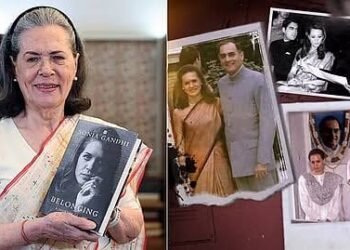


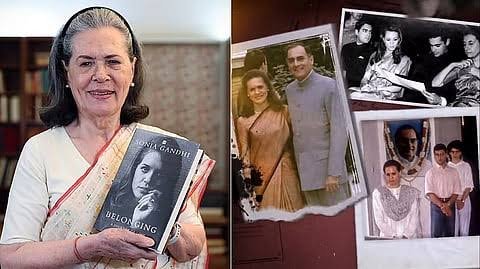
NEW DELHI | NOVEMBER 10, 2026 : Former Congress president Sonia Gandhi has recalled that then Prime Minister Indira Gandhi broke down in tears while watching footage of the aftermath of Operation Blue Star in 1984, describing the moment as one marked by pain, regret and sorrow over the loss of lives and the way the military operation at the Golden Temple had ended.

In her memoir, Belonging: A Journey of Love, Sonia Gandhi recounts how the aftermath of the operation deeply affected her mother-in-law, who had ordered the military action to remove armed militants from the Golden Temple complex in Amritsar.
According to Sonia Gandhi, an intelligence official showed Indira Gandhi a film documenting the aftermath, including bodies, damaged fortifications and weapons recovered from positions inside the complex.
“As my mother-in-law watched the slow-moving record, I could see her face wet with tears,” Sonia Gandhi writes, describing what she believed were tears of pain, regret and sorrow over the heavy casualties.
🔴 OPERATION BLUE STAR: A DEFINING MOMENT IN INDIA’S HISTORY
Operation Blue Star was launched in June 1984 after armed militants led by Jarnail Singh Bhindranwale established a strong presence inside the Golden Temple complex, Sikhism’s holiest shrine.
Sonia Gandhi’s account traces the rise of Bhindranwale and the increasingly violent political situation in Punjab during the preceding years. She alleges that rival factions within the Punjab Congress had initially promoted him in an effort to weaken one another before he developed an independent political following.
Her memoir describes a period marked by bomb blasts, killings, bus hijackings and growing tensions between Sikh and Hindu communities.
She also alleges that Pakistani intelligence agencies infiltrated the agitation and contributed to the escalation of violence. These claims form part of her account of the political and security circumstances preceding the operation.
⚔️ GOLDEN TEMPLE COMPLEX BECAME AN ARMED STRONGHOLD
According to Sonia Gandhi, Bhindranwale established himself inside the Golden Temple complex in 1982 and developed an organisational structure that exercised influence beyond the religious institution.
She writes that weapons were accumulated inside the complex and that fortified positions were established, while people opposing Bhindranwale’s politics were targeted.
The situation created a serious challenge for the government, particularly because the complex held immense religious significance for Sikhs across India and abroad.
Sonia Gandhi says Indira Gandhi continued holding discussions with Shiromani Akali Dal leaders in an attempt to reach a political settlement, even as the violence and tensions intensified.
Her account states that intelligence reports subsequently warned of plans to declare Khalistan an independent state and raise its flag at the Golden Temple on August 15, 1984.
🪖 MILITARY ACTION RESULTED IN HEAVY CASUALTIES AND DAMAGE
Indira Gandhi eventually ordered the armed forces to launch Operation Blue Star. The operation began on June 1, 1984, and the Army entered the Golden Temple complex on June 4, according to Sonia Gandhi’s account.
She writes that the complex was more heavily fortified and equipped with weapons than security assessments had indicated.
The ensuing battle resulted in substantial casualties and extensive damage to parts of the sacred complex.
For many Sikhs, the military action inside their holiest shrine was experienced as a profound religious and emotional wound, deepening tensions between the government and sections of the Sikh community.
The operation remains one of the most sensitive and consequential episodes in modern Indian history, with continuing debate over the decisions that led to it and its lasting consequences.
💔 INDIRA GANDHI’S EMOTIONAL RESPONSE
The memoir’s most striking recollection concerns Indira Gandhi’s reaction to the footage showing the aftermath.
Sonia Gandhi describes seeing the then prime minister visibly overcome with emotion as she watched images of the dead, the destruction and the fortified positions inside the complex.
She interprets the tears as an expression of pain and regret over the lives lost and the manner in which the siege had ended.
The account offers a personal perspective on the emotional burden surrounding the decision, while reflecting Sonia Gandhi’s own interpretation of Indira Gandhi’s state of mind.
🛡️ SECURITY CONCERNS DEEPENED AFTER THE OPERATION
Sonia Gandhi also recounts the heightened security concerns facing the Nehru-Gandhi family following Operation Blue Star.
She says Indira Gandhi warned her against allowing Rahul and Priyanka to play as freely as before in the neighbouring Akbar Road premises, particularly after dusk.
Despite the growing danger, Indira Gandhi refused to remove Sikh personnel from her security arrangements, Sonia Gandhi writes, believing that such a decision would contradict her principles.
Sonia Gandhi portrays her mother-in-law as someone who believed every Indian deserved equal respect regardless of religion, caste or region.
🔫 INDIRA GANDHI’S ASSASSINATION
On October 31, 1984, Indira Gandhi was assassinated by two Sikh members of her security detail.
In her memoir, Sonia Gandhi recalls that one of the guards had regularly accompanied Rahul and Priyanka during their games at Akbar Road.
The assassination followed Operation Blue Star by several months and was followed by widespread anti-Sikh violence, leaving a deep and lasting scar on India’s social and political history.
📖 A PERSONAL ACCOUNT OF A HISTORIC TURNING POINT
Sonia Gandhi’s recollections bring together the political decisions, security concerns and personal consequences surrounding one of the most painful chapters in independent India’s history.
Her account highlights the dilemma faced by the government between addressing an escalating security crisis and protecting the sanctity of a revered religious site.
More than four decades later, Operation Blue Star remains a powerful reminder of the human cost of political violence, the dangers of communal polarisation and the lasting consequences of decisions taken during a national crisis.