


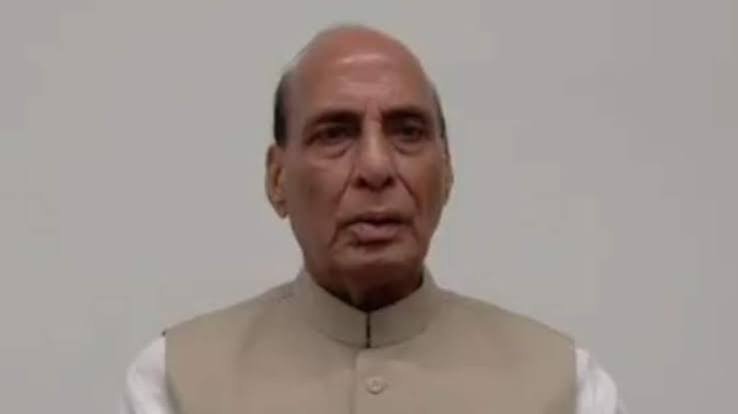
New Delhi. August 21, 2026 : Defence Minister Rajnath Singh on Friday launched a sharp attack on the Congress over its decision to restrict the singing of Vande Mataram to its first two stanzas at party programmes, describing the move as “entirely unconstitutional” and “reprehensible.”

Singh questioned the Congress Working Committee’s decision to reaffirm its 1937 resolution on the National Song, saying it raised serious questions about the party’s commitment to constitutional values and its respect for national symbols.
“The Congress’s formal refusal not only to honour Vande Mataram but to oppose it is extremely regrettable and, from a constitutional perspective, a very serious matter,” Singh said.
He argued that Parliament has the authority to enact laws that are binding on citizens and institutions, adding that refusal to abide by constitutional or legal obligations could raise questions about an individual or organisation’s commitment to the Constitution.
Singh also linked respect for the National Song with patriotism, saying that opposition to its complete rendition placed a question mark over the Congress’s approach to national symbols.
The remarks came amid an intensifying political confrontation between the Bharatiya Janata Party (BJP) and the Congress over the rendition of Vande Mataram. The Congress Working Committee recently resolved that only the first two stanzas would be sung at party events, reaffirming the position adopted by the party in 1937.
The Congress has maintained that the decision reflects the position taken by its leadership during the freedom movement.
Singh also criticised the historical circumstances surrounding the 1937 resolution. He alleged that the Congress had restricted the song at the time under pressure from the Muslim League and accused the party of repeating what he described as a policy of “appeasement.”
According to Singh, compromises with radical elements had historically produced serious consequences for the country. He alleged that the Congress’s current position represented a similar approach and warned that such politics could have implications for the country’s future.
Calling the Congress decision “foolish and dangerous,” Singh said the party had exposed its intentions by opposing the complete rendition of the National Song.
Vande Mataram, composed by Bankim Chandra Chattopadhyay in Sanskritised Bengali in 1875 and later incorporated into his novel Anandamath, became one of the most powerful symbols of India’s freedom struggle. It gained particular prominence during the Swadeshi movement and was subsequently accorded the status of India’s National Song.
The latest controversy over its rendition has once again brought questions surrounding history, national symbols, political tradition and competing interpretations of the freedom movement to the centre of the political debate.