

By M S Nazki
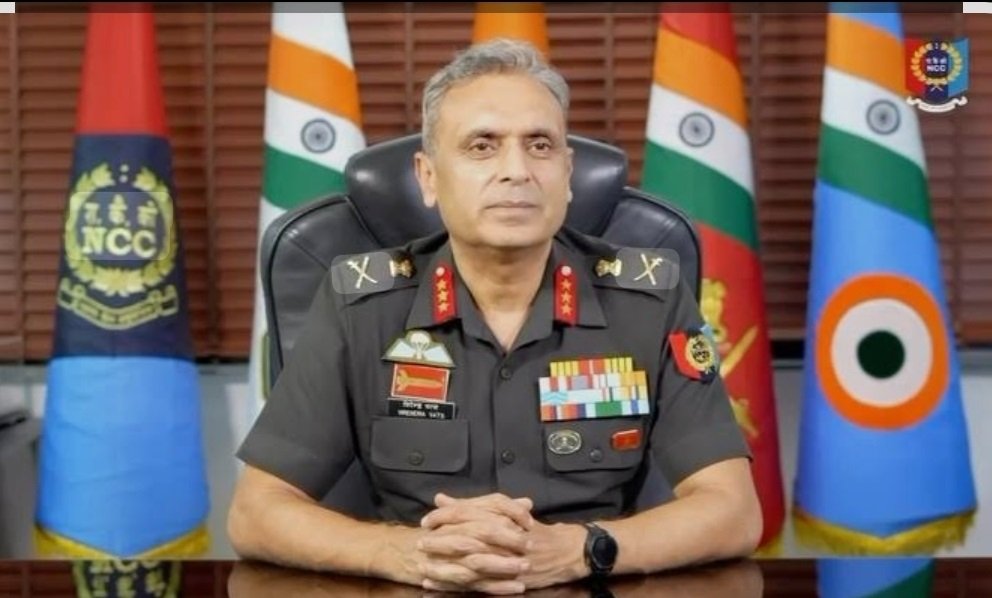
In building on this significant welfare initiative, DG NCC Lt Gen Virendra Vats, YSM, SM, VSM highlights what the reclassification of 87 Non-Military Stations means for NCC personnel. Recognising their service. Strengthening their welfare!
-National Cadet Corps (NCC) boy cadets across India have repeatedly shown extraordinary courage, stepping into life-threatening situations long before wearing an armed forces uniform. Here are some of the most inspiring real-life stories of bravery by boy cadets…
1. Sgt. Pratap Singh (1965 Indo-Pak War):
• The Crisis. On September 13, 1965, enemy aircraft bombed a goods train carrying diesel oil and live ammunition at the Gurdaspur railway station in Punjab. The diesel wagons caught fire, creating a massive inferno that threatened to detonate the adjacent ammunition wagons and wipe out the surrounding town.
• The Act of Bravery. Ignoring the blinding smoke, intense heat, and threat of imminent explosions, Sergeant Pratap Singh of the 10th Punjab Battalion NCC led 59 fellow cadets straight into the danger zone. Together, they manually uncoupled the burning diesel coaches from the ammunition wagons and pushed the explosive-laden cars to safety, sustaining severe burns in the process.
• Recognition. His quick thinking and leadership averted a catastrophic disaster, earning him the Ashoka Chakra Class III (now Shaurya Chakra) from the President of India in 1966.
2. SUO Bimal Jagdishchandra Kapadia (2002 Akshardham Temple Attack)
• The Crisis. On September 24, 2002, heavily armed terrorists stormed the Akshardham Temple complex in Gandhinagar, Gujarat, trapping hundreds of panicked pilgrims, including women and children, inside.
• The Act of Bravery. Senior Under Officer Bimal Jagdishchandra Kapadia, an NCC cadet present at the site, chose not to flee. Drawing on his NCC training, he remained calm under gunfire, guided terrified families away from the line of fire, and coordinated the evacuation of numerous women and children to safety before commando operations neutralized the threat.
• Recognition. For disregarding his personal safety to save innocent lives, he was awarded the prestigious Raksha Mantri Padak at the NCC Republic Day Camp in 2004…
3. Future War Heroes Shaped by the NCC
-Several of India’s highest-decorated soldiers began their journeys of courage as young NCC boy cadets, where their leadership instincts were first tested:
• Capt. Manoj Kumar Pandey (Param Vir Chakra). Before leading the legendary Gorkha Rifles charge at Khalubar during the 1999 Kargil War, he was adjudged the Best Cadet of the Junior Division NCC in the Uttar Pradesh Directorate in 1990.
• Capt. Vikram Batra (Param Vir Chakra). Known as Shershaah for his fearless recapture of Point 4875 in Kargil, Vikram Batra was an active Senior Division Air Wing NCC cadet in Chandigarh, earning his ‘C’ Certificate and marching in the Republic Day Parade.
• Maj. Sandeep Unnikrishnan (Ashoka Chakra). Before making the supreme sacrifice rescuing hostages during the 26/11 Mumbai terror attacks, he honed his discipline and resolve as an NCC cadet during his school years in Bengaluru…
-The National Cadet Corps (NCC) in India was formed in 1948 (under the NCC Act of 1948 and formally raised on July 15, 1948) to build a trained youth reserve for national emergencies, spark interest in defense, and shape young citizens into disciplined leaders.
-Early Roots (1917–1942):
• University Corps (1917): Created under the Indian Defence Act of 1917 to address shortages in the British Indian Army during World War I.
• UTC and UOTC (1920–1942): Replaced by the University Training Corps (UTC) under the Indian Territorial Act of 1920 to attract youth and advance the Indianization of the armed forces, later renamed the University Officers Training Corps (UOTC) in 1942.
-Post-Independence Formation (1946–1948)
• Kunzru Committee (1946): Set up at the request of Prime Minister Jawaharlal Nehru to recommend a nationwide youth cadet scheme for schools and colleges, as earlier schemes fell short during World War II.
• National Security & Youth Development: Following independence and partition, leaders saw the need for an organized, trained youth force that could support defense expansion in emergencies while fostering strong citizenship.
-Core Aims of the NCC
• Develop character, courage, comradeship, discipline, leadership, and selfless service among young people.
• Encourage interest in the defense of the country through service training.
• Maintain a reserve pool of youth to help the Armed Forces expand quickly during emergencies.
-In November 2026, India’s Ministry of Defence reclassified 87 Non-Military Stations across the country as “Hard Non-Military Stations” (HNMS) to improve welfare and allowances for armed forces personnel serving there, including those posted with the National Cadet Corps (NCC).
-What It Means for NCC Personnel
• Footprint reach: The NCC operates across more than 800 units and 831 locations covering nearly all districts in India, placing many personnel in remote or infrastructure-limited areas.
• Family accommodation: Personnel posted to these 87 locations do not have to move their families there and can retain family accommodation at a station of their choice.
• Financial & living support: The reclassification extends enhanced House Rent Allowance (HRA) and accommodation benefits to address gaps in local infrastructure, such as medical and family education facilities.
-What a Non-Military Station Is?
-Unlike a cantonment or dedicated military base, a non-military station has no military-controlled land. Personnel posted there live and work within civilian areas.
-Defence Ministry reclassifies 87 non-military stations as ‘hard’; NCC hails enhanced benefits
-The Ministry of Defence has officially reclassified 87 Non-Military Stations across India as ‘Hard Non-Military Stations’ (HNMS), extending enhanced House Rent Allowance (HRA) and accommodation benefits to defence personnel posted to these challenging locations.
-The policy shift is expected to provide substantial relief to armed forces personnel attached to the National Cadet Corps (NCC).
-Welcoming the move, the NCC highlighted its broad operational expanse and the positive impact on its staff: “The NCC, with its pan-India footprint in 831 locations across the country, truly represents the diversity of Bharat. This measure will be a significant relief to the personnel of NCC posted to remote and challenging areas.”
-The organisation further characterised the reclassification as a meaningful step towards ensuring the financial security and family welfare of its personnel.
-A Non-Military Station refers to any location, city, or town where military personnel or units are posted but which lacks a dedicated, self-contained military base, cantonment, or exclusive service infrastructure.
-Unlike traditional military stations or cantonments managed by the Army or Defence Estates, Non-Military Stations have no military-controlled land.
-In these civilian environments, personnel, including those assigned to NCC units, recruiting offices, or liaison details, live and work within standard civilian communities. Because official married quarters or specialised military housing are frequently unavailable in these areas, stationed personnel are entitled to specific housing benefits, including HRA.
-Similarly, instead of accessing local service hospitals within a base, military personnel, retired staff, and veterans in these non-military areas rely on healthcare provided through standalone Ex-Servicemen Contributory Health Scheme (ECHS) polyclinics and empanelled private or civilian hospitals.
-Under the updated framework, Hard Non-Military Stations (HNMS) are formally recognised as non-combat or civilian-adjacent postings that present particularly difficult living conditions, remote geography, or a severe lack of suitable family accommodation.
-Although these sites are not active tactical combat zones, the government and defence administration designate them as “hard” or difficult posts, comparable to field or tenure postings.
-Because official family accommodation is often missing or inadequate at these remote administrative, training, and NCC or Sainik School nodes, personnel posted to designated Hard Non-Military Stations are typically permitted to retain their families at a designated or last-held duty station.
-Alternatively, they can claim HRA alongside Special/Separated Family Accommodation (SPR) benefits under specific administrative orders.
-Modern Acts of Grit & Expedition Bravery:
• 2025 NCC Everest Expedition. A team of 10 teenage NCC cadets (five boys and five girls aged 16 to 19) battled sub-zero blizzards, avalanches, and thin air across the Siachen and Himalayan ranges to successfully summit Mount Everest in May 2025, showcasing immense physical endurance and teamwork.
• 2026 Konkan Sea Expedition. Boy and girl naval cadets rowed non-motorized 27-foot DK Whaler boats across 254 km of open, rough Arabian Sea between Ratnagiri and Palshet using purely muscle power and tidal navigation.
-Women cadets in the National Cadet Corps (NCC) demonstrate courage through high-altitude expeditions, real-life acts of bravery, military training, and civic service. Female participation in the NCC has expanded significantly since the Girls Division was raised in 1949, building leadership and resilience among young women across India.
-Notable Examples of Courage and Achievement
• High-Altitude Expeditions: In September 2026, the All India NCC Girls Himalayan Expedition (Aparajita) completed Phase I by crossing the Pin Bhaba Pass at 4,890 meters (16,040 feet) along a 60-km trek toward Mud, Spiti, en route to Parang La across Himachal Pradesh and Ladakh.
• Real-Life Bravery: NCC cadet Vasundhara Chouhan stood up to armed assailants who attacked a bus escorting a convict in Rajasthan, earning direct recruitment as a police Sub-Inspector for her courage.
• Pathways to Military Leadership: Former NCC cadet Divya Ajith Kumar became the first woman to win the Sword of Honour at the Officers Training Academy and later led the first all-women contingent on Republic Day in 2015.
-Everyday Discipline and Service
• Rigorous Training: Cadets undergo drill, weapon handling, physical conditioning, and self-defense training alongside annual camps.
• Civic and Community Action: Women cadets regularly support public safety and community drives, including traffic and crowd management during major events and road-safety awareness campaigns. More details on Empowering Women through NCC highlight how structured training and peer support help cadets overcome stereotypes and take on leadership roles.
-The purpose of the National Cadet Corps (NCC) is to build an organized, trained, and motivated youth resource that provides leadership across all walks of life, serves the nation, and develops interest in joining the Indian Armed Forces.
-Guided by its motto “Unity and Discipline,” the Directorate of National Cadet Corps focuses on the following core goals:
• Personal Development: Cultivate character, courage, comradeship, discipline, leadership, secular outlook, sportsmanship, and a spirit of adventure among school and college cadets.
• Selfless Service: Instill ideals of community service and readiness to help during national needs or emergencies.
• Armed Forces Motivation: Create a supportive environment that encourages youth to pursue careers in the Army, Navy, or Air Force.
• Leadership Across Fields: Prepare capable, disciplined citizens who contribute effectively in civil life, public service, and various professions.
-Current Aim of NCC
-Directorate of National Cadet Corps
November 11, 2026 — Navigation In view of the changing socio-economic environment, an exercise was undertaken by the Ministry of Defence to make aim…
-In view of the changing socio-economic environment, an exercise was undertaken by the Ministry of Defence to make aims of National Cadet Corps in tune with the aspirations of the youth. As part of recommendations of an Evaluation Committee, the following aims have since been adopted by the National Cadet Corps:-
-Growth
-To develop qualities of Character, Courage, Comradeship, Discipline, Leadership, Secular Outlook, Spirit of Adventure and Sportsmanship, besides the ideals of Selfless Service among the youth to make them useful citizens.
-To create human resource of organized, trained and motivated youth, provide leadership in all walks of life including the Armed Forces and always be available for the service of the Nation.
The movement was open to both school and university students. The corps started in a small way with a target of only 32,500 Senior Division and 1,35,000 Junior Division Cadets. Today, its sanctioned strength stand more than 12 lakh cadets.
-The National Cadet Corps was given an inter-service image in 1950 when the Air Wing was added followed by the Naval Wing in 1952. While elementary military training was given to school students (cadets of Junior Division), college students (cadets of the Senior Division) were trained as potential officers of the Army. Following the Chinese Aggression, to meet the requirement of the nation, the National Cadet Corps training was made compulsory in 1963. However, on the resistance of students against compulsory National Cadet Corps training and also on the suggestions of some Vice Chancellors, the entry into the NCC was again made voluntary in 1968.
-The National Cadet Corps (NCC) in India was launched in July 1948 under the National Cadet Corps Act of 1948 to build a trained youth reserve, foster leadership and character, and encourage interest in national defense following independence and the 1947–1948 conflicts.
-Key Reasons Behind Its Launch
• Building a defense reserve: Post-independence security needs—including partition and the Kashmir conflict—highlighted the need for a trained reserve to help expand the Armed Forces during emergencies.
• Replacing earlier cadet schemes: It succeeded the British-era University Officers Training Corps (UOTC), which had fallen short of expectations during World War II, aiming to provide better peacetime training across schools and colleges nationwide.
• Developing citizens and leaders: Following recommendations from the 1946 committee headed by Pandit H.N. Kunzru, the NCC was designed to instill discipline, comradeship, leadership, and ideals of service in young boys and girls.
-So to the final lines
-Divya Ajith Kumar
Divya Ajith Kumar is an Army Air Defense (AAD) officer in the Indian Army. She graduated from the Officers Training Academy, Chennai. Kumar is the first woman to be conferred by the Army with the Sword of Honour, a prize given to the best cadet. She led an all-woman contingent of 154 female officers and cadets during the Republic Day Parade in 2015.
-Early life and education
-Divya Ajith Kumar was born in Chennai to a Tamil family. She is a first-generation soldier. She attended Good Shepherd Matriculation Higher Secondary School, and Stella Maris College, Chennai, where she completed her B.Com. (Hons). She joined the National Cadet Corps (NCC) and participated in the NCC women contingent in Rajpath. Kumar later joined, and graduated from the Officers Training Academy (OTA). Kumar was awarded the Sword of Honour prize, given to the best cadet. She was the first woman to be awarded the prize.
-Military career
-Kumar was commissioned into Corps of Army Air Defence in September 2010. She also jointly topped the Young Officers’ course of the Army Air Defence College in 2011 and was awarded the Silver Gun Trophy. Kumar led the first all-women contingent of the Army on Republic Day in 2015. She led a contingent of 126 officers and 28 cadets during the parade, where US President Barack Obama was present as the chief guest. She currently teaches at the Officers Training Academy in Chennai…………