

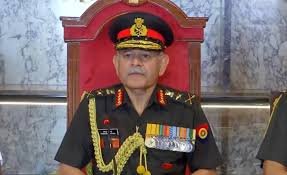
Pune, May 30, 2026 : Chief of Army Staff General Upendra Dwivedi on Saturday asserted that the Indian Armed Forces are fully prepared for “Operation Sindoor 2.0” if the need arises, emphasizing that all three services are enhancing integration and readiness to meet future security challenges across multiple domains.

Speaking at a press conference on the sidelines of the passing-out parade of the 150th course of the National Defence Academy (NDA) at Khadakwasla near Pune, the Army Chief said the armed forces continue to maintain a high level of preparedness despite the current temporary cessation of hostilities.
“As far as Operation Sindoor is concerned, firstly, it is still continuing. There is a temporary cessation of hostilities. Therefore, the Indian Army and all three services are preparing well for Operation Sindoor 2.0 if it takes place,” General Dwivedi said.
Operation Sindoor was launched by India in May 2025 to target terrorist infrastructure in Pakistan following the deadly Pahalgam terror attack in April 2025, which claimed the lives of 26 people.
Highlighting the evolving nature of warfare, the Army Chief said future conflicts will no longer be confined to conventional land, sea and air battles but will increasingly involve cyber, space and cognitive domains.
He observed that modern battlefields have become highly transparent due to technological advancements, making surveillance and intelligence capabilities more critical than ever before.
“The battlefield is so transparent that every movement is known to the other side. Therefore, we have to be extremely cautious in terms of deployment, employment of resources and protection of troops as well as civilians in border areas,” he said.
General Dwivedi stressed the growing importance of information warfare and national unity in determining outcomes during conflicts.
“Victory is always in the mind. It is not on the ground. Information warfare succeeds only when the nation trusts those providing information. A nation united in trust will always emerge victorious,” he remarked.
Reflecting on the lessons learned from Operation Sindoor, the Army Chief said the operation demonstrated India’s determination and capability to deliver a calibrated, precise and purposeful response to security threats.
“This operation underlined the importance of integrated planning, real-time intelligence, precision targeting, strong air defence, secure communications and synergy across multiple domains,” he said.
General Dwivedi also highlighted the Indian Army’s ongoing modernization drive under the “Decade of Transformation” initiative aimed at creating a future-ready force equipped to handle emerging threats.
He said several technology-enabled formations, including drone battalions, Divyastra batteries, Shaktiman regiments and Bhairav battalions, have been raised using available resources as part of this transformation process.
The Army Chief emphasized that the next major milestone is achieving complete networking and data-centric operations, where information becomes a strategic asset enabling faster, smarter and more resilient decision-making.
Speaking about the growing role of drones in military operations, he reiterated his vision of “Eagle on the Arm,” under which every soldier should possess the capability to operate drones effectively.
“This means every soldier should have an ‘eagle’ in their hand. Every soldier should have the capability to fly a drone. Training and simulator-based learning are already underway in military academies and training institutions,” he said.
General Dwivedi also provided an update on the long-awaited military theatreisation process, stating that the initiative is progressing on the right track.
He said deliberations within the Chiefs of Staff Committee have been completed and a comprehensive report has already been submitted to Defence Minister Rajnath Singh for review.
According to the proposed structure, service chiefs will continue to be responsible for raising, training and sustaining forces, while theatre commanders will oversee integrated operational deployment and orchestration.
“We are hopeful that under the new Chief of Defence Staff setup, the process will move forward and become visible on the ground within the next two to three years,” he said.
Earlier, while reviewing the passing-out parade of the NDA’s 150th course, General Dwivedi described Operation Sindoor as a defining example of India’s response to provocation.
“Operation Sindoor demonstrated how national will can be expressed with precision and resolve. It has set a benchmark for how Bharat responds to provocation,” he said.
Addressing the graduating cadets, the Army Chief urged them to prepare for an increasingly complex security environment characterized by hybrid warfare, technological disruption and contested grey zones.
Calling the occasion deeply personal, General Dwivedi recalled passing out from the same academy more than four decades ago and reflected on his long journey in uniform.
“As I stand here at the far end of a life in uniform, preparing to doff mine as you prepare to don yours, I can tell you with certainty that what you begin here endures forever,” he told the cadets.