

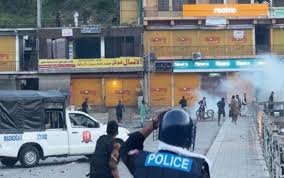
ISLAMABAD, June 10, 2026 : Large parts of Pakistan-occupied Jammu and Kashmir (PoJK) witnessed a near-complete shutdown on Wednesday following a protest call issued by the Joint Awami Action Committee (JAAC), as tensions continued to escalate in the region amid reports of casualties, arrests, and heightened security deployments.

Shops, commercial establishments, and markets remained closed in several towns, while roads witnessed limited movement as authorities intensified security measures in response to the ongoing agitation.
Protest March Gains Momentum
According to reports, approximately 2,000 protesters associated with the JAAC began a protest march from Bhimber on Tuesday as part of a larger mobilization effort aimed at reaching Muzaffarabad, the administrative center of PoJK.
Reports indicated that separate groups of demonstrators were also expected to travel through Rawalakot before converging in Muzaffarabad.
The movement forms part of a broader campaign led by the JAAC, which has been raising demands related to economic relief, governance reforms, and political representation.
Markets and Streets Witness Shutdown
Several urban centers across PoJK reported extensive business closures in response to the protest call.
Muzaffarabad
Reports from Muzaffarabad indicated that roads remained largely deserted, with significantly reduced traffic movement and commercial activity.
Although security forces maintained a strong presence throughout the city, no major public demonstrations were immediately reported during the day.
Mirpur
In Mirpur, another major urban center of the region, hundreds of people reportedly gathered at Quaid-i-Azam Stadium.
Local observers noted that markets remained closed and normal traffic activity was considerably disrupted as residents responded to the shutdown call.
Heavy Security Deployment Across Region
Authorities deployed additional police and security personnel in various sensitive areas to maintain law and order.
Security forces reportedly conducted patrols across key routes and urban centers as the protest movement continued to expand.
The heightened deployment comes amid concerns over potential unrest following recent confrontations between protesters and law enforcement agencies.
Lawyers Boycott Court Proceedings
Adding to the pressure on authorities, the legal fraternity in PoJK reportedly boycotted judicial proceedings following a call by the Bar Council.
The protest was linked to the alleged arrest of senior lawyer Amjad Ali Khan, who is reported to be a core member of the Joint Awami Action Committee.
The legal community’s participation has further broadened the scope of the ongoing agitation beyond street demonstrations.
Human Rights Concerns Raised
Pakistan’s human rights organizations have expressed concern over reports of violence and casualties associated with recent clashes in the region.
Human rights advocates stated that they were closely monitoring developments and urged restraint from all parties involved.
Reports suggest that more than twenty people have allegedly lost their lives during recent confrontations, though the exact figures remain subject to verification.
Authorities Announce Reward for JAAC Leaders
In a significant development, authorities announced financial rewards for information leading to the arrest of several key JAAC leaders.
According to official notifications, a reward of Rs 10 million has been announced for information facilitating the arrest of prominent leaders, including:
- Shaukat Nawaz Mir
- Omar Nazir Kashmiri
- Sardar Aman
- Khawaja Mehran
Authorities stated that the identities of individuals providing information would remain confidential.
Core Demands of the Movement
The JAAC has emerged as one of the most active protest groups in PoJK, advocating a range of political and economic demands.
Among its major demands are:
Subsidized Flour and Electricity
Protesters have sought greater economic relief measures, including affordable electricity and subsidized essential commodities.
Abolition of Refugee Seats
The group has also called for the removal of 12 refugee seats in the region’s legislative assembly.
These seats are currently reserved for individuals classified as refugees from Jammu and Kashmir who migrated to Pakistan after 1947.
JAAC leaders argue that the arrangement requires review and reform.
Call for Dialogue and Negotiation
Amid the ongoing unrest, PoJK’s Prime Minister Faisal Mumtaz Rathore appealed for calm and urged all stakeholders to return to the negotiating table.
Rathore acknowledged that certain issues raised by protesters, particularly those concerning refugee representation, deserve consideration and careful examination.
However, he emphasized that sustainable solutions should emerge through dialogue and democratic engagement rather than confrontation.
Region Faces Continued Uncertainty
The latest shutdown underscores the growing tensions in PoJK as economic grievances, political demands, and concerns over governance continue to fuel public mobilization.
With demonstrations ongoing, security forces on alert, and negotiations yet to yield a breakthrough, the region remains at a critical juncture.
Observers believe that the coming days will be crucial in determining whether dialogue can reduce tensions or whether the confrontation between authorities and protesters will intensify further.