

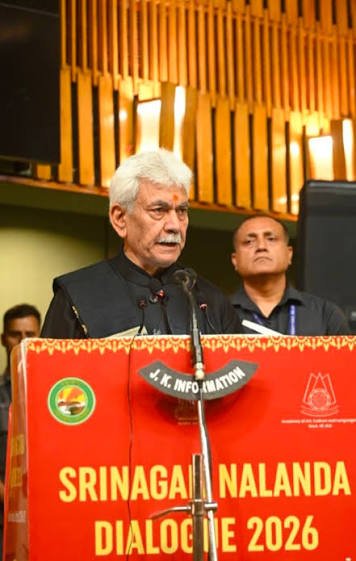
Srinagar, June 20, 2026 : Lieutenant Governor Shri Manoj Sinha today delivered the keynote address at the prestigious Srinagar–Nalanda Dialogue, emphasizing the need to revive India’s rich intellectual and spiritual heritage while building a future-oriented education system that seamlessly integrates traditional wisdom with modern technology.

The event was organized by the Ministry of Tourism, Department of Culture, Jammu & Kashmir, Indira Gandhi National Centre for the Arts (IGNCA), National School of Drama, and Nava Nalanda Mahavihara University. It brought together eminent scholars, academicians, cultural leaders, artists, and young minds to deliberate on India’s enduring civilizational legacy and its relevance in contemporary times.
Addressing the gathering, the Lieutenant Governor underscored the importance of good governance and cultural dialogue in shaping the moral, cultural, and human character of society. He noted that inclusive policies and social harmony emerge when governance and culture work hand in hand.
Shri Manoj Sinha highlighted the historic intellectual bond between Jammu & Kashmir and Nalanda, stating that scholars from both regions contributed significantly to one of the world’s oldest living civilizations.
“Together, the scholars of Jammu Kashmir and Nalanda shaped one of the world’s oldest living civilizations. This heritage is our guiding light. The Srinagar–Nalanda Dialogue is our opportunity to carry that light forward with wisdom, courage, and a new vision for Viksit Bharat,” he said.
The Lieutenant Governor also stressed the need to strengthen India’s soft power and promote cultural diplomacy on the global stage. Referring to India’s historic role as a center of knowledge and learning, he said the country once united the world through its intellectual traditions and can once again serve as a bridge for global understanding.
“Centuries ago, India’s knowledge unified the globe. Today, we can be the bridge the world needs. The world is watching. Let us lead with confidence and compassion,” he remarked.
Highlighting India’s vast cultural diversity, Shri Sinha said that the youth have inherited a remarkable legacy of languages, philosophies, artistic traditions, beliefs, and ways of life. He described this diversity as India’s greatest strength and called for efforts to weave regional identities into a harmonious national consciousness.
He noted that from Bihar to Jammu & Kashmir, from the temples of Tamil Nadu to the monasteries of Ladakh, and from the ghats of Kashi to the valleys of Kashmir, every region contributes uniquely to India’s cultural tapestry.
Reflecting on India’s ancient centers of learning, the Lieutenant Governor said that Indian civilization has always been defined by institutions of knowledge such as Nalanda, Takshashila, and Vikramashila, which attracted scholars and travelers from across Asia and beyond.
Describing Nalanda as a living intellectual universe of its era, he said it was a seat of critical thinking where scholars engaged deeply with disciplines ranging from logic and grammar to medicine, mathematics, philosophy, religion, and the arts. He drew parallels with Jammu & Kashmir’s historic Sharda Peeth, which also served as a renowned center of learning across multiple disciplines.
The Lieutenant Governor emphasized that the younger generation must understand India’s ancient knowledge traditions, whose roots were significantly strengthened during Emperor Ashoka’s reign in the third century BCE. He pointed out that Srinagar itself was established by Emperor Ashoka, making the host city an important symbol of India’s civilizational continuity.
“The Srinagar–Nalanda Dialogue reminds us that the moment has come to renew this tradition as a modern, relevant intellectual project. Just as scholars in ancient times travelled from Nalanda to Jammu Kashmir carrying manuscripts, philosophies, and scientific ideas, we must revive open exchange and deep engagement of ideas,” he said.
Calling India’s historic towns living centers of learning, Shri Sinha cited Nalanda, Srinagar, Jammu, Purmandal, Varanasi, Hampi, Sanchi, Madurai, Puri, and Thanjavur as repositories of centuries of accumulated wisdom and experience.
He stressed the need for infrastructure development, heritage conservation, and cultural exchange platforms to strengthen the role of these towns in preserving and promoting India’s civilizational heritage. He also advocated for regular festivals, exhibitions, and intellectual discussions that connect scholars, artists, and citizens from across India and the world.
Among those present on the occasion were Padma Shri Prof. Shafi Shauq; Suman Billa, Director General, Ministry of Tourism, Government of India; Prof. Siddharth Singh, Vice Chancellor, Nava Nalanda Mahavihara University; Chittaranjan Tripathy, Director, National School of Drama; Ms. D. Aaliya, Festival Chairperson, Nalanda Literature Festival; Ganga Kumar, Festival Director, Nalanda Literature Festival; Prof. A. Ravinder Nath, Vice Chancellor, Central University of Kashmir; Prof. Nilofer Khan, Vice Chancellor, University of Kashmir; Dr. G.V. Sundeep Chakravarthy, SSP Srinagar; Akshay Labroo, Deputy Commissioner Srinagar; senior government officials, literary personalities, distinguished citizens, and a large number of youth participants.