


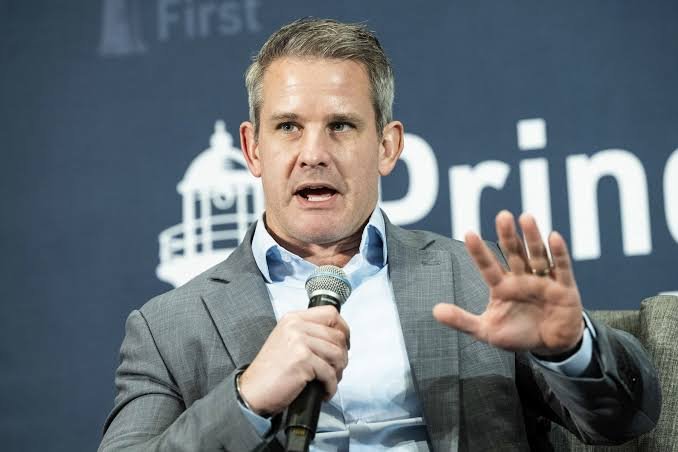
Washington, October 23, 2026 : A controversial oil agreement between the United States and Venezuela has come under scrutiny after former US Congressman Adam Kinzinger alleged that the deal involves a Venezuelan businessman who has faced money-laundering investigations in several countries.

Kinzinger claimed that North American Blue Energy Partners (NABEP), the company involved in the agreement, is run by businessman Alejandro Betancourt, who has reportedly faced investigations in Switzerland, Spain and the United States.
Citing an investigation by ProPublica, Kinzinger further alleged that US Department of Justice officials had asked foreign governments to close investigations involving Betancourt. These allegations have not, in the supplied report, been established as proven wrongdoing.
Agreement Reportedly Gives US Stake in Oil Company
According to the ProPublica report cited by Kinzinger, the agreement would give the US government a 35 per cent stake in NABEP’s parent company. The deal was reportedly signed by US Secretary of State Marco Rubio and Defence Secretary Pete Hegseth.
The report said the agreement was structured to make it difficult for future administrations in Washington or Caracas to dismantle the venture.
NABEP spokesperson Terry Wade reportedly rejected the allegations against Betancourt, stating that he had never been charged with a crime in any country and describing the claims against him as baseless.
The White House, State Department, Pentagon and NABEP have defended the arrangement, arguing that the public-private venture would deliver lasting economic benefits to both countries.
Trump Administration Highlights Massive Oil Reserves
US President Donald Trump has promoted the agreement as a major step towards strengthening American energy dominance. He has claimed it could provide access to 111 billion barrels of oil, comprising 65 billion barrels from Venezuela and 46 billion barrels from proven US reserves.
According to the report, however, the 18-page contract indicates that US purchasing rights would expire after half the period publicly described, while the underlying operating rights could conflict with Venezuelan laws limiting oil concessions to 25 years.
The White House has described the agreement as a historic initiative intended to stabilise Venezuela’s economy after years of hyperinflation and limited new investment.
Discounted Oil Terms Raise Questions
Under the reported terms, the United States would have the right to purchase 20 per cent of NABEP’s oil at a discounted price of $30 per barrel.
However, ProPublica’s report raised questions about whether the price adequately reflects the actual cost of obtaining Venezuelan crude.
Much of Venezuela’s oil is exceptionally heavy and must be blended with lighter petroleum products before it can flow through pipelines. The report said the additional materials can account for 20 per cent or more of the mixture, potentially adding substantial costs that are not included in the stated price.
The report also questioned whether the agreement explicitly obliges Betancourt’s company to pay Venezuela an estimated $200 billion in royalties and taxes that the White House has said would benefit the country.
Venezuela Projects Billions in Investment and Revenue
The Venezuelan government has said the agreement would involve developing 17 oil fields with a stated potential of 65 billion barrels. It has projected that the initiative could attract $100 billion in investment to the country’s oil industry and generate more than $209 billion in tax revenue for Caracas.
Trump announced the sweeping arrangement in August, presenting it as an opportunity to unlock Venezuela’s vast petroleum resources and expand US access to energy supplies.
The announcement followed the US military operation, carried out at Trump’s direction nearly nine months earlier, that captured then-Venezuelan President Nicolás Maduro and brought him to the United States to face federal narco-terrorism and drug-trafficking charges.
Political and Economic Scrutiny Continues
Kinzinger, a former Republican representative from Illinois who has publicly clashed with Trump over several political and foreign-policy issues, has questioned the arrangement in light of the reported investigations and the contract’s financial terms.
The dispute places the agreement at the intersection of energy security, international investment, legal accountability and Venezuela’s economic recovery.
While supporters argue that the venture could revive Venezuela’s oil industry and strengthen US energy supplies, questions remain over the contract’s long-term commitments, the costs of transporting and processing heavy crude, and the extent to which projected financial benefits will reach the Venezuelan government.