


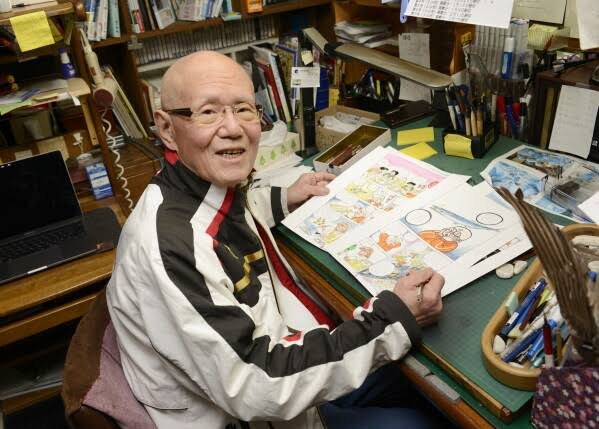
TOKYO | October 27, 2026 : The world of Japanese manga has lost one of its most influential storytellers. Tetsuya Chiba, the legendary artist behind the iconic boxing series Ashita no Joe, has died at the age of 87, according to his publisher, Kodansha Ltd.

Chiba died at a Tokyo hospital last Thursday, the publisher announced on Tuesday. The cause of death was not disclosed.
His passing marks the loss of an artist whose work inspired generations of readers through stories of struggle, determination, ambition and the human desire to rise above adversity.
But Chiba’s legacy extended far beyond the boxing ring. Shaped by his own childhood experiences of war, hunger and survival, he also became a passionate advocate for peace and freedom of expression.
🥊 1. Ashita no Joe: The Manga That Captured a Nation
<AsyncImageGroup query={[“Tetsuya Chiba Ashita no Joe original manga cover Joe Yabuki”,”Ashita no Joe classic manga artwork boxing Joe Yabuki”,”Ashita no Joe Japanese manga cover vintage”]} aspectRatio=”5:4″ layout=”bento” />
Chiba’s best-known work, Ashita no Joe, often translated as Fighting for Tomorrow, tells the story of Joe Yabuki, an orphan who fights his way toward becoming a professional boxer.
The series became a cultural phenomenon in Japan, capturing the struggles of a young man determined to find purpose and dignity through sport.
Joe was not a flawless hero. His rebellious spirit, emotional battles, fierce determination and willingness to confront seemingly impossible odds made him a compelling and unforgettable character.
The manga’s influence became so extraordinary that fans even held a mock funeral for Joe’s rival, illustrating the emotional connection readers had developed with its characters.
The series helped establish sports manga as a powerful storytelling genre, showing that athletic competition could explore much deeper themes: poverty, social inequality, ambition, sacrifice, friendship and the cost of pursuing a dream.
🎨 2. From a Difficult Childhood to Manga Stardom
<AsyncImage query=”Tetsuya Chiba Japanese manga artist portrait” aspectRatio=”5:4″ width=”100%” />
Born in Tokyo in January 1939, Chiba spent much of his early childhood in northeastern China, where his father worked at a printing factory during Japan’s occupation of the region.
His formative years were marked by upheaval and uncertainty.
When Japan surrendered on August 15, 1945, Chiba and his family were still in China. In the turbulent period that followed, they faced hunger and danger amid anti-Japanese violence.
The family survived with the help of his father’s Chinese translator, who reportedly sheltered them in an attic.
During that frightening period, young Chiba found comfort in drawing pictures for his three younger brothers.
That childhood experience would become one of the most meaningful foundations of his artistic life: even amid fear and uncertainty, drawing offered a way to express himself and bring comfort to others.
The family eventually fled to the Chinese port city of Huludao and returned to Japan in 1946.
The memories of war and survival remained with Chiba, influencing his later commitment to anti-war themes and his advocacy for peace.
✏️ 3. A Career That Helped Shape Japanese Manga
Chiba made his professional manga debut in 1956, initially creating comic books aimed at girls before moving toward stories for boys in the early 1960s.
In 1961, he debuted in a boys’ comic magazine with Chikai no Makyu, translated as The Magic Ball, a baseball-themed manga that helped establish his place in Japan’s developing sports-comics tradition.
Over the years, he created memorable stories featuring young people confronting demanding challenges and pursuing their ambitions.
His major works included:
- ⚾ ** Chikai no Makyu — The Magic Ball**: A baseball story that helped launch his career in boys’ manga.
- ⚔️ ** Ore wa Teppei — I’m Teppei**: The story of a high school student training in kendo, the Japanese martial art of swordsmanship.
- 🤼 ** Notari Matsutaro**: A story centred on sumo wrestling and the life of its determined protagonist.
- ⛳ ** Ashita Tenki ni Naare — Let’s Hope the Weather’s Fine Tomorrow**: A golf-themed story about a young aspiring athlete.
- 🥊 ** Ashita no Joe**: The landmark boxing series that became his defining work.
Across these different sporting worlds, Chiba repeatedly explored a common idea: ordinary people can discover extraordinary strength when they refuse to surrender to hardship.
🕊️ 4. The Artist Who Never Forgot the Reality of War
Although many readers remember Chiba for his sports heroes, his own life gave him a deep understanding of the devastating consequences of conflict.
His childhood memories of war, displacement and hunger influenced autobiographical stories and other works with anti-war themes.
He also spoke in support of peace and freedom of expression, believing that art could preserve memories, challenge indifference and help people understand the human cost of violence.
His experiences offered a perspective that extended beyond national boundaries. The family that helped him survive in China demonstrated how compassion can endure even when societies are divided by conflict.
That lesson gives his legacy particular poignancy: an artist whose work celebrated fighting spirit also understood why humanity must strive to prevent war.
🌟 5. Why His Legacy Will Endure
Chiba’s influence cannot be measured only by the popularity of a single series.
His work helped demonstrate that manga could be more than entertainment. It could serve as a mirror of society, an exploration of personal struggle and a means of connecting readers with people whose lives were very different from their own.
Through Joe Yabuki and his other protagonists, Chiba gave readers characters who struggled, failed, learned and continued moving forward.
His stories resonated because they did not portray success as effortless. They showed the emotional cost of ambition and the courage required to keep going when circumstances appear overwhelming.
For countless readers, Ashita no Joe became more than a boxing story. It became a story about the fight to find one’s place in the world.
And for future generations of artists, Chiba leaves behind an enduring example of how imagination, personal experience and social conscience can combine to create work that transcends its era.
🕯️ Farewell to a Manga Legend
Tetsuya Chiba’s life connected two seemingly different worlds: the brutality of war and the exhilarating struggle of the sporting arena.
Yet both appeared in his work through the same central question: how does a person find courage when life becomes difficult?
His characters fought in boxing rings, trained in dojos and pursued sporting dreams. Their battles reflected the struggles that millions of readers face in their own lives.
Chiba’s passing closes an extraordinary chapter in manga history, but his art remains. Every new reader discovering Joe Yabuki, every artist inspired by his storytelling and every person moved by his message of perseverance helps carry his legacy forward.
Rest in peace, Tetsuya Chiba. Your stories taught generations that even in the hardest circumstances, the human spirit can continue to fight for tomorrow.
Source note: This tribute is based on the supplied report and information attributed to publisher Kodansha Ltd. Images are illustrative references to the artist and his work.