


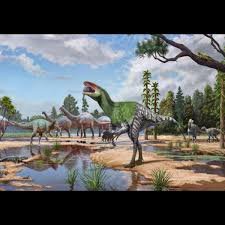
LONDON | October 27, 2026 : A remarkable discovery hidden in a museum collection for more than a century is giving scientists fresh clues about the evolution and global spread of dinosaurs.

Researchers have identified a new species of meat-eating dinosaur from a fossilised skull fragment originally discovered on England’s Isle of Wight. Named Invictibellatrix amberina, the dinosaur is believed to have lived approximately 120 million years ago, during the Early Cretaceous period.
Even more remarkably, it belongs to the mysterious group known as Megaraptora—predatory dinosaurs recognised for their slender skulls, lightly built bodies and enormous, powerful hand claws.
The discovery is particularly significant because it represents the first known European member of this group, helping scientists reconsider how these predators spread across prehistoric continents.
🔍 1. A Dinosaur Fossil Hidden for More Than 100 Years
The story began with a small piece of fossilised bone sitting among the extensive collections of London’s Natural History Museum.
In 2020, palaeontologist Paul Barrett came across the specimen while examining the museum’s fossil holdings. He recognised it as a potentially important part of a dinosaur skull known as the braincase—the structure that encloses and protects the brain.
Museum records traced the fossil to a beach near Sudmoor Point on the Isle of Wight, a location renowned for its rich dinosaur heritage.
The specimen was subsequently studied in detail by researchers, including palaeontologist Cassius Morrison, who was specialising in dinosaur braincases during his doctoral research.
Comparisons with other dinosaur fossils revealed that the specimen did not match any previously recognised species from the island.
What had appeared to be an unremarkable fragment turned out to be evidence of a previously unknown dinosaur.
The extraordinary lesson: a major scientific discovery can sometimes begin with nothing more than taking a second look at something already in a museum drawer.
🦴 2. A Five-Metre Predator With a Remarkable Family History
Scientists estimate that Invictibellatrix amberina measured approximately five metres from head to tail and weighed roughly as much as a large tiger.
That would make it comparatively small among known megaraptorans, some of which were considerably larger and possessed hand claws exceeding one foot in length.
Megaraptorans belonged to the theropod group of dinosaurs—the broader evolutionary lineage that also includes birds.
They are known for their distinctive combination of relatively slender skulls, lightly built skeletons and prominent claws. These features suggest that they were active predators, although the exact hunting strategies of individual species remain a subject of scientific investigation.
The newly identified British species may preserve clues about the earlier stages of megaraptoran evolution, before some members of the group evolved into much larger predators.
Its discovery adds an important piece to the puzzle of how these unusual carnivores developed and diversified over millions of years.
🧠 3. CT Scans Helped Reveal the Fossil’s Secrets
To investigate the fossil, the researchers compared its anatomical features with those of other predatory dinosaurs.
They also used computed tomography (CT) scanning, a technique that combines X-rays and computer processing to produce detailed images of structures hidden inside an object.
This allowed the team to examine the internal structure of the braincase and investigate features associated with the dinosaur’s brain.
The researchers then used a computer-based evolutionary analysis to help determine where the species belonged on the dinosaur family tree.
By combining anatomical comparisons, internal imaging and computational analysis, the team could evaluate its evolutionary relationships more systematically.
The results support the interpretation that Invictibellatrix amberina was an early member of the megaraptoran lineage, providing evidence about what these predators may have looked like before some of their relatives reached much larger sizes.
🌍 4. Why the First European Megaraptoran Matters
Before this discovery, known megaraptoran fossils came from places including Thailand, Japan, Australia and Argentina.
Their distribution across widely separated regions posed an important evolutionary question: How did these dinosaurs spread across the ancient world?
During the Cretaceous period, the arrangement of Earth’s continents was very different from today. Continents were shifting, and land connections and barriers changed over geological time.
Large terrestrial dinosaurs could not simply swim across vast oceans to populate distant continents. Their fossil distribution therefore provides clues about ancient geography, migration routes and the timing of evolutionary diversification.
The discovery of a megaraptoran in Europe offers a missing geographical link in this story.
The researchers propose that the group may have spread from Asia through Europe and Africa before reaching southern continents, including South America and Australia.
This is an evolutionary hypothesis rather than a completely settled migration route. Further fossils will be needed to establish the timing and pathways more precisely.
The discovery also raises the possibility that additional megaraptoran fossils could eventually be identified in places where the group remains poorly documented, potentially including Africa and Antarctica.
🏆 5. What Does Its Name Mean?
The dinosaur’s scientific name, Invictibellatrix amberina, carries a striking meaning.
It translates approximately to “unconquered female warrior of the amber.”
The name reflects the researchers’ interpretation of megaraptorans as successful predators that eventually became dominant in certain ecosystems, particularly in the later Cretaceous of South America.
The story of the group may represent a familiar pattern in evolution: a relatively modest early form gives rise to later species that become much more prominent within their environments.
In this case, the British fossil may provide clues to the earlier chapters of that evolutionary story.
🦕 6. What Other Dinosaurs Shared Its World?
Invictibellatrix amberina probably lived alongside several other predatory dinosaurs known from the Early Cretaceous of the Isle of Wight, including:
- Neovenator — a large predatory dinosaur related to allosauroids.
- Ceratosuchops — a spinosaurid dinosaur associated with a group that included fish-eating specialists.
- Eotyrannus — an early tyrannosauroid, belonging to the broader lineage that eventually produced Tyrannosaurus rex.
Having several carnivorous dinosaurs in the same ecosystem raises an important question: how did they coexist without all competing for exactly the same food?
Different predators may have favoured different prey, habitats or hunting strategies.
Researchers suggest that Invictibellatrix may have fed on smaller dinosaurs, mammals, lizards and possibly crocodilians. Spinosaurids, meanwhile, are associated with adaptations for exploiting aquatic or fish-rich environments, although their diets were not necessarily limited to fish.
These ecological differences may have helped multiple predators survive in the same prehistoric landscape.
🔬 7. The Greatest Discovery May Still Be Waiting
Perhaps the most remarkable aspect of this discovery is not simply the dinosaur itself, but how it was found.
The fossil was not unearthed during a dramatic new expedition. It had already been collected and stored for decades.
The Natural History Museum houses tens of millions of specimens. Collections of this size preserve enormous scientific value, but identifying that value can take generations of research, new technologies and fresh questions.
A fossil that once seemed insignificant may become important when scientists develop better methods for studying it or discover new specimens that provide a useful comparison.
The discovery of Invictibellatrix amberina demonstrates why preserving museum collections is essential: they are not merely records of the past, but archives of evidence that future scientists can continue to investigate.
And every newly identified species helps researchers reconstruct a little more of the complex history of life on Earth.
🌎 A Message From the Ancient World
A small fossil fragment, overlooked for generations, has helped illuminate a much larger story about evolution, ancient continents and the remarkable diversity of prehistoric life.
Invictibellatrix amberina reminds us that the history of our planet is still being pieced together—and that important answers can be hiding in places we thought we already understood.
Scientific note : This post is based on the supplied report. The proposed evolutionary relationships, migration route and diet are scientific interpretations that may be refined as further fossil evidence becomes available.