

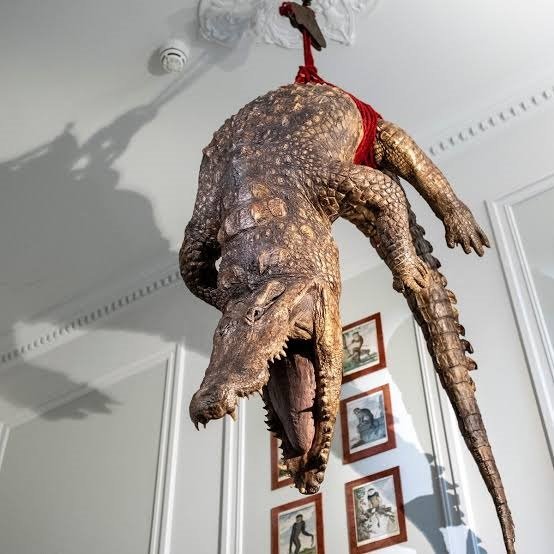
AMSTERDAM, NETHERLANDS | OCTOBER 30, 2026 : Imagine walking into a museum where a giant crocodile hangs overhead with its jaws wide open, a massive spider crab stretches its six-foot legs across a doorway, and preserved animals appear frozen in dramatic, almost theatrical poses. Now imagine that the humans are the ones behind bars—not the animals!

Welcome to Art Zoo, Amsterdam’s striking new museum, where natural history, artistic imagination and the macabre collide in an extraordinary exhibition that challenges how visitors see the animal kingdom.
🏛️ A MUSEUM UNLIKE ANY OTHER
Housed in a 17th-century canal house, Art Zoo features hundreds of preserved creatures, unusual bone arrangements, illuminated tulips displayed in apothecary jars and cabinets filled with bizarre fish specimens.
Unlike traditional natural history museums, where animals are generally displayed in poses resembling their behaviour in the wild, Art Zoo transforms taxidermy into dramatic visual storytelling.
Visitors encounter a cheetah slouched in an alcove beneath the gaze of a cassowary, a giant Japanese spider crab towering over a doorway and an enormous crocodile suspended above them.
The atmosphere is deliberately dark, theatrical and unsettling—making the museum particularly appealing to those fascinated by unusual art and the stranger side of nature.
🎨 THE ARTISTS BEHIND THE VISION
Art Zoo was created by Dutch artists Jaap Sinke and Ferry van Tongeren, who draw inspiration from the historic Wunderkammer—or cabinets of curiosities—that wealthy Europeans assembled during the 16th and 17th centuries.
These collections brought together unusual objects from nature, science and art, often blurring the boundaries between knowledge, wonder and spectacle.
Sinke and van Tongeren have taken that tradition in a bold new direction. Rather than simply reproducing the appearance of animals, they give their subjects dramatic poses and personalities, turning preserved specimens into elements of carefully constructed artistic narratives.
Their work gained international attention in 2015, when renowned artist Damien Hirst purchased their entire exhibition at a London art show.
🦁 WHEN HUMANS BECOME THE EXHIBITS
Perhaps the museum’s most striking feature is its reversal of the traditional zoo experience.
Instead of confining animals behind bars, Art Zoo places visitors inside rooms enclosed by imposing black metal cages, while the preserved creatures appear to roam freely around them.
Van Tongeren explained that the artists wanted the entire building to function as a single artwork, with the unusual arrangement of people, animals and architecture becoming part of the experience.
The result challenges visitors to reconsider the familiar relationship between observer and observed—and to question who, in this setting, is really on display.
🦴 A COLLECTION WITH A NATURAL HISTORY
According to the artists, none of the animals in their collection were taken from the wild. Sinke said the specimens came from zoos where the animals died of natural causes.
The pair primarily sourced specimens from Europe so they could better understand and document their histories. Sinke also acknowledged that obtaining the necessary paperwork could be challenging.
The museum’s displays combine taxidermy, skeletons and other unusual objects, creating a space where artistic presentation meets the history of collecting natural specimens.
🧬 CHARLES DARWIN: THE THIRD MEMBER OF THE ARTISTIC TRIO
Sinke and van Tongeren jokingly regard naturalist Charles Darwin as the third contributor to their artistic partnership, describing their museum as a revival of Darwin’s sense of wonder.
One wall features a series of Darwin busts turned sideways, offering an unconventional tribute to the scientist whose theory of evolution transformed our understanding of life.
The setting adds another layer of irony: the building once housed the Biblical Museum, while the new exhibition draws inspiration from the natural world and evolutionary thought.
🐟 FROM SCIENCE TO SEA MONSTERS
Not everything on display is an actual animal in its natural form.
Beneath the suspended crocodile is a collection of Jenny Hanivers—ray carcasses historically modified by sailors into grotesque, monster-like figures and presented to collectors as supposed sea creatures.
These bizarre objects recall an era when curiosity cabinets mixed genuine specimens with fabricated wonders, reflecting humanity’s enduring fascination with the mysterious and the unexplained.
Their presence adds a historical dimension to Art Zoo, reminding visitors that the line between scientific observation, artistic invention and spectacle has not always been clear.
🌍 WHY ART ZOO STANDS OUT
Art Zoo is more than a collection of preserved animals. It is an immersive artistic experience built around several powerful ideas:
🔹 Art meets natural history: Taxidermy becomes a medium for drama and storytelling.
🔹 A reversal of perspective: Human visitors are confined while the animals appear free.
🔹 A tribute to curiosity: The museum revives the spirit of historic cabinets of wonders.
🔹 Nature and imagination collide: Real specimens share space with strange historical artefacts and artistic interpretations.
🔹 A darker museum experience: Its dramatic setting offers an alternative to conventional natural history exhibitions.
✨ THE FINAL THOUGHT
At Art Zoo, the familiar rules of museums and zoos are turned upside down. Animals become dramatic characters, preserved remains become works of art, and visitors find themselves looking at the natural world from an entirely different perspective.
It is a place where beauty meets the bizarre, science meets imagination, and curiosity takes a distinctly darker turn.