

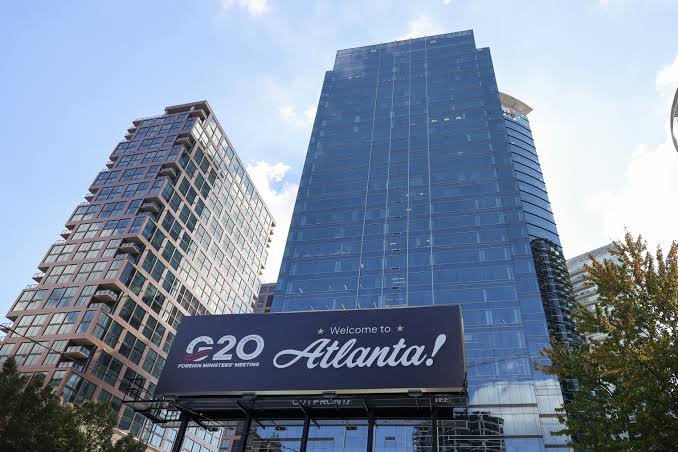
Washington | October 30, 2026 ; Top diplomats from the Group of 20 (G20) economies are gathering in Atlanta amid escalating geopolitical tensions, competing national interests and mounting concerns over global security, energy prices and international trade.

The meeting, chaired by US Secretary of State Marco Rubio, is scheduled for Friday and Saturday and is expected to lay the groundwork for the G20 leaders’ summit hosted by President Donald Trump in Miami in December.
However, with major powers sharply divided over multiple conflicts and economic disputes, reaching a common position on the most contentious issues appears unlikely.
⚔️ MAJOR FLASHPOINTS DOMINATE THE AGENDA
The gathering comes against the backdrop of several crises affecting international stability:
🔹 Russia–Ukraine conflict: Russia’s continued war in Ukraine remains a major source of friction between Moscow and Western governments.
🔹 US–Iran tensions: The prospect of renewed American military strikes against Iran has heightened concerns across the Middle East, including Saudi Arabia.
🔹 US–China rivalry: Disputes over the South China Sea and regional security continue to strain relations between Washington and Beijing.
🔹 Trade and tariffs: US tariff policies and broader disagreements over the global economic order are contributing to uncertainty in international commerce.
🔹 Energy and food security: Disruptions to shipping routes and geopolitical instability are raising concerns about fuel prices, food supplies and critical supply chains.
🚢 FREEDOM OF NAVIGATION A KEY PRIORITY
US officials have identified freedom of navigation as a central issue for the discussions, particularly in the Strait of Hormuz, the Red Sea, the Black Sea and the South China Sea.
These strategic waterways are vital to global trade and energy transportation. Any prolonged disruption could affect shipping costs, energy markets and the movement of essential goods.
Washington hopes to build cooperation around these shared concerns, even if broader political disagreements prevent a unified declaration.
LAVROV’S PRESENCE MAY DEEPEN WESTERN DIVISIONS
Russian Foreign Minister Sergey Lavrov is representing Moscow at the Atlanta meeting, while China is sending a deputy foreign minister. Most other participating countries have reportedly sent their top diplomats.
Russia’s participation has raised concerns among some Western allies, particularly as the war in Ukraine continues.
Russian Foreign Ministry spokeswoman Maria Zakharova said Moscow intended to advocate reform of global economic institutions and promote its vision of a multipolar world. She also criticised difficulties encountered in securing visas for the Russian delegation.
Analysts cited in the report warned that Lavrov’s presence could complicate efforts to develop a common Western position on Ukraine and create domestic political challenges for Trump ahead of the US midterm elections.
🇺🇦 UKRAINE AND SOUTH AFRICA ABSENT FROM THE INVITEE LIST
Ukraine, which is not a G20 member but has attended previous meetings by invitation, was not invited to the Atlanta gathering. US officials said they had chosen to limit participation to formal G20 members.
South Africa, which chaired the G20 last year, is also absent from the invitee list amid strained relations with the Trump administration.
These decisions add another dimension to questions about representation, diplomatic priorities and the group’s ability to address international crises collectively.
🛡️ FOREIGN INTERFERENCE AND REGIONAL SECURITY CONCERNS
The possibility of renewed US military action against Iran is casting a shadow over the talks. Media reports cited in the supplied account said US officials had urged several Middle Eastern countries and regional allies to prepare for possible renewed strikes following the US midterm elections.
Any escalation could widen regional instability and further complicate cooperation among G20 members.
The discussions are therefore taking place at a time when diplomacy must contend not only with existing conflicts but also with the risk of new confrontations.
🤝 CAN THE G20 DELIVER RESULTS WITHOUT CONSENSUS?
The US State Department says Rubio wants the meeting to advance practical cooperation on shared economic and security challenges, including energy and food security, freedom of navigation and critical-mineral supply chains.
However, analysts remain sceptical that the members can bridge their substantial differences.
Elaine Dezenski of the Foundation for Defense of Democracies described the meeting as a test of whether Washington can build effective partnerships even when agreement among all members is out of reach.
The challenge is to translate shared economic interests into concrete cooperation without allowing geopolitical rivalries to paralyse the process.
🌐 THE BIGGER PICTURE
The Atlanta gathering highlights a central challenge facing global diplomacy: the world’s major economies remain deeply interconnected, yet increasingly divided over security, trade and political influence.
The outcome may depend less on achieving complete agreement and more on whether participating countries can identify practical areas of cooperation despite their disagreements.
With wars, trade disputes and energy-security concerns converging, the Atlanta meeting could offer an important indication of how effectively the G20 can respond to an increasingly fragmented international order.