

By M S Nazki

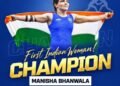
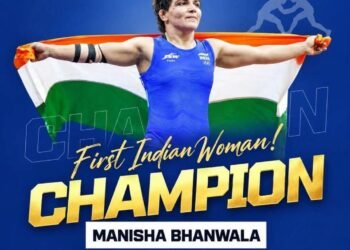
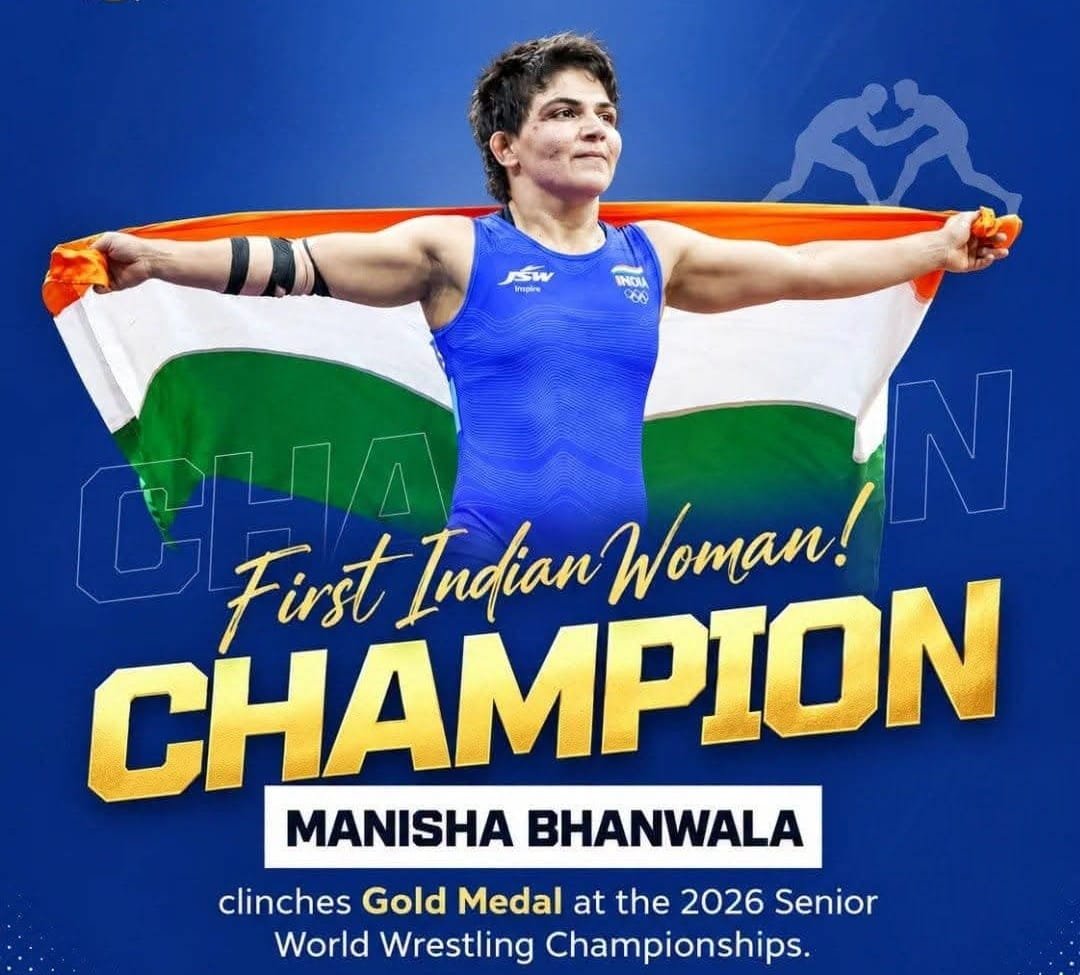
A golden moment for Indian wrestling! Manisha Bhanwala scripts history, becoming the first Indian woman to win a World Championship title! She staged a remarkable fightback from 0-6 down to seal an 8-6 victory over Pan American Champion Abigail Nette in the 59kg final………..The comeback was indeed remarkable………….This was the story which we had in our hands!
-We have tried to dig in deeper!
-Wrestling in India was not started by a single individual; rather, it evolved thousands of years ago from ancient combat traditions and religious epics.
-Ancient and Mythological Roots
* Vedic and Epic Era: Wrestling dates back to around 3100 BCE or earlier, with early hand-to-hand combat (such as Musti-han) mentioned in the Rig Veda and Atharva Veda.
* Malla-yuddha: The traditional combat sport was famously known as Malla-yuddha. Legendary figures and epic heroes like Bhima, Hanuman, Balarama, and Jarasandha are described in the Mahabharata and Ramayana as master wrestlers.
* The 13th Century: The formal rules and techniques of these early styles were later codified in historical texts like the Malla Purana.
-Evolution into Pehlwani (Kushti)
-• Mughal Era: During the Mughal Empire, Persian and Turko-Mongol wrestling styles blended with traditional Malla-yuddha to create Pehlwani (also called Kushti).
* Royal Patronage: Rulers like the Maratha King Shivaji further expanded local training grounds by ordering akharas (traditional wrestling schools) to be built across his realm to train fighting-fit warriors.
* Modern Icons: Figures like Gama Pehlwan (Ghulam Mohammad Baksh Butt) rose to global fame in the late 19th and early 20th centuries as India’s first modern wrestling superstars, while K. D. Jadhav won independent India’s first individual Olympic bronze medal in wrestling in 1952
-Wrestling is widely recognized as one of the oldest competitive sports in human history, with origins dating back over 15,000 years.
-Ancient Origins and Early Civilizations (Prehistory – 500 AD)
* Prehistoric Roots: Cave drawings, carvings, and rock art found in France, Mongolia, and other regions depict human figures grappling, dating back 15,000 to 20,000 years.
* Mesopotamia and Egypt: Early reliefs and tomb paintings (such as those at Beni Hasan in Egypt and in Sumerian art around 3,000–2,500 BC) show wrestlers using standard holds and techniques still recognized today.
* Asia: Traditional grappling forms developed independently across the continent, including Shuai Jiao in China, Bokh in Mongolia (used by Genghis Khan to train warriors), Pehlwani (Kushti) in India, and Persian Zurkhaneh traditions.
* Ancient Greece: Wrestling was a cornerstone of Greek education, military training, and myth. It was introduced to the ancient Olympic Games in 708 BC as part of the pentathlon and stood out as a brutal, central combat test.
* Ancient Rome: The Romans adopted Greek wrestling but modified the rules to lower the extreme level of violence, laying early groundwork for what would become Greco-Roman style.
-Medieval and Renaissance Eras
* Across medieval Europe, wrestling was a popular sport and pastime across all social classes, featured widely in local festivals, Celtic games, and royal courts (such as a famous match between King Francis I of France and Henry VIII).
* Regional folk styles branched out globally, including Viking Glima, English catch-and-throw styles, Turkish oil wrestling (Yağlı Güreş), and Japanese Sumo.
-Modern Era: Amateur vs. Professional Split (19th – 20th Century)
* Revival in the 1800s: European gymnasiums and fairs revived formal wrestling. The modern amateur styles—Greco-Roman (prohibiting holds below the waist) and Freestyle (allowing leg holds and trips)—were standardized.
* Olympic Return: Greco-Roman wrestling returned to the modern Olympic Games in Athens in 1896, and Freestyle was added at the 1904 St. Louis Olympics. Women’s freestyle wrestling later joined the Olympic program at the 2004 Athens Games.
* The Great Split (1920s): Competitive amateur wrestling diverged sharply from professional wrestling, which transitioned into a theatrical, scripted entertainment spectacle promoted through regional territories, cable television, and global organizations like the WWE and AEW
-Women’s freestyle wrestling evolved from early grassroots and national exhibitions in the late 20th century into a premier global and Olympic sport.
-Early Roots and Pioneers (1970s–1980s)
* 1975: In the United States, 9-year-old Tricia McNaughton Saunders won a federal court case against the Amateur Athletic Union to earn the right to compete against boys, later becoming a four-time World champion.
* 1960s–1970s: Organized women’s freestyle roots began taking shape in countries like France and Norway.
* 1987: The first unofficial/official international momentum culminated when the United World Wrestling (then FILA) environment set the stage for the growth of women’s events. The first Women’s World Wrestling Championships featured competitors from eight countries.
* 1989: The first official U.S. delegation medaled at the World Championships in Martigny, Switzerland (including silver medalists Asia DeWeese and Leia Kawaii, and bronze medalist Afsoon Roshanzamir Johnston).
-Expansion and World Dominance (1990s–2000s)
* 1999: The U.S. won its first Senior Women’s World Team Championship, led by stars like Tricia Saunders and Sandra Bacher.
* Global Growth: Japan emerged as the sport’s powerhouse, collecting a dominant share of world and international titles under legendary coaching and institutional backing. Nations like China, Norway, and later India and post-Soviet states also developed deep competitive programs.
* 2004 Athens Olympics: Women’s freestyle wrestling made its official Olympic debut with four weight classes, marking a historic breakthrough for female combat sports.
-Olympic Evolution and Modern Milestones (2012–Present)
* 2012–2016: The Olympic program expanded to six weight classes for women at the London and Rio 2016 Games to match the men’s categories. Helen Maroulis won the U.S.’s first women’s Olympic gold medal in 2016.
* 2021 Tokyo Olympics: Tricia Mensah-Stock became the first Black woman to win an Olympic gold medal in women’s freestyle wrestling (68 kg).
* Collegiate Growth: Freestyle wrestling was added to the NCAA Emerging Sports for Women program, rapidly expanding collegiate varsity programs across the United States.
* Recent History: International depth continues to surge, with historic breakthroughs such as India’s Manisha Bhanwala capturing gold at the Senior World Wrestling Championships in Astana, Kazakhstan, and Team USA securing landmark global team titles
-Indian men and youth are drawn to wrestling (including traditional Kushti and modern mat wrestling) due to a combination of deep-rooted cultural pride, economic mobility, and the influence of international and national role models.
-Key Reasons for Wrestling’s Appeal
* Deep Cultural and Martial Tradition: Wrestling has ancient roots in India—ranging from Malla-yuddha and epic figures like Bhima and Hanuman to the regional akhara culture in states like Haryana and Punjab. Physical strength and valor have long been core markers of traditional masculinity and community honor.
* A Path Out of Poverty and Upward Mobility: For many young men, particularly from rural or farming backgrounds, wrestling offers a tangible ladder to financial success and stable employment. International medals bring substantial government cash rewards, sports quotas, and prestigious government or police jobs (such as in the railways, army, or state forces).
* Low Barrier to Entry: Unlike sports that require expensive equipment or sprawling commercial infrastructure, traditional wrestling (Kushti) requires little more than a mud pit (akhara), a mentor (guru), and dedication, making it accessible to youth with limited means.
* Inspirational Role Models and Media Visibility: The success of Indian wrestlers on global stages—such as Olympic and Commonwealth medalists like Sushil Kumar, Yogeshwar Dutt, and Ravi Kumar Dahiya, alongside mainstream pop-culture and media visibility—has turned wrestlers into national folk heroes.
* Alignment with Agrarian Lifestyles and Diets: The rigorous physical conditioning of wrestling naturally complements traditional rural, agricultural lifestyles. The emphasis on high-protein diets, physical endurance, and mud-training resonates strongly with regional pride
-Manisha Becomes India’s First-Ever Women’s World Champion!
-Manisha created history for India after winning its first-ever Women’s Wrestling gold medal at the World Championships.
-After two failed attempts to get its first-ever women’s world champion at 2026 World Championships in Astana, India finally got its historic gold medal as MANISHA (IND) won gold medal at the 59kg.
-Manisha achieved the historic result in incredible manner, coming back from a 6-0 deficit against Abigail NETTE (USA) in the final, winning 8-6 for the gold medal.
-“Can’t feel anything. I’ve been waiting for a long time for this moment,” Manisha said. “From 2022 I’ve been writing that I would be world champion. This was my dream that I would be the first Indian woman to become a world champion. Today that dream has come true. I want to continue with this dream.”
-Earlier in the 2026 World Championships, NEELAM (IND) at 50kg and KAJAL (IND) at 76kg, tried to become world champions but both fell short in the finals. ANSHU (IND) was the only previous Indian to reach a world final in Women’s Wrestling when she did that in 2021.
-“When Kajal made the final, everyone was saying that she’s winning a gold. Easy gold,” she said. “But I think maybe god wanted to make me the first champion. Maybe this is the reward of my tapasya. For me wrestling is like worship. The way I feel about my father. That’s how I feel about wrestling.”
-Meanwhile, Everest LEYDECKER (USA) provided the victory that eventually gave the United States the team title, scoring a 2-point defensive exposure in the second period of the 55kg final that clinched a 4-1 win over Nataliia KLIVCHUTSKA (UKR).
-The U.S. finished with 137 points, two points ahead of Japan which had 135 points. China was third with 121 points. This is the U.S. first team title in Women’s Wrestling since 1999.
-“It just makes it even better knowing that that win pushed Team USA to the team title,” Leydecker said. “I was keeping track of it. I was like, OK, one more win and we secure it. And then Japan won the bronze-medal match and they were in the lead. But knowing that I won the title, it’s just crazy.”
-Wrestling in the 59kg final, Manisha got dumped for four points by Nette but India challenged that call only to lose and give another point to Nette. A caution against Manisha extended Nette’s lead to 6-0. But Manisha got a step out before the break to get one point on board.
-But Manisha then mounted a comeback first with a takedown against Nette which the United States challenged saying that the referee whistled to stop the bout. The challenge was lost, giving one more point to Manisha and position in par terre.
-From 6-4, Manisha managed to turn Nette using a gut-wrench for two points and tried holding Nette for the fall but failed to do so.
-“Bharandaaj [gut-wrench] is my favorite move,” she said. “It’s been my favourite for some time now. When I got that move, I felt I was going to get to 10 points just like that or even pin her. But she got out of that position. At that time I thought, how did that happen? Then when the bout restarted I got her down.”
-Nette then went on trying to defend her 6-6 criteria lead but Manisha scored a pressure takedown and took a 8-6 lead that she defended to win the historic gold medal.
-“I think that’s my strong point,” she said. |If anyone comes to the red zone, I can finish that shot. No matter who it is. When I get them to that red zone then I always finish that shot.”
-Manisha is the second world champion for India in wrestling after Sushil KUMAR (IND), who won the Freestyle 66kg gold medal at the 2010 World Championships.
-“I made my first senior team in 2022. I follow Sushil. I follow Sadulaev and Yazdani. I wanted to experience what this belt was. I just wanted to win a belt,” she said.
-Another reason for the former Asian champion to be emotional was completing her late father’s wish of winning the gold medal. She even carried a photo of her father to the final.
-“I’ve always been my father’s favorite,” she said. “We are two sisters and a brother but I think my father loved me the most. The first time I went to a [sports] hostel, I would always think I heard his voice. Like he was calling me. I don’t think I’ve had that connection. I always hear his voice. I can’t explain it. It’s like he is inside me and talks to me.”
-Manisha now wants to repeat as the world champion next year in Las Vegas but in the Olympic weight category 57kg, and wants more Indian wrestlers to win gold now that the barrier has been broken.
-“Next year is very important,” she said. “I will try my best to win the world belt in 57kg. I think next time Indian girls won’t be scared when they get to the final or come under pressure whether they win a medal or not. I think their mind will relax now. Hope has come in.”
-That is what the spirit should be!
-Women’s professional wrestling first gained recognized champions in the early 20th century, with figures like Cora Livingston starting around 1906 and winning a recognized title in 1910, while Mildred Burke rose to prominence as a world champion starting in 1937.
-Key Milestones in Women’s Wrestling History:
-1906–1910 Early Championships Cora Livingston begins wrestling and wins the early recognized women’s title around 1910.
-1937 Mildred Burke’s Reign Mildred Burke wins the original World Women’s title, later forming the World Women’s Wrestling Association in the 1950s.
-1956 WWE Women’s Title Origin The original WWE Women’s Championship lineage begins, with The Fabulous Moolah later recognized as an early champion.
-1987 First World Championships The first official international amateur/freestyle Women’s World Wrestling Championships are held.
-2004 Olympic Debut Women’s freestyle wrestling makes its official debut at the Olympic Games in Athens, Greece.
-2015–Present Modern Era & Revolution Women’s wrestling expands heavily in high schools, the NCAA, and main-event slots in major promotions like WWE.
-Top women wrestlers
-Top women’s freestyle wrestlers in the world include historic legends, Olympic/World champions, and recent gold medalists from international competitions:
-All-Time & Iconic Greats
-Kaori Icho (Japan): Widely regarded as one of the greatest freestyle wrestlers ever, having won four consecutive Olympic gold medals and multiple World Championships.
-Saori Yoshida (Japan): A 13-time World Champion and 3-time Olympic gold medalist who dominated the lightweight divisions for over a decade.
-Helen Maroulis (USA): The first American woman to win Olympic wrestling gold (Rio 2016) alongside multiple World Championships.
-Hitomi Obara (Japan): Multiple-time Olympic and World Champion.
So we come to the final lines:
Wrestling doesn’t build character, it reveals it. Once you’ve wrestled, everything else in life is easy. and You don’t wrestle to beat others; you wrestle to beat yourself. Sometimes you win, sometimes you learn. Wrestling values hard work, self-reliance, and stands as the epitome of a well-rounded, one-on-one sport. Wrestling teaches you nothing comes without hard work, and you must keep grinding to get where you want to go. Overcoming fatigue and pushing past physical limits through rigorous training are crucial keys to success on the mat. Wrestling is a team sport, and an individual sport all rolled into one…