

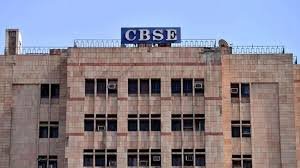
New Delhi, May 16, 2026 : The Central Board of Secondary Education (CBSE) has made the study of three languages compulsory for students of Class IX from July 1, 2026, in line with the implementation of the National Education Policy (NEP) 2020 and the National Curriculum Framework for School Education (NCF-SE) 2023.

In a circular issued on May 15, the CBSE clarified that although students will be required to study three languages — referred to as R1, R2, and R3 — there will be no Board examination for the third language at the Class X level.
According to the new guidelines, at least two out of the three languages chosen by students must be native Indian languages.
“With effect from July 1, 2026, for Class IX, the study of three languages shall be compulsory, with at least two languages being native Indian languages,” the circular stated.
The CBSE said assessments for the third language (R3) will remain entirely school-based and internal in nature.
“To keep the focus on learning and reduce undue pressure on students, no Board examination will be conducted for the third language in Class X,” the board clarified.
However, the performance of students in the third language will still be reflected in the official CBSE certificate.
The board further stated that no student would be barred from appearing in the Class X Board examinations on account of the third language requirement.
Schools have been permitted to offer any language listed under CBSE subjects, provided the condition of selecting at least two Indian languages is fulfilled.
The circular also clarified that foreign languages may only be opted as the third language if the other two selected languages are Indian languages, or alternatively as an optional fourth language.
As part of the transition process, CBSE informed schools that students of Class IX would temporarily use Class VI textbooks for the third language until specialised secondary-level textbooks are prepared and introduced.
Schools have additionally been advised to supplement language teaching with local and regional literary content.
Acknowledging possible shortages of qualified language teachers, the CBSE suggested temporary measures such as inter-school teacher sharing, virtual classes, and hiring retired teachers or qualified postgraduate instructors.
The board also announced relaxations for Children with Special Needs (CwSN), Indian schools located abroad, and foreign students returning to India, with exemptions and accommodations to be considered on a case-by-case basis.
The move is part of broader reforms under the National Education Policy 2020 aimed at promoting multilingualism, preserving Indian languages, and strengthening foundational learning among students.