

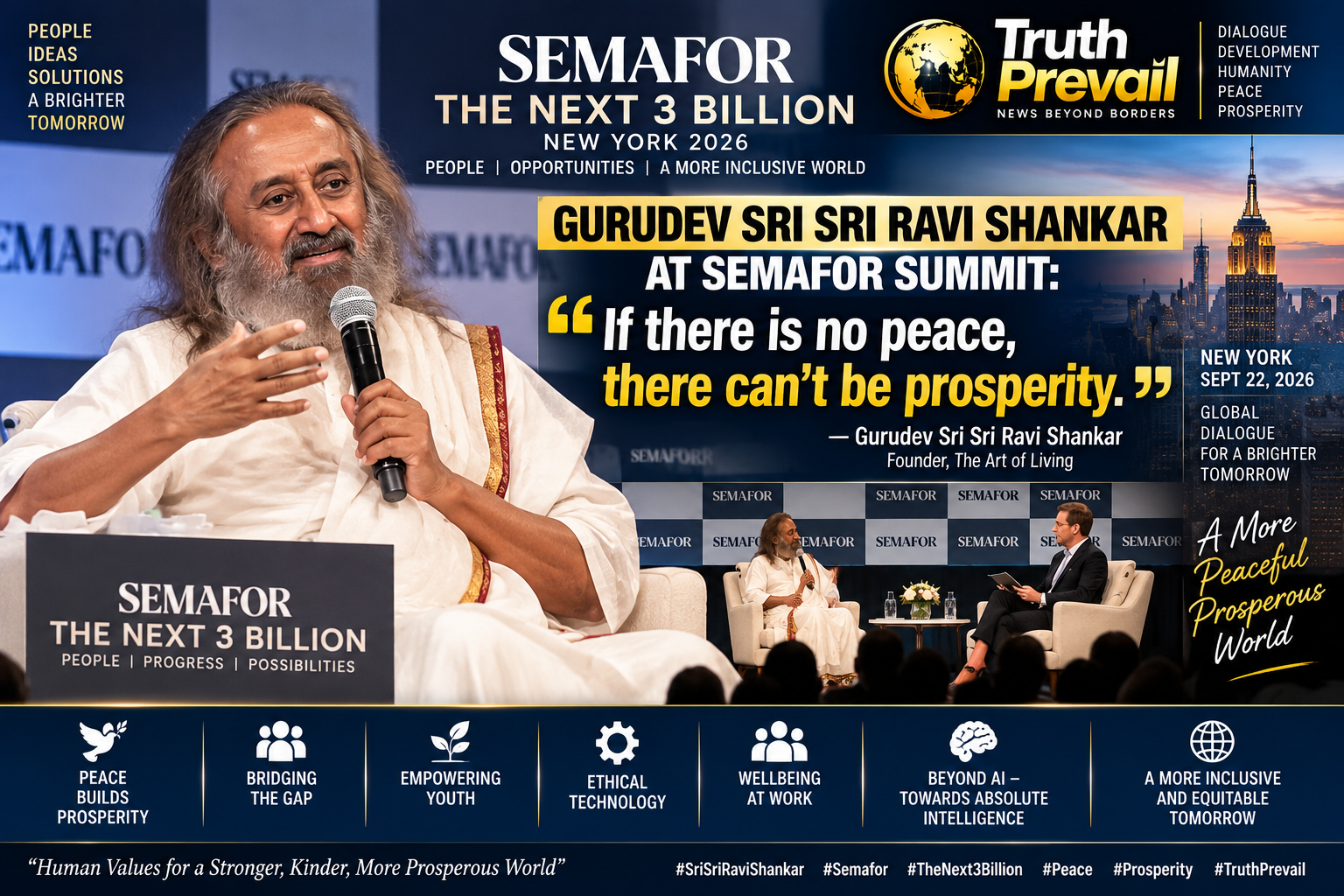
New York, September 22, 2026 ; Gurudev Sri Sri Ravi Shankar, founder of The Art of Living, addressed Semafor’s The Next 3 Billion summit in New York, highlighting the connection between peace, human well-being and sustainable economic prosperity.

The summit brought together heads of state and government, leaders of global institutions and prominent business figures to discuss how technology and digital inclusion can expand economic opportunity for billions of people.
The gathering featured speakers including Kenyan President William Samoei Ruto, Democratic Republic of the Congo Prime Minister Judith Suminwa, WTO Director-General Dr. Ngozi Okonjo-Iweala and IMF Managing Director Kristalina Georgieva.
“Prosperity Comes With Peace”
In a conversation with Semafor Co-Founder and CEO Justin B. Smith, Gurudev stressed that economic development cannot be viewed separately from people’s inner well-being.
“Prosperity comes with peace. If there is no peace, there can’t be prosperity.”
His remarks came a day after the International Day of Peace, with the discussion focusing on how societies can build more inclusive and sustainable pathways to development.
Bridging the Gap Between Haves and Have-Nots
Gurudev said economic inequality remains a challenge in countries across the world, including the United States.
He argued that addressing the divide requires efforts from both sides. People facing disadvantage, he said, need to move beyond a “victim consciousness” and take greater responsibility for their own progress, while those with greater resources need to cultivate empathy and recognise the importance of sharing.
He also identified corruption as a major factor preventing resources from reaching communities at the grassroots level across parts of the Global South.
From Unemployment to Entrepreneurship
Gurudev recalled an initiative involving around 500 unemployed young people near an Art of Living centre in rural India.
According to him, the youth initially rejected around 200 projects offered by the government, believing that none of the proposed opportunities would succeed.
A two-month programme focused on developing an entrepreneurial mindset helped change their outlook, he said.
Gurudev said the approach has subsequently been taken to several African countries, including Kenya, Ghana, Nigeria, Botswana and South Africa, among others.
Stress and the Future of Work
The conversation also turned to the workplace and the impact of stress on communication and business performance.
Gurudev said people need a greater sense of belonging and security to perform effectively, particularly during periods of uncertainty.
He linked individual well-being with healthier workplace relationships and more productive organisations.
A Lighter Take on Artificial Intelligence
Asked by Justin B. Smith about his views on artificial intelligence, Gurudev responded with a play on words:
“There’s an absence of intelligence, artificial intelligence, and absolute intelligence.”
Smith concluded the exchange by saying that, given the choice, he would choose the third.
Gurudev has also founded the Institute of Absolute Intelligence, which aims to advance scientific exploration into consciousness.
Peace, Technology and Human Potential
The New York discussion placed technology and economic opportunity alongside questions of peace, human consciousness, inclusion and personal well-being.
Gurudev’s central message was that technological and economic progress alone cannot guarantee prosperity unless societies also address the human factors that influence peace, trust, resilience and social participation.