

BHILDI, BANASKANTHA, GUJARAT | OCTOBER 30, 2026 : From farmer support and fertiliser affordability to national development, Prime Minister Narendra Modi delivers a strong political message while inaugurating a major bovine research centre and announcing development initiatives.

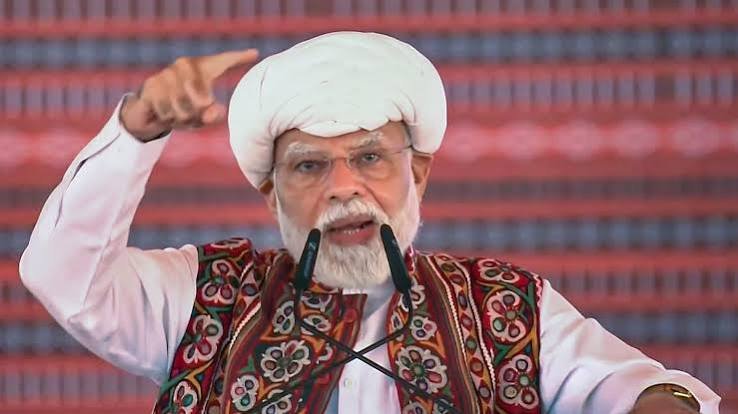
Prime Minister Narendra Modi on Friday reaffirmed his commitment to serving the people of India throughout his life, declaring that he would continue working for the public until his last breath. His remarks came amid a political controversy triggered by Congress president Mallikarjun Kharge’s reported statement, “Modi ka baap bhi jayega,” which had sparked a sharp political reaction.
Addressing a gathering at Bhildi in Gujarat’s Banaskantha district, Modi combined a message of public service with criticism of the Opposition, a defence of his government’s agricultural policies and an appeal for national unity amid the ongoing conflict in West Asia.
The visit also featured the inauguration of the Bharat Bovine Breeding and Research Centre (BBBRC), the launch and foundation-laying of development projects worth approximately ₹14,000 crore, and the release of the 24th instalment of the PM-Kisan scheme.
“I WILL SERVE THE PEOPLE UNTIL MY LAST BREATH”
Reiterating his commitment to public service, Modi told the gathering:
“Jeevan ke antim kshan tak janta ki seva main hi juta rahunga” — I will continue to serve the people until my last breath.
The statement came against the backdrop of the controversy surrounding Kharge’s remark and intensified political exchanges between the ruling party and the Congress.
Gujarat Deputy Chief Minister Harsh Sanghavi, who addressed the rally before Modi, asserted that the Prime Minister enjoyed the support and affection of people across the country. He argued that the Congress and its allies could not break the bond between Modi and the public.
Sanghavi also referred to the counter-slogan “Modi kahi nahi jayega”, saying it had resonated from villages in Banaskantha to Kashmir and Kanyakumari.
🌾 PM-KISAN: ₹18,000 CRORE TRANSFERRED TO AROUND 10 CRORE FARMERS
A major highlight of the programme was the release of the 24th instalment of the Pradhan Mantri Kisan Samman Nidhi (PM-Kisan) scheme.
According to Modi, more than ₹18,000 crore was transferred to the bank accounts of approximately 10 crore farmers under this instalment.
The scheme provides eligible farmers with ₹6,000 annually in income support through direct bank transfers.
Modi also highlighted the cumulative benefits of PM-Kisan, stating that approximately ₹4.5 lakh crore had been transferred directly to small farmers since the scheme began in early 2019.
The government presents PM-Kisan as a key element of its efforts to provide financial assistance to farming households and strengthen rural livelihoods.
🚜 FERTILISER AFFORDABILITY: GOVERNMENT SAYS IT IS ABSORBING GLOBAL COST PRESSURES
Addressing concerns linked to the ongoing conflict in West Asia, Modi accused the Opposition of spreading rumours and creating panic about the availability of fertilisers and cooking gas.
He alleged that claims of possible fertiliser shortages had frightened farmers and contributed to artificial queues. He also accused political opponents of creating anxiety among women by suggesting that cooking gas supplies could be disrupted.
Modi maintained that the government had taken steps to ensure that global price increases did not place the full burden on Indian farmers.
Citing prices, he said:
- Urea: A bag that costs around ₹3,000 globally was being supplied to Indian farmers for less than ₹300.
- Diammonium phosphate (DAP): While the global price of a bag had crossed ₹5,000, Indian farmers were receiving it for ₹1,350.
The Prime Minister said the government was absorbing a substantial part of the increased cost of fertilisers and the chemicals required to manufacture them.
His remarks placed agricultural input affordability at the centre of the government’s response to international market uncertainty.
🌍 WEST ASIA CONFLICT AND INDIA’S ENERGY SECURITY
Modi linked the challenges facing farmers to the wider international situation, particularly the conflict in West Asia and the Gulf region.
The region is important to India’s energy security and is also connected to global supply chains for fertilisers and related industrial inputs.
The Prime Minister said the country was united in responding to the situation but alleged that some political opponents were using uncertainty to create fear among the public.
He insisted that his government had maintained fertiliser availability despite the continuing conflict.
The remarks underscored the connection between international instability and domestic concerns over fuel, agricultural supplies, household expenses and economic security.
📊 ₹50 LAKH CRORE IN FARMER BENEFITS AND SAVINGS: MODI
Highlighting the broader impact of government programmes, Modi said farmers across India had received or saved more than ₹50 lakh crore through various initiatives over the past several years.
He cited several schemes and support mechanisms:
1. PM-Kisan
The Prime Minister said around ₹4.5 lakh crore had been transferred directly to small farmers through the scheme since its launch.
2. Fertiliser support
Modi said the government had spent approximately ₹16 lakh crore to protect farmers from rising fertiliser prices amid global uncertainty.
3. Minimum Support Price (MSP)
He stated that wheat and paddy growers had received approximately ₹24 lakh crore through the MSP mechanism over the preceding 12 years.
4. Pradhan Mantri Fasal Bima Yojana
According to Modi, farmers had received more than ₹2 lakh crore in compensation through the crop insurance scheme over the previous 10 to 12 years.
5. PM-KUSUM
The Prime Minister said nearly 12 lakh solar-powered irrigation pumps had been installed under PM-KUSUM, helping farmers reduce dependence on diesel and lower irrigation expenses while supporting solar energy generation.
Modi presented these initiatives as evidence of the government’s focus on farmer welfare, income support, risk protection and agricultural energy reform. The figures reflect claims made in his address.
🐄 BHARAT BOVINE BREEDING AND RESEARCH CENTRE INAUGURATED
The Prime Minister inaugurated the Bharat Bovine Breeding and Research Centre (BBBRC) at Bhildi, adding an animal-breeding and research component to the development programme.
Bovine breeding and research are relevant to livestock productivity, animal health, genetic improvement and the wider rural economy. Livestock and dairy activities provide income and livelihood opportunities for many farming households.
The inauguration formed part of a broader programme that also included launching projects and laying foundation stones for development initiatives valued at around ₹14,000 crore.
The event therefore combined political messaging with an emphasis on agriculture, livestock development and infrastructure investment in Gujarat.
🪑 A DISTINCTIVE “CHARPAI SABHA” IN BANASKANTHA
The rally venue featured an unusual arrangement: organisers placed traditional charpais, or woven cots, instead of conventional chairs for the audience.
Modi welcomed the arrangement and suggested that it might be among the largest “charpai sabhas” he had addressed.
The setting added a distinctly rural character to the gathering, which focused heavily on farmers, agricultural support and village-level development.
🏛️ POLITICAL EXCHANGE SHARPENS AROUND MODI’S PUBLIC SERVICE MESSAGE
The rally also became a platform for the wider political contest between the BJP and Congress.
Modi criticised unnamed Opposition figures, alleging that they welcomed national difficulties and attempted to exploit crises for political gain. His remarks were directed particularly at claims and concerns surrounding fertiliser availability and cooking gas supplies during the West Asia conflict.
Sanghavi, meanwhile, defended the Prime Minister and argued that public support for Modi remained strong.
The exchange illustrates how agricultural concerns, international instability and the cost of essential supplies have become intertwined with political messaging.
🔎 THE BIG PICTURE: FARMER SUPPORT, DEVELOPMENT AND POLITICAL ACCOUNTABILITY
Friday’s programme in Banaskantha brought together several themes central to the government’s public agenda: direct financial support for farmers, affordable agricultural inputs, crop insurance, solar-powered irrigation, livestock research and large-scale development investment.
The release of the 24th PM-Kisan instalment provided immediate financial assistance to eligible beneficiaries, while the announced development projects and research-centre inauguration formed part of the wider regional development push.
At the same time, Modi’s criticism of the Opposition and his response to Kharge’s remark placed the event firmly within the country’s ongoing political debate.
The central message from Bhildi was clear: Modi reaffirmed his commitment to public service, defended his government’s farmer-focused measures and urged the country to remain united amid international uncertainty.
The lasting impact of these announcements will ultimately be judged by their implementation, the benefits farmers and rural communities receive, and their contribution to livelihoods and development.