

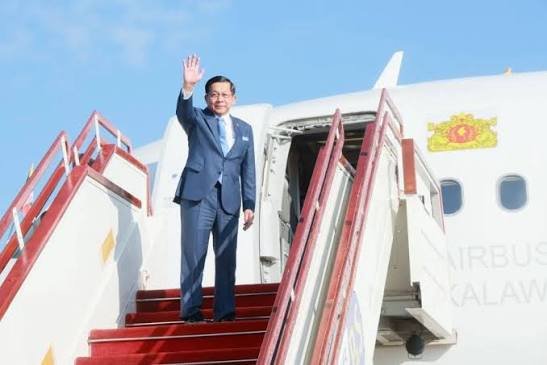
NAYPYITAW, October 7, 2026 : Myanmar’s military-backed leader Min Aung Hlaing travelled to Malaysia on Wednesday for talks with senior Malaysian leaders as the two Southeast Asian countries work on the phased repatriation of thousands of Myanmar nationals from Malaysia.

The two-day visit comes amid criticism from international organisations and rights groups, which have raised concerns about the safety and humanitarian consequences of returning people to Myanmar while armed conflict and instability continue in several parts of the country.
According to state-run MRTV television, Min Aung Hlaing departed from the military airport in Naypyitaw on Wednesday morning.
During his visit, he is expected to meet Malaysian Prime Minister Anwar Ibrahim and participate in a business dialogue involving members of the Malaysian Cabinet.
Repatriation at the Centre of Talks
Min Aung Hlaing’s visit comes only four days after nearly 1,500 Myanmar nationals returned from Malaysia.
Malaysia says approximately 5,000 Myanmar nationals have agreed to return in stages, including those who arrived back in Myanmar on Sunday.
The repatriation programme has attracted criticism from the UN refugee agency and human rights organisations, which have warned that parts of Myanmar remain affected by armed conflict and humanitarian insecurity.
Critics have expressed concern that some returnees could face persecution or other serious risks after arriving in the country.
Concerns Over Conscription and Security
Rights groups have also raised concerns that people returning to Myanmar could potentially face forced military conscription, particularly given the country’s continuing conflict.
Myanmar has experienced widespread armed resistance and civil conflict since the military removed the elected government in February 2021.
The political crisis that followed the takeover triggered armed resistance across the country and created a complex humanitarian situation involving millions of displaced people.
The security situation varies considerably across Myanmar, meaning the risks faced by returnees can differ depending on their location and circumstances.
Thousands Remain in Malaysian Detention Centres
Malaysia continues to host a large population of Myanmar nationals.
According to Malaysia’s Home Ministry, 11,804 Myanmar nationals were being held at immigration detention depots across the country as of the end of August.
The government has said the staged repatriation programme is intended to address the long-term situation involving Myanmar nationals living in Malaysia.
Prime Minister Anwar has defended the policy, arguing that Malaysia cannot host refugees indefinitely and that Myanmar should take responsibility for its citizens.
Rohingya Issue Adds Further Sensitivity
The repatriation programme has also raised particular concerns over the possible return of Rohingya, the predominantly Muslim minority that has faced persecution and severe restrictions in Myanmar.
It remains unclear whether any of the recent returnees were Rohingya.
The Rohingya have faced longstanding discrimination in Myanmar, including restrictions on citizenship rights.
Many Rohingya fled to neighbouring countries following violence and persecution, while Malaysia has become home to a large Rohingya refugee population.
Malaysia Hosts Large Refugee Community
Malaysia currently hosts approximately 215,600 refugees and asylum seekers registered with the UNHCR, including around 126,000 Rohingya.
The country is not a party to the 1951 UN Refugee Convention and generally treats refugees as undocumented migrants under its domestic immigration framework.
Malaysia’s Rohingya community has faced increasing public opposition in recent years, with concerns expressed in parts of society about employment, public services and security.
The issue has consequently become both a humanitarian and domestic political challenge for Malaysian authorities.
Myanmar’s Growing Regional Engagement
Min Aung Hlaing’s Malaysia visit also reflects his government’s efforts to rebuild diplomatic relationships within Southeast Asia.
Myanmar’s military authorities have faced significant regional and international criticism since the 2021 military takeover, which removed the government led by Aung San Suu Kyi.
ASEAN has continued to exclude Myanmar’s top military leadership from its highest-level political meetings under the bloc’s policy following the coup.
Nevertheless, several ASEAN member states have maintained diplomatic engagement with Myanmar.
Fifth ASEAN Member-State Visit
Wednesday’s trip represents Min Aung Hlaing’s fifth visit to an ASEAN member state, following previous visits to Laos, Thailand, Vietnam and Cambodia.
His increased diplomatic activity comes after he was sworn in as president in April, following an election that critics have questioned and described as an effort to reinforce the military’s political position.
The military-backed government has sought greater regional engagement despite the continuing conflict inside Myanmar.
Criticism From Conflict Monitors
The visit has also drawn criticism from activist and conflict-monitoring organisations.
The Armed Conflict Location and Event Data (ACLED) has warned that cooperation over refugee repatriation could potentially strengthen the international standing of Min Aung Hlaing’s administration.
ACLED Asia-Pacific analyst Sindy Ajara argued that repatriation without meaningful progress toward resolving Myanmar’s civil conflict could expose returnees to serious risks, particularly members of vulnerable communities such as the Rohingya.
The criticism highlights the central disagreement surrounding the repatriation programme: Malaysia presents it as part of a long-term diplomatic solution, while rights groups argue that returns should take into account the security conditions facing individuals inside Myanmar.
A Delicate ASEAN Balancing Act
Min Aung Hlaing’s visit places Malaysia and other ASEAN governments in a delicate position.
ASEAN has sought to address Myanmar’s crisis through diplomatic engagement while maintaining restrictions on participation by the country’s military leadership in some high-level regional meetings.
At the same time, individual ASEAN members continue to maintain bilateral relations with Myanmar on issues including trade, migration, border security and humanitarian matters.
Malaysia’s engagement with Naypyitaw therefore reflects the broader challenge faced by the region in dealing with Myanmar’s continuing political and security crisis.
Repatriation Remains Under Scrutiny
The future of the repatriation programme is likely to remain closely watched by international organisations and human rights groups.
Questions surrounding the safety of returnees, the situation of vulnerable minorities and conditions inside Myanmar remain central to the debate.
For Malaysia, the challenge is balancing its domestic concerns and diplomatic relationship with Myanmar against international calls to ensure that people are not returned to situations where they could face persecution or serious danger.
For Min Aung Hlaing’s administration, greater engagement with ASEAN governments represents an opportunity to strengthen regional diplomatic ties after years of isolation and criticism.
The Malaysia visit therefore carries significance beyond bilateral relations, placing the issue of Myanmar’s refugees and its continuing conflict at the centre of a broader regional diplomatic discussion.